NEEDО · SOURCING & PROCUREMENT
How to Choose a Sourcing Agent Before Your First Purchase Order
A sourcing agent can save a buyer time by finding factories, translating requirements, coordinating samples and following production. The risk is not that every agent is untrustworthy; it is that the buyer may not know which company is actually supplying the goods, how the agent is paid, what the fee includes or who controls the evidence. Before the first purchase order, define the agent's role, compare the complete economics, verify the factory relationship and put deliverables and exit rights in writing. This is a buyer-side procurement checklist, not legal advice or a claim that one fee model is always best.
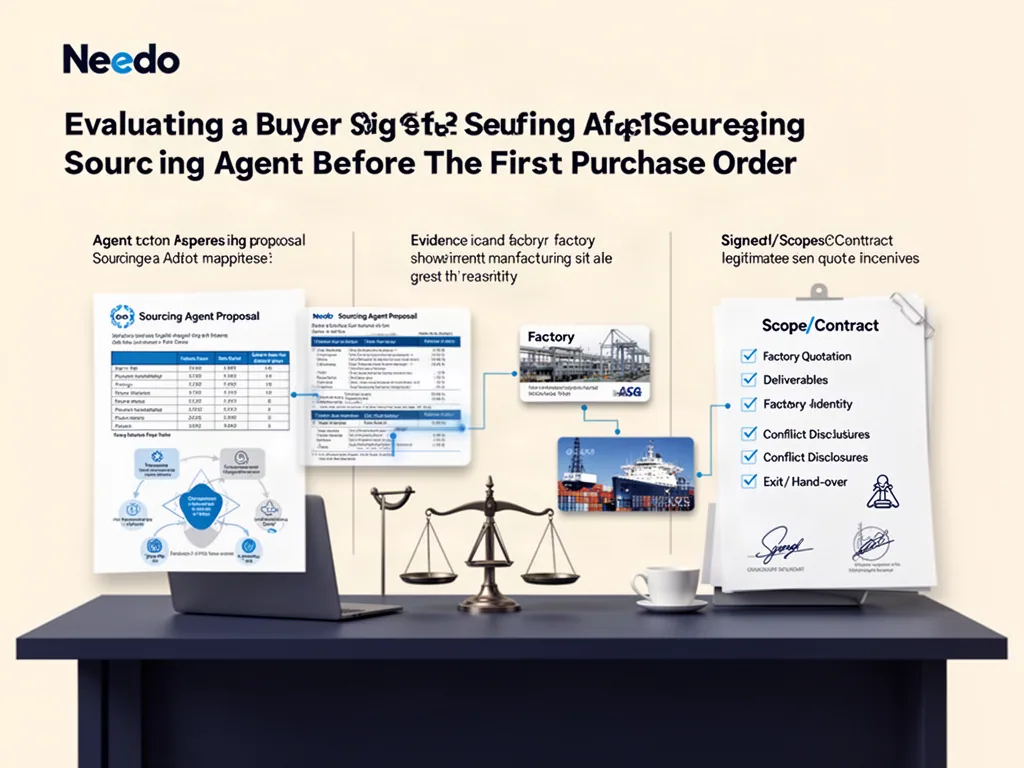
1. Start with the role you are actually appointing
The words sourcing agent, buying office, procurement consultant, broker and trading company are not interchangeable. A buyer-side agent may research suppliers and coordinate work for a fee while the buyer contracts directly with the factory. A trading company may buy goods from a factory and resell them to the buyer at its own price. A broker may introduce parties or arrange a transaction without managing production. Some businesses combine these roles. The label on a website does not settle which model applies.
Map the transaction before comparing candidates: who signs the purchase order, who invoices the goods, who receives the product payment, who takes title or bears loss, who approves samples, who appoints the inspector and who is responsible if delivery or quality fails? If the agent buys and resells, compare it as a supplier or reseller, not as a transparent buyer-side representative. That model can be commercially legitimate, but the buyer should understand the margin and the counterparty.
Write down the proposed role
- Supplier discovery and shortlist only
- Factory identity and capability checks
- Quotation collection and negotiation support
- Sample coordination and specification follow-up
- Production monitoring and quality coordination
- Logistics coordination or resale of goods
- Who signs, invoices, receives money and carries each obligation
2. Verify the legal entity and the people doing the work
Ask for the full legal name, registered address, registration identifier where available, trading names, ownership or control information and the entity that will sign the agreement. Reconcile those details with the invoice issuer, bank beneficiary, website, email domain and named project team. A local sales contact, an overseas parent company and the company receiving payment may be different entities; record the relationship rather than assuming they are interchangeable.
Ask who will perform the work, where they are based, which product categories they understand and whether they have completed comparable projects. Request references that you can contact with the provider's permission. A polished profile or a large list of claimed clients is not independent evidence. If the agent relies on local partners, factory auditors or subcontractors, identify those parties and what each one is responsible for.
Identity and capability evidence
- Legal entity and registration details checked through the relevant official register where available
- Named owners, directors or controlling persons where relevant to the risk
- Project lead, technical contacts and local partners identified
- References tied to comparable products, order sizes or markets
- Conflicts, litigation, regulatory findings or public-sector relationships escalated where material
- Unverified claims clearly marked as claims rather than confirmed facts
3. Compare the fee model, not just the headline percentage
A sourcing agent may charge a fixed project fee, hourly or daily rates, a retainer, a percentage of an agreed value, a per-service charge or a combination. A trading company may instead quote a resale price that includes its margin. None of these structures is automatically best. The important questions are what the fee is calculated on, which services it buys, who pays it, whether the agent receives supplier-side compensation and whether the factory's original price is visible.
Ask whether a percentage is calculated on the factory price, the purchase-order value, freight-inclusive value or another base. Identify currency, tax, minimum fee, exchange-rate method, reimbursable expenses, inspection and sample charges, storage, travel and cancellation costs. If the supplier pays a rebate, referral fee or other benefit, require disclosure and decide in writing whether it is permitted and who receives the benefit. Do not assume that a low buyer fee means the agent is inexpensive if the factory price is not separately visible.
Use one comparison basis. Total buyer cost should show the goods price, the buyer-paid agent fee, separately billed services and other transaction costs that are not already included. Show supplier-paid compensation or price markups separately as a disclosure item; do not add the same amount twice if it is already embedded in the quoted goods price. If the agent will not provide an original factory quotation, mark the underlying price as unknown rather than inventing a benchmark.
Fee questions to send every candidate
- What exact amount or percentage is charged, and what is the calculation base?
- Who pays the agent: buyer, supplier, both or another party?
- Are rebates, commissions, gifts, referral fees or other supplier benefits received or permitted?
- Which services are included and which are separately priced?
- Can the buyer see the original factory quote and each material price change?
- What happens to fees if the supplier is rejected, the sample fails or the order is cancelled?
4. Keep factory identity and the original quotation visible
The buyer should know which legal entity will manufacture or supply the product, at which site and under whose contract. Ask for the factory's registered name, manufacturing address, direct contact route and the role of any trading company or subcontractor. Compare those details with the quotation, sample label, audit record, certificate, purchase order and payment instructions. A genuine factory may use a separate export company or subcontract a process; that is not automatically improper, but the relationship and responsibility must be clear.
Request the factory's original quotation or a version that preserves the supplier's identity, line items, currency, validity and assumptions. If confidentiality prevents full disclosure at the first stage, agree a staged process: the agent can shortlist first, then disclose the factory and supporting documents before the buyer commits to a deposit or signs a binding order. Avoid a process where the agent permanently controls all supplier information and the buyer cannot independently confirm a material fact.
Factory transparency checklist
- Factory legal name and actual production site identified
- Manufacturer, trader, exporter and subcontractor roles separated
- Original or traceable factory quotation available before commitment
- Specification, tooling, packaging, sample and freight charges separated
- Buyer can arrange an appropriate factory visit or independent verification
- Direct confirmation route exists for important production and payment facts
5. Define the work product and service boundaries
A fee is easier to assess when the buyer can see what will be delivered. Replace broad promises such as full sourcing support or quality assurance with specific outputs and dates. For example: a shortlist with legal identities and evidence links; a comparable quotation table; a sample log; a list of open technical questions; a production milestone report; or an inspection brief. Define who approves each output and what happens if the agent cannot obtain the evidence.
Separate coordination from professional services. An agent may arrange a factory visit or third-party inspection without being an accredited auditor or inspection body. If the buyer needs testing, certification, engineering sign-off, customs advice or legal review, identify the qualified party that performs it. Do not treat the agent's statement that a product is good or a factory is certified as a substitute for the relevant evidence.
Turn the proposal into deliverables
- Number of suppliers researched and the qualification criteria used
- Evidence links, source dates and unresolved verification questions
- Quotation normalization and documented assumptions
- Sample tracking, approval owner and change history
- Production updates, escalation timing and reporting format
- Inspection provider, scope and report recipient if inspection is arranged
- Final records, supplier contacts and files handed over at completion
6. Review quality, samples and inspection independence
The agent's role in quality should be explicit. Does it only arrange a sample, compare it with the buyer's specification, coordinate a factory correction or appoint an independent inspection provider? Identify who writes the acceptance criteria, who keeps the approved reference sample, who records deviations and who has authority to approve mass production. A sample that looks acceptable is not proof that every production unit will match it.
Ask who chooses and pays the inspector, who receives the report first, whether the agent or inspector has a relationship with the factory and whether subcontractors are involved. The buyer should retain access to the original report and the evidence needed for a release decision. If the product needs laboratory testing, product certification or regulatory review, name the appropriate qualified organization and do not let a general sourcing service imply that it performs those functions.
Quality-control questions
- Who owns the specification and approved sample?
- What defect categories, measurements or tests define acceptance?
- Who approves sample changes and production deviations?
- Is the inspection provider independent of the factory and agent?
- Does the buyer receive the original report and supporting photographs or data?
- Who pays for reinspection, rework, replacement or a failed sample?
7. Reconcile payments and the beneficiary before sending funds
Separate the payment for the agent's service from the payment for goods, inspection, freight and other third-party costs. Each amount should have an identified contracting party, invoice, purpose, currency, due event and beneficiary. If the agent receives the buyer's goods payment and passes it to the factory, document the authority, custody of funds, reconciliation, refund route and responsibility for a failed or cancelled order. Do not rely on a chat message that a different company account is normal.
Reconcile the beneficiary name with the contract and invoice. If the beneficiary changes, verify the change through a contact route already held in your trusted records, not only the email or messaging account that sent the new details. Needo can organize the documents and flag mismatches; the buyer's finance team must perform its own payment controls and confirm the bank details before release.
Payment-flow checks
- Agent service fee and goods payment have separate purposes and records
- Invoice issuer, contracting entity and beneficiary are reconciled
- Any third-party receipt or pass-through of funds is expressly authorized and documented
- Refund, cancellation, currency and bank-charge responsibilities are clear
- Unexpected bank changes are confirmed independently before payment
8. Apply proportionate conflict and anti-bribery due diligence
An intermediary can create risks when its incentives, ownership, customers or public-sector relationships are not understood. Ask whether the agent represents other buyers or suppliers in the same transaction, receives benefits from recommended factories, has a family or ownership relationship with a supplier, or will interact with public officials, customs authorities or state-owned customers. A conflict does not automatically make the agent unsuitable; it needs disclosure, assessment and an agreed control.
The United Kingdom's Bribery Act guidance recommends proportionate, risk-based due diligence on persons performing services for or on behalf of a business. Its examples include checking whether an agent is needed and qualified, examining ownership and references, researching relevant individuals, and documenting the precise services, fees, commissions and remuneration. The Act's legal scope is jurisdiction-specific. The U.S. DOJ and SEC FCPA Resource Guide is also relevant to businesses and transactions within the FCPA's scope, not a universal rule for every buyer. Obtain qualified advice where the agent's role, market or counterparties create a material compliance question.
Conflict questions
- Does the agent receive money, rebates or benefits from any recommended supplier?
- Does the agent represent a competing buyer, supplier or other party in this transaction?
- Are ownership, family, employment or financial relationships disclosed?
- Will the agent interact with a public official or state-owned entity on the buyer's behalf?
- Are services, fees, expenses and any success-based payments commercially justified and documented?
- What monitoring or re-check is required if the relationship or scope changes?
9. Protect technical information and supplier records
A sourcing project may expose drawings, CAD files, samples, formulas, source lists, prices, customer identities, process parameters and other confidential information. List what will be shared, who may access it, which suppliers or subcontractors may receive it, for what purpose and how it must be returned or deleted. A generic confidentiality sentence may not explain ownership of new drawings, engineering changes, tooling, sample data or work created by the agent.
The agreement should state the buyer's rights to use and retrieve project files and supplier records after the engagement ends. Define whether the agent may use a factory for other customers, whether the buyer can contact the factory directly, how confidential information is marked and stored, and what happens to copies. IP ownership, trade-secret protection and assignment rules vary by jurisdiction; use a qualified lawyer for the actual wording rather than assuming that paying a service fee transfers every right.
Information and handover terms
- Drawings, specifications, samples, tooling and process files identified separately
- Ownership or licence rights for new work and modifications stated
- Permitted recipients, purpose and access controls defined
- Supplier contacts, quotations and project records exportable to the buyer
- Return or deletion duties and continuing confidentiality addressed
- Termination does not leave the buyer without critical supplier or production records
10. Use a worked comparison rather than a fee-rate guess
Illustrative example: Agent A presents a factory quotation of USD 10,000 and a separately stated buyer service fee. It identifies the factory, supplies the original quotation and explains which sample and inspection tasks are included. Agent B offers one all-in price of USD 10,300, but does not identify the factory or show whether the price includes a resale margin, supplier commission, inspection or freight. The USD 300 difference does not prove that Agent A is better or that Agent B is hiding a payment. It shows that the proposals are not yet comparable.
Ask Agent B to identify the contracting seller, itemize the goods and services, explain the payment flow and state whether the arrangement is an agency service or a resale. Ask Agent A to confirm any supplier-side benefit and define the exact inspection deliverable. If either proposal cannot be reconciled before a material deposit, mark the relevant point CLARIFY or HOLD. The example is hypothetical and does not describe an actual provider or market rate.
Normalize the commercial picture
- Same product, specification, quantity, factory or disclosed supply model
- Same currency, delivery basis and quote-validity date
- Goods price, agent fee and other services shown separately where available
- Supplier-paid benefits and embedded markups disclosed or marked unknown
- Missing evidence kept visible rather than converted into an assumed zero
11. Send the same due-diligence request to every candidate
A short, consistent request makes it easier to compare candidates without relying on a sales presentation. Give each agent the same product brief and ask for the same commercial and evidence fields. Do not send confidential drawings, bank credentials, customer lists or other sensitive data until the sharing arrangement and recipient have been checked.
Copy-ready sourcing-agent questions
- Please state your legal entity, ownership, jurisdiction and the entity that will sign and invoice.
- Are you acting as our buyer-side agent, a broker, a trader/reseller or a combination? Who contracts with the factory and who takes title to the goods?
- Please itemize your fee, calculation base, included services, expenses and any supplier-side commission, rebate or other benefit.
- Can we review the original factory quotation and independently confirm the factory's legal name, site and product capability before the order?
- Which people or subcontractors perform factory visits, samples, production follow-up and inspections?
- Who appoints the inspector, who receives the original report and how are conflicts disclosed?
- Who invoices and receives the agent fee, goods payment, inspection and freight charges?
- What project records, supplier contacts, drawings and files will be handed over at completion or termination?
12. Make the decision GO, CLARIFY or HOLD
GO means the agent's legal role, fee basis, factory relationship, service scope, payment route and information rights are understood well enough for the authorized buyer to proceed to its normal contract and supplier approvals. CLARIFY means a material detail is missing but can be resolved with a document, direct confirmation or revised clause. HOLD means a key identity, beneficiary, conflict, factory or ownership issue remains unresolved, or the agent will not provide information needed to understand the transaction.
Needo can organize the evidence and prepare the next questions. It cannot certify that an agent is honest, prove that no undisclosed compensation exists, guarantee factory performance or approve the contract. The final appointment, payment and legal decisions remain with the buyer and its qualified advisers.
Decision triggers
- GO: role, fee, factory, deliverables and payment flow are documented and reconciled
- CLARIFY: factory disclosure, reference, fee base or service responsibility is incomplete
- CLARIFY: a disclosed conflict needs a written control or independent review
- HOLD: beneficiary or contracting entity cannot be reconciled
- HOLD: material supplier-side compensation or resale economics are refused or obscured
- HOLD: the buyer cannot obtain the files or evidence needed to manage the supplier relationship
Sources and further reading
- UK Ministry of Justice — The Bribery Act 2010 Guidance
Principle 4 describes proportionate, risk-based due diligence for persons performing services for or on behalf of an organization. Appendix A includes an agent case study with questions about need, expertise, ownership, references, services, fees and remuneration. The legal guidance is UK-specific.
- UK Legislation — Bribery Act 2010, section 8
Defines an associated person for section 7 of the UK Bribery Act by reference to services performed for or on behalf of an organization; it expressly gives an agent as an example. Apply the Act only where its jurisdictional scope is relevant.
- U.S. Department of Justice — FCPA Resource Guide
DOJ and SEC guidance on the U.S. Foreign Corrupt Practices Act, including third-party intermediaries and compliance considerations. It applies to persons and transactions within the FCPA's scope, not as a universal rule for all sourcing relationships.
- OECD — Due Diligence for Responsible Business Conduct
Explains the OECD's risk-based due-diligence approach to identifying and addressing adverse impacts in operations, supply chains and business relationships.
Sources support the specific points noted above. Confirm current requirements for your product, destination and contract before committing.
Need the actual problem solved?
This guide explains the method. Needo can work from your specific requirement, compare relevant options, verify important details and help move the next step forward.
Start with your exact problem →Selling or exporting? See live buyer requirements by product · see a sample verified shortlist