NEEDО · SUPPLIER VERIFICATION
How to Tell If a Supplier Is a Manufacturer or Trading Company
A supplier profile can say manufacturer even when the company mainly sells, coordinates or exports goods made by another business. That does not automatically make the supplier unsuitable: a capable trading company may add value through consolidation, export documentation, communication or quality coordination. The important question is who controls the production work, which site will make your order, what is outsourced, and which legal entity is responsible if the product is late or does not meet the specification.
Define the role you actually need
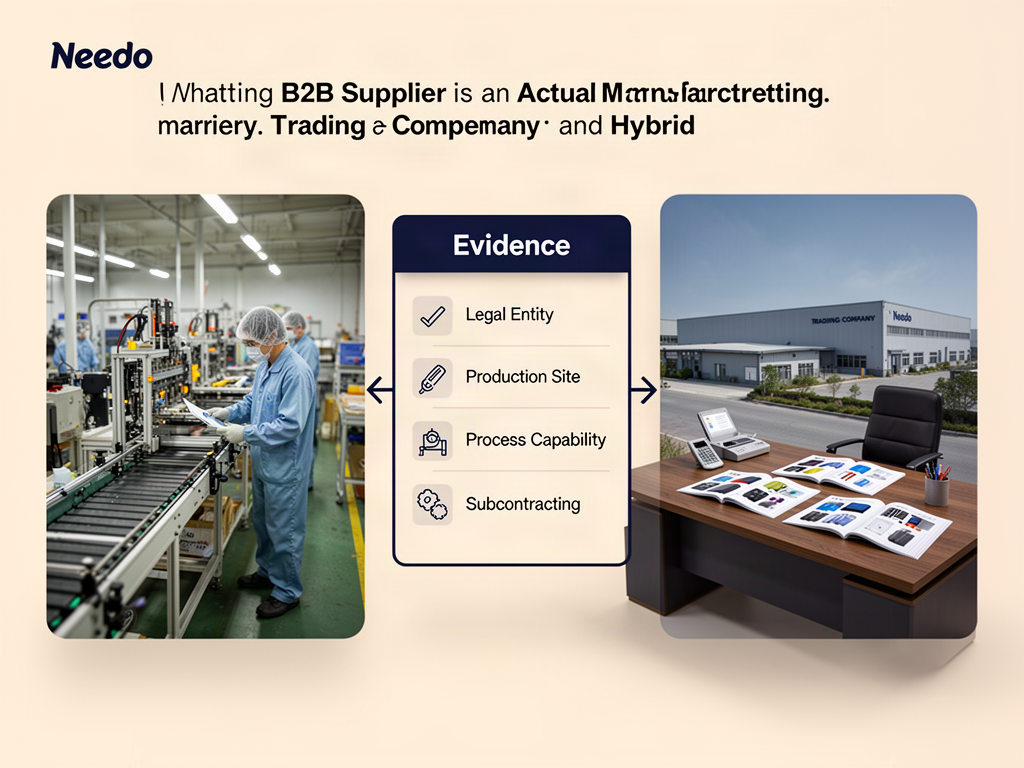
A manufacturer performs production or processing itself. A trading company primarily buys from manufacturers and resells or exports the goods. A hybrid may manufacture some products or processes while sourcing other items or subcontracting particular stages. Real businesses do not always fit a simple label, so ask about the specific product and order rather than relying on the company-wide description.
Choose the supply model that fits the transaction. Direct manufacturing may be useful when you need engineering changes, tooling control, process traceability or repeat production. A trading company may be useful when you need mixed products, smaller quantities, supplier consolidation, export handling or one commercial contact across several factories. The goal is not to eliminate traders; it is to understand the model and contract for it.
Write down the decision before checking
- Does the order require custom manufacturing, standard stock, assembly or resale?
- Which production steps must be controlled by the contracted supplier?
- Are subcontractors acceptable, and which processes need prior approval?
- Do you need direct access to engineering, quality or production staff?
- Who must own non-conformance, rework, replacement and delivery commitments?
Match the legal entity across records and documents
Ask for the full legal name, registration identifier, registered address, trading name and the entity that will sign the contract. Compare those details with the supplier website, quotation, pro forma invoice, purchase-order acknowledgement and proposed payment beneficiary. If different companies appear, ask for the relationship in writing: one may be a sales office, export company, group affiliate or authorized distributor. A mismatch is a question to resolve, not automatic proof of fraud.
Use the relevant official company registry for the country where the entity is registered. As one example, the UK Companies House service can show company type, registered office, nature-of-business classification, status, filing history and officer information. Companies House also cautions that its public information is not comprehensive and that errors or omissions can occur. A registry record helps establish what entity exists and what has been filed; it does not prove that the entity owns a factory or can make your product.
Entity reconciliation checklist
- Legal name and registration number recorded from an official source where available
- Registered office distinguished from sales office and production address
- Quotation, contract and invoice issuer identified
- Bank beneficiary matched to the contracting entity or explained and independently reviewed
- Group-company, export-agent or distributor relationships documented
- Unresolved name or address differences assigned for clarification
Separate the registered office from the production site
A registered office, head office, showroom, warehouse and factory can be different places. Do not treat matching addresses as proof that a company manufactures, or different addresses as proof that it is only a trader. A registered office can be separate from a factory for legitimate reasons, and a hybrid group may use different legal entities for sales, export and production. The useful evidence is the traceable connection between the legal operator, the actual site and the process used for your order. Ask the supplier to list every site that will perform a meaningful step on your order: machining, moulding, cutting, sewing, assembly, coating, testing, packing or final inspection. Record the legal entity operating each site and whether it is owned, leased, affiliated or subcontracted.
Request evidence that connects the named company to the named production location. Depending on the risk and product, that could include a live video walk-through, dated process photographs, site records, equipment lists, production documents or an independent site visit. A polished factory video may be useful context, but it does not by itself establish when it was filmed, who owns the site or whether your order will be made there.
Questions for the site
- What is the full production address for this order?
- Which legal entity operates the site?
- Which steps will happen at this location and which elsewhere?
- Can the supplier show the relevant equipment and process, not just the entrance?
- Can the site be inspected by you or an independent auditor before a high-risk commitment?
Ask process-specific questions a real production team can answer
Generic questions such as how many years the company has been in business are weak evidence of product capability. Ask about the process your product actually requires. For a moulded part, ask about resin grades, machine tonnage, mould ownership, cycle time and dimensional controls. For metal fabrication, ask about material grades, cutting, forming, welding qualifications where relevant, finishing and inspection. For textiles, ask about fabric sourcing, cutting, stitching, dyeing, finishing and batch traceability.
Request answers tied to your specification and quantity. Ask who approves engineering changes, how first-off samples are checked, how non-conforming output is contained and how the supplier plans capacity around existing orders. A trader may need to obtain some answers from a factory; that is not necessarily disqualifying, but it should be visible in the response time, evidence and responsibility model.
Evidence that is more useful than a brochure
- Equipment or process list linked to the product specification
- Recent, appropriately redacted production or inspection records
- Named technical and quality contacts for the relevant process
- A sample or pilot plan with measurable acceptance criteria
- Capacity assumptions that identify shifts, bottlenecks and outside processes
Map every in-house and subcontracted process
Ask for a simple process map from incoming material to finished goods. Mark which steps the supplier performs itself, which are performed by a related company and which are subcontracted to independent parties. The map should identify the site, process owner and quality-control hand-off for each important step.
Subcontracting is common and may be commercially sensible. The risk is undisclosed subcontracting, uncontrolled site changes or uncertainty about who investigates a defect. Put the approved sites and processes into the purchase specification or contract. Require written approval before a material change to the production location, critical process or subcontractor, and define which records or inspections must be available.
Subcontracting controls to agree
- Approved production and subcontractor sites listed by legal name and address
- Critical processes identified, including any outsourced testing or finishing
- No unapproved site or process substitution for the order
- Traceability from incoming materials through finished lots
- Supplier remains responsible for meeting the contract unless the contract clearly states otherwise
- Inspection, corrective-action and record-access rights defined
Check certificates against the entity, site and scope
A certificate is useful only when it belongs to the relevant organization and covers the activity or location you are relying on. Read the legal name, address, sites, standard, scope, certification body, certificate identifier and status. A certificate held by a group company, office or unrelated supplier is not automatically evidence that the factory making your order is covered.
ISO develops standards but does not certify companies or issue ISO certificates. Certification is performed by external certification bodies. ISO explains the distinction between certification and accreditation and points users to certificate-verification resources. For management-system certificates, also check the certification body's accreditation and the relevant scope. A management-system certificate is not a product approval, test report or guarantee that every unit will conform.
For a step-by-step certificate review, use the related Needo guide: How to Verify a Supplier's ISO 9001 Certificate. It explains certificate scope, issuing body, site coverage, database checks and the current ISO 9001 transition.
Certificate questions
- Does the certificate name the same legal entity that will contract and receive payment?
- Does its site schedule include the production location?
- Does the stated scope cover the process or activity relevant to your order?
- Is the certification body identifiable and is its accreditation scope relevant?
- Has the status been checked with the issuer or an authoritative register?
Compare the commercial trade-offs, not just the label
Compare the supplier model against your actual requirements. A direct factory may offer closer engineering control but require a larger minimum run or more buyer-side coordination. A trader may offer mixed orders, smaller quantities, consolidation or export-document support, but you need visibility into the actual factory and the trader's control over changes and quality. A hybrid may be appropriate for core production with selected outsourced processes.
Ask every candidate to quote on the same specification, quantity, delivery basis and payment assumptions. Record whether the quote includes tooling, inspection, packaging, export handling and freight. Identify who will issue the invoice, who will receive funds, who owns the production schedule and who is accountable for a defect. Do not choose a supplier solely because it claims to be a factory or because its unit price is lower.
Use a risk-based verification sequence
For a low-value standard-stock order, registry checks, document reconciliation and a credible sample may be proportionate. For custom tooling, safety-critical parts, regulated products, large deposits or sole-source production, consider an independent factory audit, product testing, staged payment, approved sample, first-article inspection or pre-shipment inspection. Select checks based on the product, transaction value, failure impact and contractual requirements.
Keep a decision log with four labels: verified, supplier-stated, unresolved and not applicable. Attach the source and date to each important fact. If a claim cannot be verified, say what additional evidence is needed and who will obtain it. Do not convert an unanswered question into a pass.
A practical go / clarify / hold decision
- Go: legal entity, site, process and contract responsibilities are consistent with the order
- Clarify: a mismatch or missing document has a credible explanation and an owner
- Hold: production site, beneficiary, critical capability or subcontracting remains unresolved
- Reject or re-source: material claims cannot be supported or the supplier will not accept necessary controls
Worked example: a custom metal enclosure
Illustrative example: a buyer needs 2,000 custom steel enclosures with laser-cut panels, welded frames and powder coating. Supplier A says it is a manufacturer. Its legal entity is registered as a trading business, its office is separate from the workshop, and it proposes to subcontract cutting and coating. That does not automatically make Supplier A unsuitable. The buyer asks for the actual workshop address, identifies the cutting and coating subcontractors, reviews a sample and process records, and requires the named sites and change-approval process in the contract.
Supplier B owns a workshop and performs cutting and welding but outsources powder coating. Its certificate covers the workshop's quality-management system but the buyer still checks whether the coating site is in scope and agrees how coating defects will be handled. The buyer compares the two offers on the same specification, lead time, inspection plan and responsibility terms. The decision is based on evidence and risk, not the word manufacturer.
Copy-ready manufacturer or trading-company checklist
Before approving a first order, make sure the file answers each of these questions. If a question is not relevant, record why. If the answer is unknown, leave it open rather than assuming the best.
- What legal entity signs the contract and receives payment?
- What is the actual production address for this product?
- Which process steps are performed in-house and which are subcontracted?
- What product-specific equipment, technical staff and capacity evidence is available?
- Which certificates cover the entity, site and relevant scope?
- Who approves material, process, site or subcontractor changes?
- Who is accountable for inspection, defects, rework, replacement and delivery?
- What independent checks are proportionate before deposit or bulk production?
Use Needo to organize the supplier evidence
Needo can work from a supplier name, website, quotation, registration details, certificates and your product specification to organize a research plan, compare available evidence and identify questions that still need confirmation. Ask it to distinguish the contracting company from the production site, map subcontracted processes and prepare a risk-based verification checklist for the order you are considering.
Review important findings with the relevant procurement, quality, legal or compliance owner. Needo does not conduct a physical factory audit, certify a supplier or guarantee that a company will perform. Its value is helping you move from a broad supplier claim to a specific, evidence-led next decision.
Sources and further reading
- UK Government — Searching the Companies House Register
Official example of company-register information such as company status, registered office, nature of business, officers and filings; the register itself warns that records are not comprehensive and can contain errors.
- U.S. Department of Commerce — Perform Due Diligence
Official guidance on researching foreign business partners, company risk and the use of background information before a commercial relationship.
- ISO — Certification
Explains that ISO develops standards but does not issue certificates, and distinguishes certification from accreditation.
- UKAS — Validating Management-System Certificates
Accreditation-body guidance on checking the certification body, relevant accreditation scope and certificate validity.
Sources support the specific points noted above. Confirm current requirements for your product, destination and contract before committing.
Need the actual problem solved?
This guide explains the method. Needo can work from your specific requirement, compare relevant options, verify important details and help move the next step forward.
Start with your exact problem →Selling or exporting? See live buyer requirements by product · see a sample verified shortlist