NEEDО · EXPORT RESEARCH
How to Find Importers by HS Code: A Practical Export Research Workflow
An HS code can help you narrow the products and markets to research, but it is not a ready-made list of importers who want to buy from you. A useful export workflow combines correct product classification, trade-flow research, company-level evidence and a fit check against your actual capacity and commercial terms.
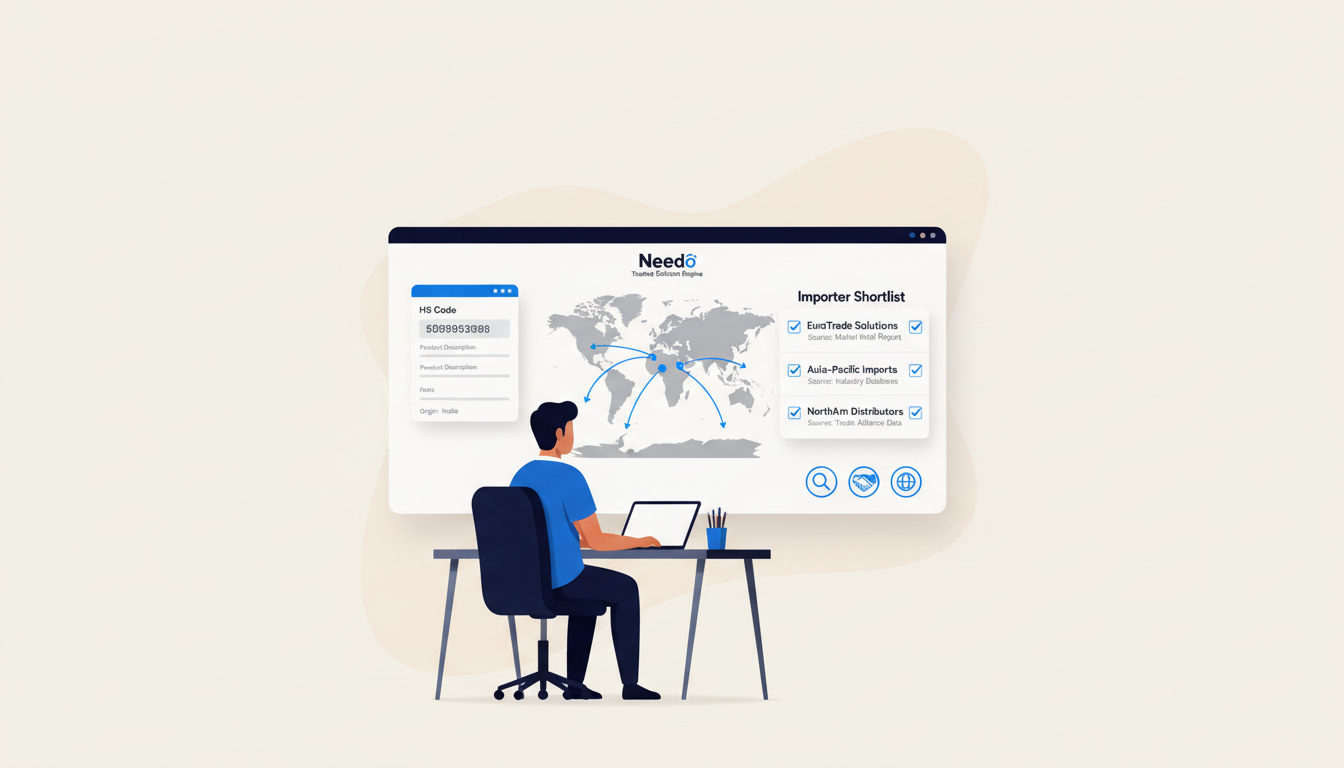
Know what an HS code can—and cannot—tell you
The Harmonized System classifies traded goods so customs administrations and trade-data providers can describe product categories consistently. It can help you investigate which markets report imports in a product category. It does not, by itself, identify a named buyer, prove current purchasing intent or show whether an importer will accept your specification and price.
Treat HS-code research as the first filter in a larger process: choose markets, identify candidate companies, find a credible buying signal, and then qualify each prospect. Keep those stages separate in your notes and reporting.
Separate the outputs
- Trade statistics: product flows reported by country and period
- Company candidate: an importer or distributor that may fit the category
- Buying signal: a public requirement, RFQ, project or other relevant evidence
- Qualified prospect: a candidate that fits your product and has a defensible next step
Confirm the product classification before comparing markets
Start with the product’s composition, function, material, grade, processing, intended use and technical specification. Similar-looking products can fall under different classifications. The World Customs Organization explains the international HS structure; national tariff schedules may add more digits and country-specific detail.
Do not select a code only because a search result or competitor uses it. If the classification affects duties, licensing, origin rules or a material commercial decision, confirm it through the relevant customs authority or a qualified customs professional. Record the classification source and version or date so the research can be repeated later.
Write down the classification evidence
- Product description and intended use
- Material, grade, composition or technical properties that affect classification
- HS code and level of detail being used
- Country-specific tariff code, if applicable
- Source checked, date checked and any unresolved classification question
Use trade data to shortlist markets—not to claim buyer demand
A trade-statistics source such as UN Comtrade lets users explore reported merchandise trade by product and trading partner. Compare the reporting countries, product category and available periods that match your research question. Look for markets worth investigating, not a guaranteed order pipeline.
Before interpreting a chart, check the reporter and partner definitions, the period covered, the product-code level and whether the latest period is complete. Reported values can be revised or differ because of classification, valuation and reporting practices. A country importing a category does not prove that a specific company is buying now or that your product can compete there.
Market-screening questions
- Which target markets report imports in the relevant product category?
- Are the periods and product-code levels comparable?
- Does the market fit your supply capacity, lead time and documentation?
- Are there tariff, regulatory, logistics or payment constraints to investigate?
- What company-level evidence would justify the next research step?
Turn the market shortlist into company candidates
Once a market looks plausible, look for named companies through relevant trade bodies, official trade platforms, industry associations, buyer–seller events, public procurement notices, specialist distributors and company websites. For India-based exporters, check the current services offered through the official Trade Connect ePlatform and relevant national or sector trade-body events. Availability and access can vary, so confirm the current terms directly with each source.
A directory entry is a discovery lead, not proof of current demand. Save the original source URL, the date you checked it and the exact claim the source supports. If a company profile only says it distributes industrial supplies, do not rewrite that as actively buying your product.
A candidate record should include
- Legal or trading name and target country
- Product categories and evidence of fit
- Original source URL and date checked
- Public RFQ, project or other buying signal, if one exists
- Publicly listed business contact route or relevant department
- Unknowns and the next reasonable verification step
Grade the evidence before spending sales time
Use simple evidence labels that prevent a weak lead from looking stronger than it is. The labels are an operating rule for your team, not an external certification. Update them when the source changes or direct confirmation resolves an unknown.
Practical evidence levels
- Explicit demand: a current public requirement or RFQ closely matches the product
- Relevant signal: credible activity suggests possible fit, but a current requirement is not established
- Directory-only: the company may fit the category, but demand is unproven
- Poor fit: the specification, order size, market, compliance or timing conflicts with your offer
- Unverified claim: a key detail is stated by a seller or intermediary but lacks independent support
Score each importer against your actual offer
A prospect is commercially useful only when the product and operating constraints line up. Compare candidates against the same checklist instead of ranking by company size or the apparent attractiveness of a market. A high score must not override a failed mandatory requirement.
For example, a large importer may be a poor fit if it buys a different grade, requires a certification you do not hold or needs delivery faster than you can supply. A smaller specialist distributor may be more relevant if its product range, customer base and order pattern match your offer.
Buyer-fit scorecard
- Product, grade and specification match
- Quantity fit with your capacity and MOQ
- Destination, delivery terms and lead time are workable
- Required certifications and documents are actually available
- Evidence is recent enough for the decision being made
- A relevant department or decision path is identified
- Remaining questions are clear and proportionate to the opportunity
Illustrative example: from a product code to a shortlist
Suppose an Indian manufacturer sells a particular grade of industrial fastener. The team first documents the material, dimensions, application and any standards that matter, then confirms the appropriate classification with a qualified source. It compares available trade data to choose two or three markets worth researching, while noting the period and classification level used.
The team then checks industry directories, official trade resources and public buying notices for named importers. Each candidate is labelled as explicit demand, relevant signal or directory-only; the team records product fit, source date and unknowns. Only candidates with a plausible fit move to the next step. This is an illustrative workflow, not a claim about actual importers or demand in any particular market.
Copy-ready brief for an importer-research task
Use this brief to keep the research specific. Mark unknown fields as unknown rather than guessing; a correct limitation is more useful than a confident but unsupported match.
Research brief
- Product and application: [exact product, grade, use and specification]
- HS code: [code, classification source and level of detail, if confirmed]
- Supply: [available quantity, MOQ, monthly capacity and lead time]
- Target markets: [countries to assess or constraints for selecting them]
- Required documents or standards: [only those actually held or required]
- Commercial basis: [currency, target price range and delivery terms]
- Evidence wanted: [current RFQs, public buying signals, relevant importers and source dates]
- Output: [candidate, evidence level, fit rationale, unknowns and next step]
Common mistakes to avoid
HS-code research becomes misleading when classification, market demand and company-level intent are collapsed into one claim. Keep the evidence chain visible and do not present an aggregate trade statistic as proof that a named company is ready to purchase.
- Using a code without checking the product description and classification level
- Treating country-level trade data as a named importer list
- Calling directory-only companies verified buyers
- Ignoring quantity, certification, delivery and payment constraints
- Leaving out source dates or using stale evidence without a warning
- Reporting leads found as orders, revenue or confirmed buyer interest
Use Needo to move from market research to a qualified next step
Needo can help structure the product requirement, research candidate importers, compare public evidence and distinguish a real buying signal from a directory listing. It should show sources and dates, identify missing information and avoid claiming that a company is interested unless the evidence supports that statement.
Start with your product description, confirmed or tentative HS code, available quantity, target markets, required documents and delivery constraints. Review the evidence-backed shortlist before deciding which prospect deserves more due diligence or an approved commercial approach.
Sources and further reading
- World Customs Organization — What is the Harmonized System?
Explains the HS classification system and why country-specific tariff detail should be checked separately.
- United Nations — UN Comtrade Database
Official source for reported merchandise-trade statistics by product and trading partner; aggregate data is not a list of named buyers.
- Government of India — Trade Connect ePlatform
Check current official export and buyer-connect services; access and features may vary.
Sources support the specific points noted above. Confirm current requirements for your product, destination and contract before committing.
Need the actual problem solved?
This guide explains the method. Needo can work from your specific requirement, compare relevant options, verify important details and help move the next step forward.
Start with your exact problem →Selling or exporting? See live buyer requirements by product · see a sample verified shortlist