NEEDО · EXPORT DISTRIBUTION
How to Qualify an Overseas Distributor Before Signing an Agreement
Finding a distributor is only the first step. Before sharing sensitive pricing, promising a territory or granting exclusivity, establish whether the candidate can reach the customers you want, support the product and operate under terms your business can sustain. This guide is a qualification workflow—not a guarantee of a partner's performance or a substitute for legal advice on a material agreement.
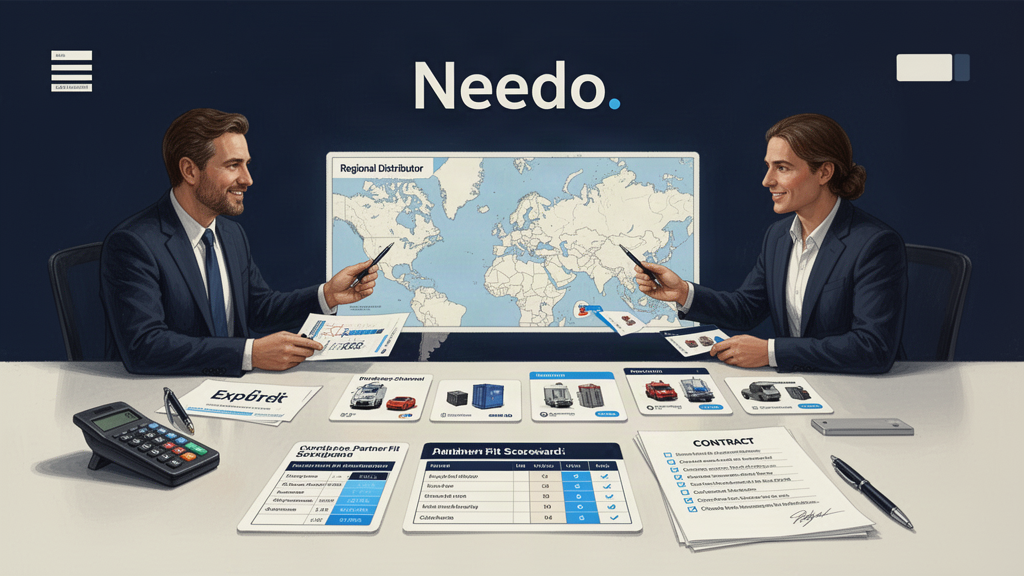
Define the job the distributor must do
Write down the customer segment, products, territory and responsibilities you expect the partner to cover. A stock-and-resell distributor, sales representative, installer and service partner do different work. Specify who owns inventory, credit risk, marketing, technical support, returns and after-sales service before comparing candidates.
Separate mandatory conditions from preferences. For example, a required licence or service capability may be a pass/fail condition; an existing complementary product line may be a preference. Avoid granting rights based on a vague promise to 'cover the market'.
Partner brief checklist
- Products and customer segments to be served
- Countries, regions or named accounts in scope
- Sales, stocking, installation and service responsibilities
- Required licences, certifications or technical capability
- Forecast assumptions and realistic opening-order size
- Support your company will provide
Test actual market access and sales capacity
Ask which customer types the candidate serves, how its sales team reaches them and what evidence supports the claim. Depending on the product, useful evidence may include a current product catalogue, anonymized customer segments, territory coverage, a named sales-team structure, service locations or references you are permitted to contact. A polished website or a long brand list does not by itself prove active customer access.
The U.S. Department of Commerce's foreign-representative guidance recommends evaluating sales force size, sales record and territorial coverage. Treat those as prompts to investigate, not as a universal scoring formula. Ask for a clear explanation of gaps between the candidate's current coverage and the market you need.
Questions to ask
- Which customer segments and regions do you serve today?
- How many people actively sell or support this product category?
- What comparable products do you represent, and where might conflicts arise?
- How are forecasts, pipeline and sell-through reported?
- Can you support installation, returns or technical questions if needed?
- Which claims can be confirmed through independent references?
Verify the business and the people involved
Check the legal entity, business address, official contact route and the authority of the person negotiating on its behalf. Use independent public registries or professional checks where available and appropriate to the country. Compare names and addresses across proposals, company records and contract drafts; resolve material inconsistencies before sharing confidential information or making commitments.
Record the source and date for each important fact. Label statements supplied only by the candidate as claims until corroborated. If a reference cannot be contacted or a capability cannot be checked, record the gap and decide whether it matters to the intended role.
Evidence register
- Legal name, jurisdiction and registration evidence where available
- Independent company contact route and representative role
- Product lines, customer segments and territory evidence
- References or examples relevant to the proposed role
- Open questions, source links and dates checked
- Conflicts or restrictions that require legal review
Model the economics before discussing exclusivity
Compare the full economics of the relationship: distributor discount or margin, marketing support, samples, training, logistics, warranty costs, payment timing, returns and any stock commitments. Use your own product costs and current quotes. Do not rely on a generic margin benchmark or a forecast that the candidate has not supported.
Exclusivity can limit your ability to appoint another partner or sell directly. If it is being considered, define the exact products, territory, channels, term, performance measures, reporting requirements, exceptions and termination conditions. A time-limited pilot or non-exclusive start may be worth evaluating, but the right structure depends on the product, country and negotiating position. Obtain qualified legal and tax advice for material cross-border arrangements.
Commercial terms to resolve
- Price, payment timing, currency and credit exposure
- Opening order, minimum purchases and forecast assumptions
- Marketing spend, training, technical support and warranty responsibilities
- Territory, channels, named-account exceptions and competing products
- Performance review, reporting cadence, renewal and termination
- Applicable delivery term and named place where relevant
Use a scorecard without hiding deal-breakers
A scorecard can make candidate reviews consistent, but it must not allow a high average to hide a failed mandatory requirement. First apply pass/fail gates for legal eligibility, required technical support, product fit and acceptable commercial risk. Then score softer factors such as customer access, sales coverage, responsiveness and reporting quality, with notes and evidence beside each score.
Example: a distributor with excellent reach but no ability to service a product may fail a mandatory support requirement. Another with narrower reach may be suitable for a pilot if it serves the right segment and can demonstrate capability. The conclusion should follow the intended role and evidence, not the total score alone.
Decision labels
- Proceed to reference checks: core requirements appear to fit and evidence is available
- Pilot or clarify: a limited set of important questions remains open
- Hold: a mandatory requirement or material risk is unresolved
- Decline: a confirmed mismatch makes the proposed arrangement unsuitable
Prepare the next step and document the decision
Before signing, align the agreement with the actual operating plan: products, territory, channels, forecast assumptions, order process, support obligations, performance review and exit conditions. Keep the evidence register and the final contract version together. If an assumption changes, revisit the qualification rather than treating the original approval as permanent.
Needo can help turn your product, target market and proposed partner information into a comparison matrix and a list of due-diligence questions. Provide the candidate's actual details and your non-negotiable constraints; review the evidence and seek professional advice where legal rights, tax or significant commercial exposure are involved.
Sources and further reading
- U.S. Department of Commerce — Choosing a Foreign Representative
Official guidance on assessing a potential representative or distributor, including sales force, sales record and territorial coverage. It is U.S. export guidance; tailor checks to the relevant jurisdiction.
- International Chamber of Commerce — Incoterms® Rules
Reference for the responsibilities, costs and risks allocated by an agreed delivery term; use the exact rule and named place in the contract.
- U.S. Department of Commerce — Perform Due Diligence
Practical starting point for evaluating foreign business partners and transaction risk. The checks required depend on the product, country and transaction.
Sources support the specific points noted above. Confirm current requirements for your product, destination and contract before committing.
Need the actual problem solved?
This guide explains the method. Needo can work from your specific requirement, compare relevant options, verify important details and help move the next step forward.
Start with your exact problem →Selling or exporting? See live buyer requirements by product · see a sample verified shortlist