NEEDО · EXPORT SALES
How to Respond to a Buyer RFQ: A Quote Template for Manufacturers and Exporters
When a buyer sends a request for quotation (RFQ), the useful response is not a brochure or a price with missing terms. It is a clear, traceable answer to the buyer's stated requirements, with every exception and assumption visible. This guide is written for the supplier or exporter replying to an RFQ—the counterpart to a buyer's RFQ-writing checklist.
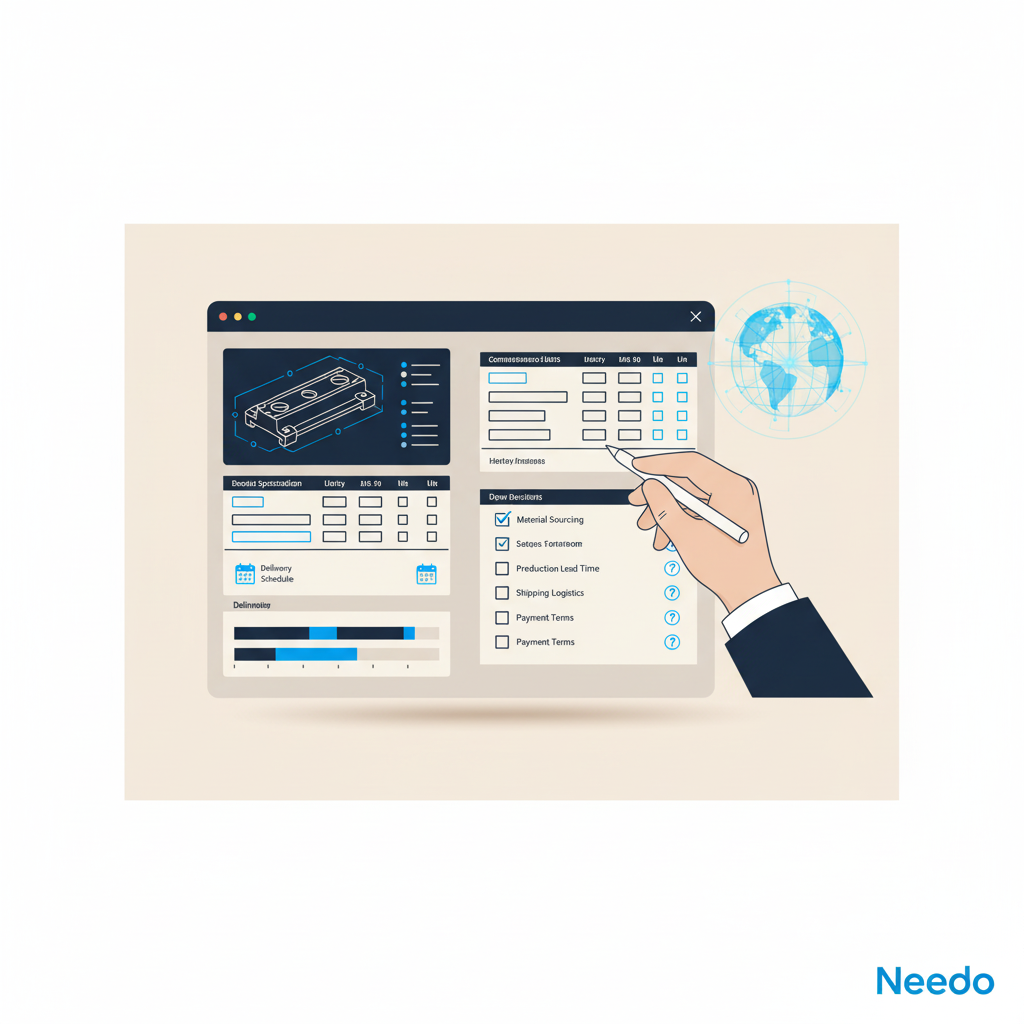
Log the deadline and preserve the buyer's reference
Record the RFQ number, buyer, receipt date, response deadline, required format, contact route and every attachment or specification revision. Check whether the buyer requires an online portal, signed forms, separate technical and commercial files, or a specific quotation currency. Missing a mandatory submission instruction can matter more than the quality of the sales copy.
Assign an owner for technical questions, pricing, production capacity, quality documents and final approval. If the deadline or required information is unclear, ask a specific clarification question early enough for the buyer to answer.
RFQ intake checklist
- Buyer name and RFQ reference
- Closing date, time zone and submission method
- Product, drawing and revision identifiers
- Required quantity tiers and units of measure
- Mandatory forms, certifications and supporting documents
- Named contact for questions and permitted clarification process
Check compliance before preparing the price
Read the buyer's requirement line by line. Separate mandatory requirements from preferences and identify any conflict between the RFQ, drawings, commercial terms and attachments. Do not assume that a product is compliant because it is similar to something you supplied previously.
Create a simple compliance matrix and mark each item as comply, exception, clarification needed or not offered. Ask the technical or quality owner to validate the answer. If a requirement cannot be met, state the deviation clearly and ask whether an alternative is acceptable; never hide it in a footnote.
Compliance matrix fields
- Buyer requirement and document revision
- Your response: comply, exception, clarification or not offered
- Evidence or internal owner supporting the response
- Impact on price, delivery, quality or documentation
- Question for the buyer, if an answer is needed before quoting
Build a quotation that can be compared fairly
Mirror the buyer's line items and units where possible. Show the quoted quantity, unit price, extended line total, currency, minimum order, price breaks and any one-time tooling or setup charge. Check the arithmetic and confirm that the price applies to the exact specification and quantity requested.
State the delivery basis explicitly. For international trade, identify the requested or proposed Incoterms® rule, the named place or port and the applicable version. Explain whether freight, insurance, packaging, customs handling, duties, taxes and inland delivery are included, excluded or only estimated. The appropriate cost allocation depends on the transaction and the agreed term; do not imply that every charge is covered by a shorthand label.
Commercial fields to reconcile
- Quantity, unit of measure, currency, unit price and total
- MOQ and price breaks by SKU, variant or shipment
- Lead time and the event that starts the clock
- Delivery term, named place and freight treatment
- Payment schedule, quote validity and price assumptions
- Tooling, sample, inspection, packaging and documentation charges
Copy-ready RFQ response structure
Use this structure as a starting point, then follow the buyer's requested format. Replace every bracket with a verified value or remove the field if it does not apply. Do not send placeholders, estimated lead times or unapproved terms as if they were commitments.
Quotation response template
- Subject: Quotation for [RFQ reference] — [product] — [company]
- Reference: [RFQ number, date and specification revision]
- Scope: [items and quantities quoted; identify any excluded line items]
- Compliance: [compliant requirements, exceptions and clarification requests]
- Price: [currency, unit price, quantity tier, line total and total value]
- Delivery: [Incoterms® rule, named place, version and included or excluded charges]
- Lead time: [verified production or dispatch estimate and its starting condition]
- MOQ and availability: [quantity limits and stock or capacity status, confirmed or pending]
- Quality and documents: [only certifications, reports and documents actually available]
- Payment and validity: [approved payment terms and quotation expiry date]
- Assumptions and exclusions: [each condition that could change price or delivery]
- Next step: [sample, technical clarification or approval needed to finalize the offer]
Make exceptions specific instead of vague
If you cannot meet one part of the request, state the requirement, the proposed alternative and the consequence. For example, an illustrative supplier might say: The requested coating is not included in our base price. We can quote it as a separate operation after the drawing revision and acceptance criteria are confirmed. That is clearer than silently omitting the coating or saying only subject to confirmation.
Do not propose a substitute as equivalent unless you have evidence for the relevant performance, dimensions, compatibility and compliance requirements. If the difference could change the buyer's decision, put it in the main response and request written acceptance before treating it as approved.
Attach evidence that supports the claims
Include the documents the buyer requested and that your business can legitimately provide: current specifications, relevant test reports, certificates, product photos, quality plans or references approved for sharing. Check document names, revision numbers, validity dates and whether the document applies to the exact product and facility being quoted.
Never invent a certification, customer result, production capacity, stock position or delivery commitment to make a response look stronger. If a document is pending, say who must confirm it and when you expect to have an answer. Protect confidential drawings, prices and customer information, and use the buyer's approved submission channel.
Evidence check
- Document matches the quoted product and revision
- Certification is current and covers the relevant scope, if required
- Capacity and lead time have been checked by the responsible team
- Product photos represent the offered item or are labelled as illustrative
- Confidential information is shared only through an appropriate channel
Run the final pre-submission check
Before sending, ask a second person to check the response against the RFQ rather than reading it as a standalone document. The aim is to catch omissions, arithmetic errors and hidden assumptions while there is still time to correct them.
Final checklist
- Correct RFQ reference, buyer, deadline and submission format
- Every required line item answered or explicitly flagged
- Specification and revision match the buyer's documents
- Prices, quantities, units, totals and currency reconcile
- Delivery term, named place, lead time and validity are clear
- Exceptions, assumptions and exclusions are visible
- Required forms and evidence are attached and current
- Final quote has the required approval and is submitted before the deadline
Track what happens after the quote is sent
Record the submission time, version, quoted value, validity date, open questions and next agreed milestone. If the buyer asks for a revision, keep the old version and document what changed. That prevents a revised price or delivery commitment from being confused with the original offer.
Follow the buyer's stated process and reasonable timetable. A useful follow-up adds something relevant—a resolved technical question, a missing document or a clear alternative—not repeated generic reminders. Track outcomes separately: submitted, clarification requested, shortlisted, rejected, order received and order confirmed are different states.
Use Needo to prepare a reviewable response
Needo can help extract the requirements from an RFQ, organise the compliance matrix, identify unanswered questions and draft a structured response for review. Commercial facts still need to come from your own approved price, capacity, quality and delivery records; the system should not fill gaps with guesses.
Provide the RFQ and the facts you can confirm, including quantity, available capacity, cost basis, delivery location, certifications and deadline. Review every number, assumption and commitment before the quotation is approved or sent.
Sources and further reading
- International Chamber of Commerce — Incoterms® Rules
Authoritative reference for the responsibilities, costs and risks allocated by international delivery terms; confirm the rule and named place for the actual transaction.
- U.S. Department of Commerce — Perform Due Diligence
A government resource on assessing market, buyer and partner risk when conducting international trade.
Sources support the specific points noted above. Confirm current requirements for your product, destination and contract before committing.
Need the actual problem solved?
This guide explains the method. Needo can work from your specific requirement, compare relevant options, verify important details and help move the next step forward.
Start with your exact problem →Selling or exporting? See live buyer requirements by product · see a sample verified shortlist