NEEDО · COMPONENT SOURCING
How to Source Suppliers for a Bill of Materials (BOM): A Practical Checklist
A bill of materials is only as useful as the detail behind each line. A familiar component family can contain different orderable part numbers, packages, revisions, tolerances or approved manufacturers. If you send a vague list to suppliers, you may receive quotes for items that are not interchangeable—or miss a packaging, minimum-order or delivery constraint that changes the real cost. This guide turns a BOM into a sourcing brief that suppliers can quote consistently and your team can review without silently accepting a substitute.
Decide what the BOM must achieve
First clarify whether you are buying electronic components, mechanical parts, raw materials, finished assemblies or a mix. The right sourcing route depends on the product. Some lines may have an exact manufacturer part number; others may be specified by a drawing, material grade, dimensions, tolerance or performance requirement. Keep those cases separate rather than forcing every line into the same search method.
Set the buying context before requesting quotes: quantity per build, number of builds, destination, target date, required documentation, budget constraints and whether the source must be manufacturer-authorized. A prototype order, pilot build and recurring production order can require different packaging, availability and commercial terms.
Brief the supplier with these inputs
- BOM revision and date, plus the intended build quantity
- Line number, item description, exact part number or controlled specification
- Manufacturer or approved manufacturer list, if applicable
- Package, grade, dimensions, tolerance, revision or other orderable details
- Quantity per build and total quantity to quote
- Required delivery date, destination and shipping constraints
- Mandatory certificates, traceability, warranty or source restrictions
Normalize every line before searching
Use one row per orderable item and avoid merging distinct variants just because their descriptions look similar. Preserve the manufacturer's punctuation and suffixes in the source record even if a search tool normalizes them for matching. For engineered items, keep the drawing number and revision, material, finish, tolerance and inspection requirements. For electronic components, record the full manufacturer part number, package, temperature or performance grade where relevant, and any approved alternate list.
Add a status field for each line: exact part identified, specification incomplete, possible alternate allowed, or engineering decision required. This stops a supplier from interpreting an unanswered question as permission to quote any similar product. If the BOM contains ambiguous rows, resolve the highest-risk items before asking several suppliers to price the whole list.
Useful columns for a clean BOM
- Line number and item description
- Manufacturer and exact part number or controlled drawing
- Revision, package, grade, size or other differentiating detail
- Quantity per assembly and total required quantity
- Approved alternates and who can approve a change
- Target date, destination and required delivery split
- Evidence or clarification still needed
Choose the right supplier route for each line
For standard electronic components, manufacturer websites and authorized distributors are useful starting points for confirming product identity and the channel relationship. TrustedParts, created with the Electronic Components Industry Association, describes its BOM tool as using authorized and validated distributors; its authorized-channel guidance explains why sourcing route matters when component authenticity and manufacturer support are important. That guidance is specific to electronic components, so do not apply its authorization model blindly to every industry.
For mechanical parts, industrial supplies or custom manufacturing, consider the original manufacturer, a qualified distributor, a specialist supplier or a contract manufacturer that can meet the actual specification. A broad directory can help discover candidates but does not establish current stock, technical capability or willingness to quote. Record the source, the date checked and exactly what the evidence supports. If a candidate claims to be an authorized channel partner, verify the relationship with the manufacturer or an authoritative current source when it materially affects the purchase.
Record the evidence, not just the supplier name
- Company identity and a credible contact route
- Manufacturer or brand relationship where relevant
- Product or process capability tied to the exact requirement
- Current quote, stock or production evidence and its date
- Required quality documents, traceability or certifications
- Open questions and the next legitimate verification step
Compare quotes on the same build quantity
A line-by-line BOM quote should make it possible to see which source can supply each required quantity and on what terms. Compare the total cost for the planned build, not only the lowest one-piece price. Check MOQ, order multiple, reel or tray quantity, pack size, price breaks, partial shipment rules, lead time, quote validity, currency, shipping, taxes or duties where applicable, payment terms and any handling or inspection fees. If one supplier quotes a full kit and another quotes only available lines, show the coverage difference instead of comparing their totals directly.
Availability is a dated statement, not a permanent fact. Ask whether stock is physically held, allocated to your order, subject to confirmation or expected from a future delivery. For production items, ask what happens if one line slips: can the supplier split shipment, reserve the remaining quantity or propose an approved alternative? Record the assumptions behind any landed-cost calculation and confirm the destination-specific charges before committing.
Comparison fields
- Exact match or clearly identified deviation
- Quantity covered and quantity still missing
- Unit and extended price at your actual quantity
- MOQ, pack multiple and applicable price break
- Stock status or production lead time, with date and source
- Shipping basis, fees, currency and quote validity
- Warranty, traceability and required documents
- Risk, open question and recommended next action
Treat substitutions as a controlled decision
A substitute can have a similar description and still fail electrically, mechanically, chemically, dimensionally or operationally. For a critical component, compare the full specification and relevant operating limits, not just the base model number. A different package, connector pinout, material, grade, firmware requirement or certification can make an apparently similar item unsuitable. Keep the original item and proposed alternate in separate fields so the comparison does not erase the requirement.
Require the designated engineering, quality or product owner to approve substitutions before purchase or use. Record the evidence reviewed, the person who approved the change and any test or inspection required. If no qualified reviewer has approved the alternative, label it as a candidate only. This is especially important for safety-critical, regulated or warranty-sensitive applications.
Substitution review checklist
- Full orderable part number and manufacturer identity
- Specification and operating limits compared against the original
- Package, dimensions, interfaces and mounting compatibility
- Compliance, certification and traceability requirements
- Availability, lifecycle and future replenishment considerations
- Written approval from the responsible technical owner
Worked example: a mixed BOM with one missing line
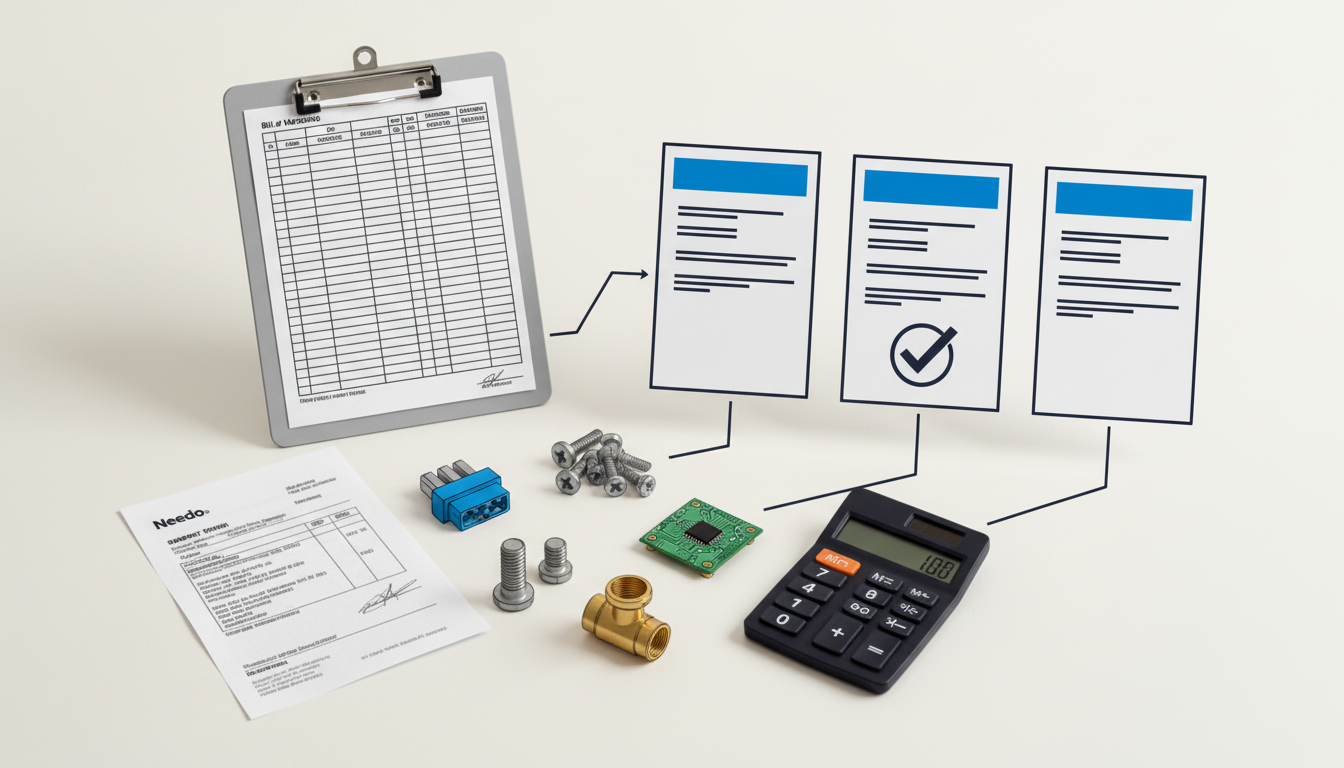
Illustrative example only: a small assembly needs 250 connectors, 250 fastener kits and 250 control boards. Supplier A can quote all three lines but gives a long lead time for the boards. Supplier B can quote the exact connectors and fasteners immediately but has no evidence for the control-board revision. Supplier C proposes a different board that appears similar. A useful comparison keeps the three lines separate, marks Supplier C's board as an unapproved alternative, and shows which supplier covers the required quantity by the target date.
The next move is not automatically to choose the lowest total. Ask Supplier A to confirm whether the board quantity can be allocated and whether partial shipment is possible. Ask Supplier B for evidence of the exact board revision or remove that line from its coverage. Send Supplier C's proposed part to the technical owner for review before it enters the commercial comparison. This makes the missing evidence visible before the buyer's schedule depends on it.
Copy-ready RFQ note
- Please quote the attached BOM revision and total build quantity shown.
- Keep exact part numbers, revisions and packaging as listed; identify any deviation in a separate column.
- Show quantity available, MOQ, order multiple, unit and extended price, lead time, quote validity and delivery basis for every line.
- Identify stock that is unconfirmed or expected later, and state any partial-shipment assumptions.
- List required traceability, warranty or source documentation and provide evidence where available.
- Do not substitute any line without identifying the proposed alternate and waiting for written approval.
Prepare a sourcing decision, not just a spreadsheet
Before choosing a source, check whether every mandatory line is covered, whether exact identities match, whether the delivery plan meets the required date, and whether any unresolved substitute or documentation issue blocks the purchase. A good output makes both the chosen route and the remaining uncertainty visible. Keep the BOM revision, quote versions, source URLs, quote dates and approvals together so the next build does not repeat the same research.
Needo can help structure a BOM brief, research potential sourcing routes, compare quotes and flag missing evidence. Give it the actual BOM or representative line items, build quantity, destination and must-have constraints. Review technical equivalence and commercial commitments with the responsible people before placing an order; a research result is not a live inventory guarantee or a purchase authorization.
Sources and further reading
- TrustedParts.com — Start a New BOM
A specialist electronic-component BOM tool describing supported file formats, part-line matching and sourcing information. Use it as a component-sourcing reference, not as a universal supplier database for every industry.
- TrustedParts.com — Why Buy Electronic Components Through the Authorized Channel?
Explains why authorized sourcing can matter for electronic-component authenticity, manufacturer support and supply-chain handling. Confirm the actual channel and product for your purchase.
- NIST — How Small Manufacturers Can Develop Risk Management Strategies for Their Supply Chains
Official manufacturing supply-chain guidance on mapping components and supplier dependencies, assessing risks and considering alternative sources.
Sources support the specific points noted above. Confirm current requirements for your product, destination and contract before committing.
Need the actual problem solved?
This guide explains the method. Needo can work from your specific requirement, compare relevant options, verify important details and help move the next step forward.
Start with your exact problem →Selling or exporting? See live buyer requirements by product · see a sample verified shortlist