NEEDО · SUPPLIER VERIFICATION & CERTIFICATION
How to Verify a Supplier's ISO 9001 Certificate: Scope, Site and Status
A supplier may send an ISO certificate as evidence of its quality system, but the document is useful only if it is authentic, current, issued by a credible certification body, and relevant to the legal entity, location and activity you are buying from. A logo or PDF is not enough. This guide shows how to check the certificate in layers, what a database result does and does not prove, and why an ISO 9001 management-system certificate is not the same as a product test report or regulatory approval.
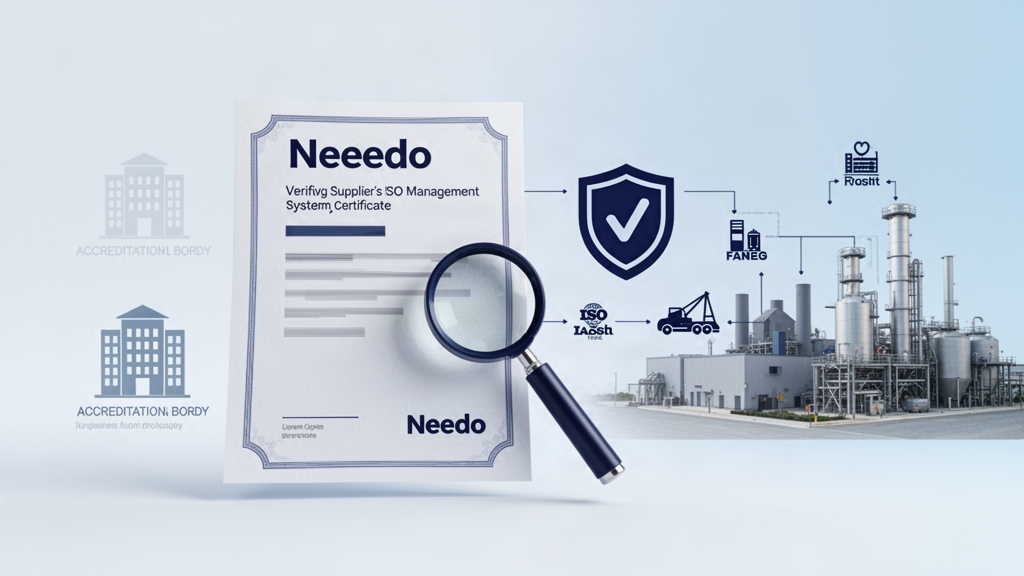
Understand what the certificate does and does not prove
ISO 9001 is a quality-management-system standard. Certification indicates that an independent certification body has assessed an organization's management system against the standard within a stated scope. It does not mean that ISO itself inspected or certified the supplier: ISO develops standards and does not issue company certificates. Accreditation is a separate recognition of the certification body's competence by an accreditation body.
Do not treat ISO 9001 as proof that a particular product model passed a test, meets a customer drawing, complies with a technical regulation or will arrive defect-free. Those questions may require product-specific test reports, declarations, licenses, inspection records or other evidence. First decide exactly what you need the certificate to support: confidence in the supplier's management system, coverage of a particular site, or a separate product or regulatory requirement.
Keep these evidence types separate
- Management-system certificate: the organization's quality or other management system within a defined scope
- Product certificate or approval: a product or scheme-specific conformity claim
- Test report: results for a defined sample, method, laboratory and date
- Factory audit: observations and findings from a particular site and audit scope
- Supplier performance evidence: actual quality, delivery and corrective-action history
Read every field on the certificate
Start with the complete certificate, not a cropped logo or cover page. Record the certificate identifier, standard and edition, certified legal name, address or site schedule, scope statement, certification body, accreditation mark or reference, issue date, expiry date if shown, and current status. Check whether the supplier's name is a trading name, parent company, affiliate or different legal entity from the one that will sign the purchase contract.
Read the scope literally. Phrases such as design, manufacture, assembly, distribution, installation or servicing describe different activities. A broad scope for sales or distribution may not cover the manufacturing process you need. If several sites are listed in an annex or schedule, obtain the full schedule and identify which location performs your product's critical processes.
Capture these certificate fields
- Certificate ID and issuing certification body
- Certified organization's full legal name
- Every covered site and its address
- Standard number and edition
- Exact scope wording and any exclusions
- Issue, expiry, suspension, withdrawal or current-status information
- Accreditation body and relevant accreditation reference
Verify the certification body and its accreditation
ISO recommends checking whether the certification body is accredited and explains that accreditation provides independent confirmation of the body's competence. Accreditation is not compulsory in every circumstance, and the absence of accreditation does not automatically prove that a certificate is false or that the issuer is disreputable. It does mean you should understand what assurance is present and whether your contract, customer or industry requires accredited certification.
Check the accreditation body and the certification body's scope. A certification body may hold accreditation for some standards or sectors but not for the exact management system or activity stated on a supplier's certificate. Use the accreditation body's official register or verification service, and contact it if the scope is unclear. Do not accept a logo as a substitute for a verifiable accreditation record.
Issuer checks
- The certification body is a real, identifiable organization
- The issuer's own website or register recognizes the certificate
- The accreditation body is independently identifiable
- The certification body's accreditation covers the relevant standard and scope
- The certificate has not been suspended, withdrawn or superseded
Search an authoritative certificate database, then confirm gaps
For accredited management-system certifications, ISO points users to IAF CertSearch, which aggregates information from accreditation bodies and certification bodies. Search by the company name or certificate identifier where the service is available. Also check a relevant national accreditation-body service; for example, UKAS CertCheck is a public tool for checking claims of UKAS-accredited management-system certification.
A database search is a useful first check, not a universal pass/fail test. UKAS explains that IAF CertSearch coverage is not complete because certificate uploads have been voluntary. If a certificate is not found, do not label it fake on that basis alone. Contact the issuing certification body using contact details obtained independently from its official website, provide the certificate ID and ask it to confirm the organization, scope, sites and current status. If necessary, ask the accreditation body to confirm the issuer's accreditation.
If the certificate is missing from a database
- Recheck the certificate ID, company spelling and legal name
- Try the issuing body's own public certificate directory
- Contact the issuer through independently sourced contact details
- Ask for written confirmation of status, scope and covered sites
- Escalate to the accreditation body if the issuer or scope cannot be confirmed
- Keep the result as unresolved until reliable evidence is obtained
Confirm the production site and multi-site coverage
A supplier's head office may not be the site making your order. Compare the certificate's legal name and site schedule with the factory address, production records, quotation and contract. If the supplier says the certificate covers several locations, obtain the annex or schedule that lists those locations and clarify which activities are performed at each one.
Ask the certification body to confirm a site or scope question when the certificate wording is ambiguous. A group company, sister company or subcontractor does not automatically inherit another entity's certification. Likewise, a site appearing in a group certificate does not automatically mean every process, product or subcontractor is covered. Match the evidence to the actual order route.
Site-to-order reconciliation
- Contracting legal entity matches the certificate or the relationship is documented
- Production address appears in the certificate or verified site schedule where required
- The stated scope includes the relevant manufacturing or service activity
- Critical outsourced processes and subcontractors are separately assessed
- The site that will make or release the goods is identified in the purchase documents
Account for the ISO 9001:2026 transition
ISO 9001:2026 was published on 16 September 2026 and is now the current edition. Global Accreditation Cooperation Incorporated (Global ACI) published transition requirements on the same date. Under that framework, organizations already certified to ISO 9001:2015 have until 30 September 2029 to complete transition; from 31 March 2028, new and initial accredited certifications covered by the framework may only be issued to ISO 9001:2026.
These dates apply to Global ACI MRA signatories and their accredited certification bodies operating within the applicable scope. They are not a reason to reject every supplier that still presents a 2015 certificate in November 2026. Ask the supplier and its certification body for the transition plan and confirm which accreditation arrangement applies. Record the certificate's current status separately from its planned transition.
Transition questions to ask
- Is the current certificate to ISO 9001:2015 or ISO 9001:2026?
- Has the issuing body confirmed the certificate remains current?
- Which accreditation framework and transition requirements apply?
- When is the supplier's transition audit planned?
- Will the transition change the certified legal entity, site or scope?
Check whether the scope matches the purchase you are making
Translate the scope into the actual work. If you are buying machined components, a scope limited to wholesale distribution may not support the claim that the named organization controls machining. If you are buying a service, check whether the relevant service activity and delivery location are included. If the supplier uses a subcontractor for a critical process, ask how that process is controlled and whether the subcontractor is included in the management-system arrangements or separately qualified.
Then ask for product-specific evidence. Depending on the order, this may include a specification, approved sample, test report, inspection plan, process validation, material traceability or customer-specific approval. The certificate can form one part of supplier due diligence, but it should not replace the technical and contractual checks that relate directly to your product.
Recognize warning signs without jumping to conclusions
Warning signs include a certificate with no identifiable issuer, a legal name that does not match the supplier, an unexplained site mismatch, a scope unrelated to the product, a status the issuer cannot confirm, or pressure to accept a certificate screenshot instead of the complete document. A QR code can be useful, but follow it to the issuer's genuine domain rather than trusting a printed image or shortened link.
A missing database entry, an older edition during a transition, or a different group-company name is not automatically proof of fraud. Each requires a specific explanation and independent confirmation. If the supplier refuses reasonable verification, the certificate remains unverified; do not mark the supplier approved merely because a document was uploaded.
Decision labels
- Verified: issuer and current status confirmed through an authoritative route
- Partially verified: issuer confirmed, but site or scope still needs clarification
- Unresolved: database result missing or conflicting evidence requires direct confirmation
- Not relevant: certificate does not cover the activity or control you need
- Concern: issuer denies the certificate, reports withdrawal, or material details cannot be reconciled
Worked example: the certificate belongs to a head office
Illustrative example: an importer is buying precision-machined parts from a supplier whose sales team sends an ISO 9001 certificate. The certificate names a parent company and a registered office. The quotation names a subsidiary, while the production address is a third location. The buyer requests the complete site schedule, asks the certification body to confirm whether the production location is covered, and checks the stated scope against machining and inspection.
The issuer confirms that the parent company's management system is certified but cannot confirm that the proposed workshop is in the covered site schedule. The buyer does not call the certificate fake; it records the site coverage as unresolved, requests a separate audit or appropriate certification evidence, and keeps the order on hold until the production and quality responsibilities are contractually clear.
Copy-ready ISO certificate verification checklist
Use this list before relying on a supplier's certificate in a procurement approval. Add the source, date checked and reviewer beside every important result.
- Complete certificate and any site annex received
- Certificate ID, standard and edition captured
- Legal entity reconciled with contract, quotation and payment beneficiary
- Certification body independently identified
- Accreditation body and relevant scope checked
- Certificate status confirmed with an authoritative source
- Production or service site matched to the certificate scope
- Subcontracted critical processes identified
- Product-specific approvals and tests checked separately
- ISO 9001:2026 transition implications confirmed where relevant
- Open questions, owners and approval decision recorded
Use Needo to review the certificate and supplier evidence
Needo can organize the certificate fields, compare names and addresses across supplier documents, locate official verification resources, summarize scope differences and prepare the questions that should go to the certification body. Give it the supplier's legal name, country, certificate number, complete certificate and site schedule, plus the product or service you intend to buy.
Treat the result as a research and review aid. The issuing certification body or accreditation body must confirm certification status where a formal confirmation is needed. Needo does not issue certificates, accredit certification bodies, conduct a physical audit or guarantee product conformity.
Sources and further reading
- ISO — Certification and How to Verify an Accredited Certification
Explains that ISO does not perform certification, distinguishes certification from accreditation and points to IAF CertSearch and direct confirmation routes.
- ISO — ISO 9001:2026
Official standard page identifying ISO 9001:2026 as the current edition and describing its quality-management-system purpose.
- Global ACI — Transition Requirements for ISO 9001:2026
Official 16 September 2026 notice describing the three-year transition and the dates that apply to Global ACI MRA signatories and their accredited certification bodies.
- UKAS — CertCheck
Official UK accreditation-body service for checking claims of UKAS-accredited management-system certification.
- UKAS — Frequently Asked Questions
Explains CertCheck and cautions that IAF CertSearch is not comprehensively populated because certificate uploads are voluntary.
- UKAS — Validating Management-System Certificates
Practical accreditation guidance on checking the certification body, accreditation scope and certificate validity.
Sources support the specific points noted above. Confirm current requirements for your product, destination and contract before committing.
Need the actual problem solved?
This guide explains the method. Needo can work from your specific requirement, compare relevant options, verify important details and help move the next step forward.
Start with your exact problem →Selling or exporting? See live buyer requirements by product · see a sample verified shortlist