NEEDО · SUPPLIER VERIFICATION
How to Verify Supplier Production Capacity Before Placing a Large Order
A factory may have many machines and still lack enough usable capacity for your order in the required window. The practical question is not its largest theoretical output; it is whether the exact product can be made to the required quality, with materials and people available, alongside existing commitments, and then packed and dispatched on time. Treat a delivery promise as a claim to validate, not as proof by itself.
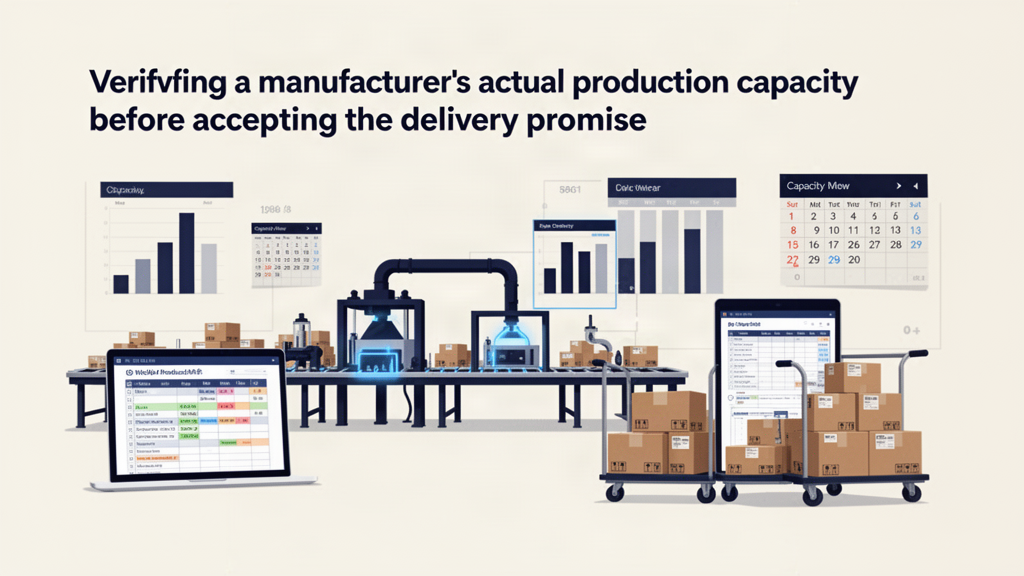
Define the order and the delivery window precisely
Before asking about capacity, freeze the requirement you want assessed: product and revision, quantity of good units, quality criteria, order-release date, required cargo-ready date, packaging and any inspection or documentation steps. If the product mix has variants, separate them because changeovers, tooling and process times may differ.
Clarify what the supplier means by lead time. It may mean time until production starts, time in production, time until the goods are packed, or time until a shipment is ready for collection. International transit and customs clearance are separate unless the supplier has explicitly quoted and taken responsibility for those stages.
Order brief
- Exact product, revision and variant mix
- Required quantity of conforming units
- Order approval and material-release date
- Production completion and cargo-ready dates
- Inspection, packaging and documentation requirements
- What is included in the supplier's lead-time promise
Ask for usable output, not the biggest machine number
Nameplate or theoretical capacity is only a starting point. Usable output can be constrained by the slowest required operation, product mix, changeovers, staffing, maintenance, material supply, quality losses and orders already scheduled. Ask the supplier to explain which process step controls the schedule for your product and how it calculated the promised quantity.
Use recent actual output for the same or a genuinely comparable product where possible. A general monthly factory figure may include other products, shifts, lines or facilities that are not available to your order. If evidence is confidential, the supplier may provide a redacted schedule, summary or reference check; record the limitations instead of treating an unsupported number as verified.
Evidence to request
- Recent output for the same product or process
- Available line, shift and staffing plan for the order window
- Current commitments that share the same constrained resources
- Material availability and supplier lead times
- Expected changeover, maintenance and quality-loss assumptions
- Subcontracted operations and their confirmed capacity
Map the bottleneck through the full production route
List each required step from incoming material through processing, assembly, finishing, testing, packing and dispatch. For each step, ask about the cycle time or output rate, operating hours, planned downtime, changeovers, staffing and yield. A fast assembly line does not solve a slow coating, curing, testing or packaging step if every unit must pass through it.
Check whether a key operation is outsourced or shared with other products. The supplier may control the factory floor but not the schedule of a subcontractor, raw-material mill or specialist test lab. Ask who owns that dependency, what confirmation exists and how the schedule changes if it slips.
Process map questions
- What are the required steps and their sequence?
- Which step limits output for this exact product mix?
- What downtime and changeover assumptions are included?
- Which steps or materials depend on outside suppliers?
- What inspection or rework loop can reduce good-unit output?
- What is the recovery plan if the bottleneck misses its target?
Calculate the capacity gap with explicit assumptions
Use a simple planning calculation rather than a broad factory claim. Start with expected output during the available window, subtract already committed work on the same resources, and adjust for realistic yield, downtime and changeovers. The result is still an estimate; it should be checked against the supplier's actual schedule and evidence.
Illustrative example only: a line is said to produce 500 units per shift, but the supplier expects two shifts to be lost to changeovers and planned maintenance during the window. Before considering existing orders or defects, the theoretical 2,000-unit total across four shifts would be reduced by 1,000 units. This is arithmetic to demonstrate the method, not a benchmark or a claim about a real factory. Confirm what the shift rate means and whether the units meet the required specification.
Capacity worksheet
- Available shifts or hours in the requested window
- Gross output rate for the same product and process
- Less planned downtime and changeover time
- Less capacity already committed to other orders
- Adjust for expected yield or rework using evidence
- Compare the resulting estimate with required good units and a realistic buffer
Verify raw materials, components and people
A machine can be available while the order remains impossible because a critical material, imported component, mould, operator or quality technician is missing. Ask which inputs are already on hand, which are ordered, the supplier-confirmed arrival dates and whether any input is shared with another order. A purchase order for material is not the same as confirmed arrival or usable inventory.
For labour-intensive production, ask whether the promised shifts are staffed and whether specialist skills or approvals are required. For regulated or safety-sensitive products, confirm the relevant process controls and required inspections with qualified people. Do not infer readiness from factory size, a site photograph or a general statement that the supplier has produced similar goods before.
Dependency checks
- Critical raw materials and component quantities
- Confirmed inbound dates and supplier references
- Tooling, fixtures and setup readiness
- Staffing, skills and shift coverage
- Quality-control and testing availability
- External processing, inspection or certification dependencies
Test the delivery promise against the schedule
Ask the supplier to map the order through material release, production start, each critical process, quality inspection, rework allowance, packing and cargo-ready date. Make the milestone owners and dependencies visible. A date that assumes every step starts immediately with no queue, no changeover and no failed inspection should be treated as an optimistic scenario until supported.
Compare the schedule with recent performance on similar orders and ask how exceptions will be communicated. A supplier may not be able to share every customer's schedule, but it can often explain the evidence behind its estimate, provide a redacted capacity plan or agree to milestone updates. Keep production completion distinct from carrier pickup and final delivery.
Milestone questions
- When is the order released to production?
- Which materials or approvals control the start date?
- When are first articles, in-process checks and final inspection planned?
- What is the packing and cargo-ready date?
- Which events would trigger a revised commitment?
- How will slippage be reported and escalated?
Use staged proof for a high-risk or unusually large order
The level of checking should reflect order value, product criticality, customization and the consequences of delay. Depending on the transaction, appropriate evidence may include a pilot run, first-article approval, a sample against the controlled specification, an agreed production milestone, a site visit, a qualified inspection or references from recent comparable customers. Each method proves different things; none is a universal guarantee.
Where commercially feasible, consider staged production or release gates so the buyer can review an early milestone before the full quantity is committed. Define the acceptance criteria, timing, payment consequences and responsibility for delay in the contract with appropriate professional advice. Do not assume a staged order is automatically safer if tooling, minimum quantities or logistics make it impractical.
Risk-based verification options
- Pilot quantity or first-article review
- Evidence of material receipt and production start
- Inspection at an agreed production stage
- Independent inspection or site visit when proportionate
- Reference check for a comparable recent order
- Written escalation and recovery plan for a missed milestone
Record what is proven, claimed and still unknown
Create a short evidence register with each capacity claim, source, date, confidence, unresolved question and the decision it affects. A supplier's written statement is useful evidence of what it promised, but it is not independent proof of the underlying capacity. Mark estimates and assumptions explicitly, and update them when a material delivery, schedule or quality result changes.
New Zealand Government Procurement guidance offers a useful public-sector example of due diligence: independently checking supplier identity, financial ability, capability and capacity, and documenting the checks. Its procurement rules are jurisdiction-specific, but the underlying discipline of asking for evidence from more than one source is useful in commercial sourcing too.
Decision checklist
- Required quantity and delivery window are unambiguous
- Capacity estimate is tied to the exact product and process
- Current commitments and material dependencies are addressed
- Quality yield, downtime and changeovers are not ignored
- The cargo-ready date includes inspection and packing
- Claims, independent evidence and unknowns are clearly separated
- The contract and escalation path match the delivery risk
Sources and further reading
- New Zealand Government Procurement — Conducting Due Diligence Checks
Explains checking supplier identity, financial ability, capacity and capability, documenting due diligence, and verifying claims with more than one source.
- New Zealand Government Procurement — Decide Your Evaluation Criteria
Identifies capacity, current commitments, availability, delivery risk and capability as relevant supplier-evaluation factors.
- New Zealand Government Procurement — Awarding the Contract
Public-sector guidance on assessing whether a supplier can demonstrate capacity and capability to meet quantity, quality, time and location requirements; rules apply to the stated jurisdiction.
Sources support the specific points noted above. Confirm current requirements for your product, destination and contract before committing.
Need the actual problem solved?
This guide explains the method. Needo can work from your specific requirement, compare relevant options, verify important details and help move the next step forward.
Start with your exact problem →Selling or exporting? See live buyer requirements by product · see a sample verified shortlist