NEEDО · EXPORT OPERATIONS
How to Check a Purchase Order Against Your Export Quote Before Accepting
A buyer's purchase order can look routine while changing a quantity, delivery date, specification revision or payment condition from the quote you approved. Before confirming an export order, compare the documents line by line and resolve material differences in writing. This checklist helps you spot mismatches; whether a document forms or changes a binding contract depends on the transaction and applicable law, so obtain qualified legal advice when the stakes warrant it.
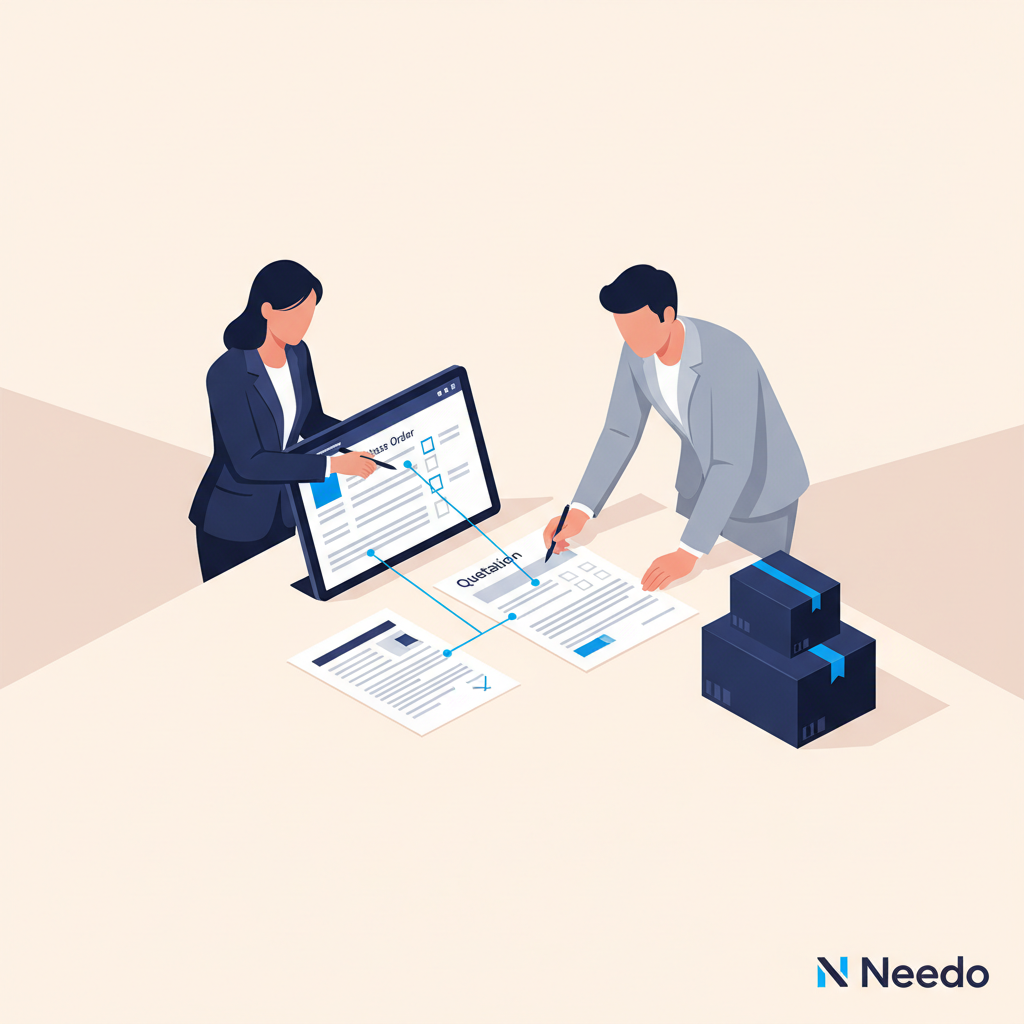
Collect the exact documents and versions
Put the buyer's purchase order beside the quotation you actually approved, any signed contract, the latest specification or drawing, and the written messages that record agreed changes. Check dates, document references and revision numbers first. If the buyer refers to an attachment or purchasing-portal term you cannot access, treat that as an open item rather than assuming it matches the previous deal.
Identify the version that your production, finance and logistics teams would use. A quotation may have expired or been superseded; a drawing may have changed after the sample; and a purchase order may contain standard terms that were not discussed during negotiation. Preserve the source documents so the review is traceable.
Document intake checklist
- Buyer legal name, billing and ship-to details
- Purchase-order number, issue date and requested confirmation deadline
- Approved quotation number, date, currency and validity
- Contract, specification, drawing and revision references
- Written amendments and any terms incorporated by reference
- Attachments or portal terms that still need to be obtained
Reconcile every item and quantity
Compare each line using the same product identifier, grade, model, specification revision, unit of measure and packaging. Check ordered quantity, price per unit, line extension, discount, tooling or setup charges and total. Watch for a quantity stated in cartons on one document and individual units on another, or a substitute model inserted without explicit approval.
Recalculate totals rather than relying on the document's printed arithmetic. Confirm the currency and whether taxes, packaging, samples, inspection or other charges are included, excluded or pending. If a line is missing from the purchase order, do not assume it was intentionally removed or remains payable under the quote; record the discrepancy and clarify it.
Comparison table fields
- PO line and quotation line
- Item code, description and specification revision
- Unit of measure, quantity and price
- Currency, discount, fees and line total
- Required date or delivery window
- Status: match, difference, missing or unclear
- Evidence or written clarification needed
Check delivery, shipment and document requirements
Compare the requested ship date, arrival date, delivery location, shipment size, partial-delivery rules, packaging, labels and required export documents. Make sure the dates are feasible for your actual production capacity and any required inspection or buyer approval. Do not turn a requested date into a confirmed promise until the responsible team has checked it.
If the documents use an Incoterms® rule, check the exact rule, named place or port and version. These rules allocate specified tasks, costs and risks; the shorthand alone does not settle every question about quality, payment, delay or dispute resolution. Ask who arranges transport, insurance, export and import formalities, and which charges are included in the quoted price.
Delivery checks
- Same named destination and delivery basis
- Incoterms® rule, named place and version, if agreed
- Production, dispatch and arrival dates clearly distinguished
- Partial shipment, split delivery and packaging requirements
- Inspection, certificates, labels and document deadlines
- Freight, insurance, customs and destination charges allocated
Reconcile payment and risk terms before confirming
Check deposit percentage, payment milestones, due date trigger, currency, bank charges, credit period and any documentary-credit requirements against the terms actually agreed. A PO that introduces open-account credit, a different balance-payment trigger or new deductions can change the transaction's risk. Ask finance and your bank to review unfamiliar trade-finance wording before committing.
Independently verify unusual requests to change bank details using a contact route already known to your business, not only the new message. The Australian government's business scam guidance, for example, recommends stopping to verify unexpected payment-detail changes directly; legal requirements and available remedies vary by jurisdiction. Do not treat a document check as a guarantee that the buyer or transaction is safe.
Commercial clauses to flag
- Deposit, balance and payment trigger
- Letter-of-credit or other bank-document requirements
- Credit period, late-payment or deduction terms
- Inspection, acceptance, warranty and defect remedies
- Cancellation, rescheduling and change-order rules
- New legal, compliance or dispute terms needing review
Use a discrepancy log and send a focused clarification
For each difference, write the PO wording, the previously approved wording, the commercial impact and the decision needed. Separate critical blockers from minor administrative corrections. Do not silently edit the buyer's document or assume a verbal conversation changed the written terms; ask for a corrected PO or a clear written amendment through the agreed process.
A useful clarification is specific and neutral: identify the document references, quote the two conflicting values and ask which one the buyer intends to govern. If the change affects price, specification, delivery, payment or liability, obtain the approvals your business requires before accepting. Keep the revised version and the final response together.
Copy-ready clarification format
- Subject: Clarification required — PO [number] / quotation [reference]
- We compared PO [number and date] with quotation [reference and date].
- Item [line]: the PO states [value]; the approved quotation states [value].
- Please confirm the intended requirement and issue a corrected PO or written amendment if needed.
- We will confirm feasibility and the commercial effect after the discrepancy is resolved.
- Open items: [list] · Required response by: [real deadline]
Illustrative example: a delivery term changed
Suppose an export quote specifies delivery to a named port, while the purchase order asks for delivery to the buyer's warehouse. The unit price may be unchanged, but the new destination can introduce inland transport, handling, insurance or other responsibilities. The exporter should not accept the order on the assumption that the original price covers the new scope. The team should identify the changed location and delivery basis, obtain current cost and feasibility inputs, and issue a revised quotation or written clarification as appropriate.
This example is illustrative, not a claim about any real order. The correct treatment depends on the actual contract, delivery rule and transaction facts. The point is to surface a change before it becomes an unpriced commitment.
Final go/no-go checklist
Before confirming the order, verify that every material line either matches the approved offer or has an explicitly resolved difference. Ensure the correct team has approved capacity, price, payment risk, compliance and delivery. If a critical point remains unknown, label it open and pause that commitment rather than marking the order ready.
Needo can organise the PO, quote and requirement into a review table, highlight mismatches, and prepare questions for the buyer. It cannot decide legal effect or accept an order on your behalf; review the evidence and obtain the appropriate approval before sending a confirmation.
Before you accept
- Documents and revisions are identified
- Products, quantities, units and totals reconcile
- Delivery scope, dates and documents are feasible
- Payment and bank instructions are verified
- New clauses or deviations are resolved in writing
- Required internal, finance, compliance or legal approval is recorded
Sources and further reading
- U.S. Department of Commerce — Pro Forma Invoice
Lists common export-quotation and pro forma fields, including buyer reference, items, prices, weights, delivery term, payment terms and validity. It is U.S.-focused guidance, not a universal contract rule.
- U.S. Department of Commerce — Know Your Incoterms
Explains how agreed Incoterms® rules allocate specified shipping tasks, costs and risks; they do not settle every contractual issue.
- Australian Government — Tips to Help You Spot a Scam
Published 31 July 2026; recommends independently verifying unexpected payment-detail changes. Apply the practical caution without assuming Australian rules govern every transaction.
Sources support the specific points noted above. Confirm current requirements for your product, destination and contract before committing.
Need the actual problem solved?
This guide explains the method. Needo can work from your specific requirement, compare relevant options, verify important details and help move the next step forward.
Start with your exact problem →Selling or exporting? See live buyer requirements by product · see a sample verified shortlist