NEEDО · EXPORT FINANCE
How to Choose Export Payment Terms for a New Overseas Buyer
Payment terms affect both the chance of collecting the export proceeds and the amount of working capital you must carry. A new overseas buyer may request credit, while your business may need payment before production or shipment. Compare the actual risks, costs, documents and cash-flow timing before agreeing. There is no single safest or cheapest method for every transaction; involve your bank and qualified trade-finance adviser when the amount or risk is material.
Start with the transaction risk, not the buyer's preferred term
Write down what you know before negotiating: order value, product and customization, production lead time, destination, buyer history, available credit evidence, your cash reserves, and what happens if the buyer pays late or refuses the shipment. A repeat buyer with a documented payment history presents a different evidence picture from a first-time buyer asking for a large shipment on credit, but neither profile removes all risk.
Separate verified facts from the buyer's statements. Confirm the legal entity, order authority, references and any available credit information using sources appropriate to the market. Ask your bank about country, currency and issuing-bank risk where a bank instrument is proposed. Do not infer creditworthiness from a professional website, a large order quantity or an attractive purchase order alone.
Transaction brief
- Buyer legal entity, country and independently checked contact route
- Order value, currency, product and whether it is customized
- Past completed transactions and evidence of payment history
- Requested payment timing and credit period
- Your cash-flow limit and cost of carrying the receivable
- Bank, country, currency or documentary risks that need specialist review
Compare the four common payment methods
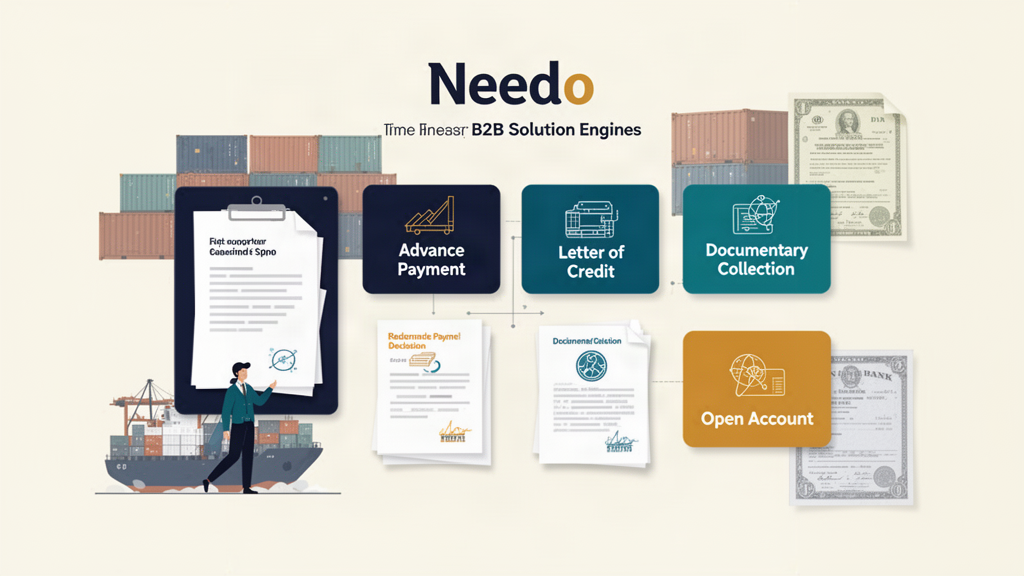
Advance payment means the buyer pays before you ship. It generally limits the exporter's non-payment exposure for the amount received, but a new buyer may resist tying up cash before delivery. For made-to-order goods, a deposit with a clearly defined balance milestone may be a negotiated alternative; the percentages and milestones must come from the actual agreement, not a generic template.
A documentary letter of credit is a bank undertaking to pay when the exporter presents documents that comply with the credit's terms. It can reduce reliance on the buyer's willingness or ability to pay, but fees, issuing-bank risk, document preparation and discrepancies matter. Documentary collection routes documents through banks under payment or acceptance instructions, but the banks do not guarantee that the buyer will pay. Open account means the goods are shipped before payment falls due, so the exporter carries the receivable and buyer-credit risk during the agreed period.
Quick comparison
- Advance payment: lower non-payment exposure for the amount received; may be difficult for the buyer to accept.
- Letter of credit: payment depends on compliant documents and the credit's terms; check the issuing bank, fees and discrepancy risk.
- Documentary collection: banks handle documents under instructions, but payment is not guaranteed; the buyer may refuse to pay or accept.
- Open account: may be commercially attractive to established buyers, but the exporter finances the receivable and bears greater non-payment exposure.
Match the method to the evidence and cash-flow gap
Use a decision matrix rather than declaring one method universally best. Consider how well you know the buyer, whether reliable credit information is available, the value and repeatability of the order, how quickly the goods can be resold if rejected, the buyer's country and bank risk, and how much cash your business can carry while waiting for payment. A highly customized product can create different recovery risks from standard stock that has other potential buyers.
If the buyer asks for a longer credit period, calculate the funding period from the agreed payment trigger through likely production, transit, documentation and collection time. Include financing cost, currency exposure, insurance or credit-cover cost if used, and the effect of delayed payment. Confirm any applicable export-proceeds deadlines and local foreign-exchange rules with your authorized bank or adviser; those rules vary by exporter jurisdiction and may change.
Decision questions
- What evidence supports the buyer's ability and willingness to pay?
- Can the order be resold or recovered if the buyer refuses it?
- Can the business fund production and delivery until the expected payment date?
- Would a deposit, staged payment, bank instrument or credit insurance address a specific risk?
- Are the issuing bank, fees, document conditions and governing rules understood?
- What is the fallback if the buyer rejects the proposed terms?
Treat a letter of credit as a document-controlled process
Before agreeing to an LC, ask your bank to review the draft terms, issuing bank and required documents. Check beneficiary and applicant names, currency, amount, shipment dates, expiry, presentation period, transport documents, inspection certificates and any wording that your team may be unable to obtain. Align the credit with the sales contract, pro forma invoice, production schedule and logistics plan before shipment.
An LC is not a reason to skip document review. Small inconsistencies can delay payment or create additional costs, and a bank's undertaking depends on the instrument's terms and applicable rules. Confirm fees, whether confirmation is needed, who pays charges, how amendments are handled and which documents must be issued by third parties. Obtain a qualified review rather than copying an LC clause from another transaction.
LC readiness checklist
- Issuing bank and any required confirmation reviewed with your bank
- Names, amount, currency and shipment details match the agreed sale
- Required documents can be obtained in the required form and timeframe
- Presentation deadline, expiry and shipment dates are feasible
- Inspection, origin, transport and insurance wording is achievable
- Fees, amendment process and discrepancy handling are understood
Write payment terms precisely in the quote and pro forma invoice
Avoid phrases such as 'usual terms' or 'payment as agreed' when the timing is material. Record the method, currency, amount or percentage at each milestone, the event that triggers payment, the due date, bank-charge allocation and any documents required. If the balance is due a number of days after shipment or invoice, define the date from which the period runs and the evidence used to establish it.
Use the same wording in the approved quotation, purchase order, pro forma invoice and contract unless a documented amendment changes it. If the buyer requests a new payment method after the order is approved, assess the commercial and cash-flow impact again. Independently verify any unexpected bank-account change through a contact route already on file; do not rely only on the message that supplied the new details.
Payment-term record
- Method and currency
- Deposit or advance amount and due date, if applicable
- Balance trigger and credit period, if any
- Documents required before payment or document release
- Bank charges, fees and any confirmed financing or insurance costs
- Quote validity, applicable contract reference and approval owner
- Unresolved bank or legal questions and who must answer them
Use a staged decision when evidence is incomplete
If the buyer is commercially promising but key evidence is missing, consider whether a smaller first order, a deposit, a bank-reviewed instrument or a shorter credit period could reduce exposure without making the deal uneconomic. These are options to evaluate, not automatic recommendations. Check whether local law, product rules, buyer procurement conditions or your own policy restrict the alternatives.
Document the decision and the conditions that would justify more credit later. A completed, paid transaction can add evidence to the relationship, but it does not guarantee future payment. Reassess when order value, buyer ownership, destination, currency, bank, delivery scope or payment behaviour changes.
Final checklist before you accept the order
The payment method should be consistent with the evidence, the cash-flow capacity and the contract. If the decision depends on an unverified buyer claim, an unknown bank condition or an unpriced financing period, mark it as unresolved and obtain the right review before making a commitment. Needo can organize the comparison and draft questions from your facts, but your bank and authorized decision-makers should confirm the financial and contractual terms.
Before approval
- Buyer identity and relevant credit evidence reviewed
- Method and milestones match the commercial agreement
- Cash-flow and currency exposure calculated from actual inputs
- Bank instrument or collection instructions reviewed where applicable
- Documents and dates are feasible and consistent
- Fees, credit period and fallback are explicit
- Finance, bank or legal review completed where needed
Sources and further reading
- U.S. Department of Commerce — Letter of Credit
Explains the documentary conditions, bank role, cost and discrepancy risks of letters of credit; guidance is U.S.-focused and should be checked against the actual transaction.
- U.S. Department of Commerce — Methods of Payment
Compares international payment methods and their timing and risk trade-offs for exporters and importers.
- Australian Government — Export payment methods
A practical comparison of advance payment, documentary credit, collections and open account; requirements and legal effects vary by jurisdiction.
- Government of Canada — Export financing requirements
Explains payment collection methods and the exporter's financing and non-payment exposure under different terms.
Sources support the specific points noted above. Confirm current requirements for your product, destination and contract before committing.
Need the actual problem solved?
This guide explains the method. Needo can work from your specific requirement, compare relevant options, verify important details and help move the next step forward.
Start with your exact problem →Selling or exporting? See live buyer requirements by product · see a sample verified shortlist