NEEDО · MANUFACTURING PROCUREMENT
How to Compare Manufacturer MOQ and Price Breaks Without Overbuying
A lower unit price at a larger quantity can still be the more expensive decision if it ties up cash, creates slow-moving stock or requires setup and tooling costs you have not included. Compare quantity tiers using both unit economics and the total commitment. This guide gives you a worksheet method and an illustrative calculation; replace every example input with the manufacturer's written quote and your own demand assumptions.
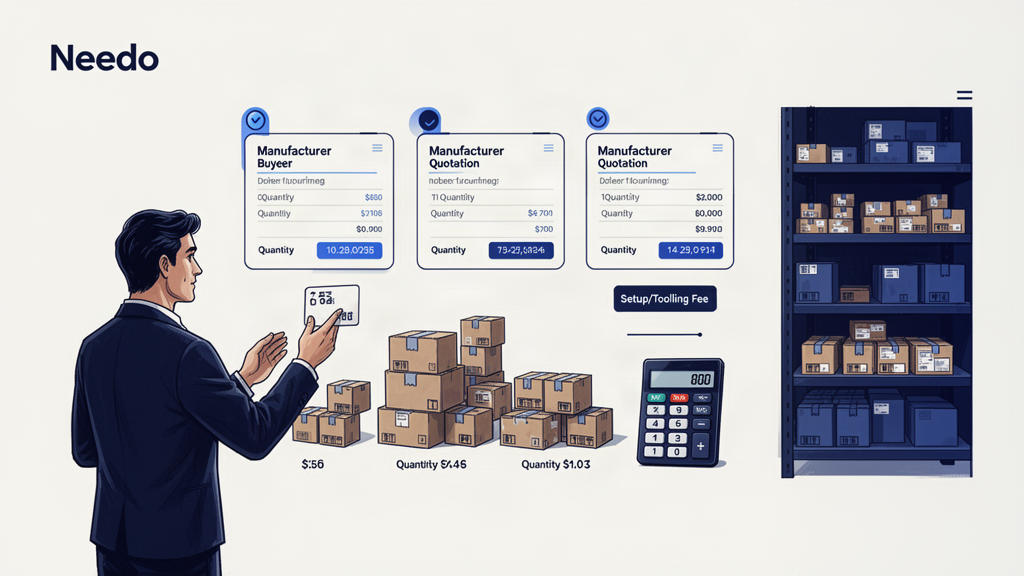
Ask for comparable quantity tiers
Request written prices at two or three quantities that reflect plausible demand—not only the manufacturer's preferred MOQ. Use the same specification, material, packaging, delivery basis, currency and quote date. Ask whether each tier has a different lead time, payment schedule, production process or validity period.
Record the supplier's minimum order, the smallest practical release, and whether the stated quantity is per SKU, colour, size, shipment or total order. For customized products, ask if different variants can share the same production run or whether each variant triggers its own setup or minimum.
Quote fields to capture
- MOQ and quoted quantity tiers
- Unit price and extended total at each tier
- One-time setup, programming, tooling or mould charges
- Packaging, labels, samples and inspection costs
- Production lead time and delivery basis
- Payment milestones, quote validity and exclusions
Separate one-time costs from per-unit costs
A quote may contain fixed costs that do not rise in direct proportion to the number of units, plus variable costs that recur for each unit. Examples of fixed or batch-level charges can include tooling, setup, programming or a first-article inspection; material, assembly and packaging may vary with quantity. Ask the supplier to identify the actual cost lines instead of assuming how its pricing is built.
To compare tiers, calculate total quoted production cost as fixed charges plus unit price multiplied by quantity, adding other included charges on the same basis. Divide by the quantity you expect to receive and accept. If expected scrap, rejects or samples reduce usable quantity, show that assumption separately rather than hiding it in the unit price.
Basic worksheet formulas
- Quoted production total = one-time charges + (quoted unit price × order quantity) + other included charges
- Quoted cost per ordered unit = quoted production total ÷ order quantity
- Cost per usable unit = total relevant cost ÷ expected usable units
- Cash required before delivery = deposits + pre-shipment payments + other amounts due before receipt
Illustrative example: compare unit price and cash commitment
Suppose a manufacturer offers 200 units at $12 each plus a $300 setup charge, or 1,000 units at $9 each with the same $300 setup charge. These are invented example inputs to demonstrate the arithmetic, not market prices or a recommendation.
At 200 units, the quoted production total is $2,700 ($2,400 in unit charges + $300 setup), or $13.50 per ordered unit. At 1,000 units, the total is $9,300 ($9,000 + $300), or $9.30 per ordered unit. The larger tier saves $4.20 per unit on the quoted production basis but requires $6,600 more total cash before any extra freight, storage, financing, defects or unsold inventory are considered.
The useful question is not simply which unit price is lower. It is whether the incremental 800 units can be sold or used on a realistic schedule, whether the cash commitment fits your working capital and whether storage, obsolescence, customization or demand uncertainty changes the economics.
Check the incremental decision
- Extra cash committed to the larger tier
- Expected sell-through or production use of the extra units
- Storage, financing, insurance and handling costs
- Risk of model changes, expiry, damage or unsold stock
- Whether smaller repeat orders would trigger setup or price changes
Check what each price break actually requires
A price break may depend on order quantity, annual volume, a blanket purchase order, scheduled releases, a minimum value, a deposit or a commitment to a forecast. These are not interchangeable. A lower tier price tied to a firm annual commitment may create more exposure than a one-time order at the same total volume spread over several releases.
Ask the supplier to state which conditions are binding, whether future prices are fixed or subject to material and currency changes, how unused forecast quantities are handled and whether the supplier will hold stock. Do not present a forecast as a guaranteed purchase unless your business has approved that commitment.
Questions for the manufacturer
- Is the price break based on order size, release size or annual volume?
- Are setup or tooling charges paid once or on every release?
- Can quantities be split across delivery dates or product variants?
- What happens if the forecast changes or a release is delayed?
- Are materials reserved, and who bears storage or cancellation costs?
- How long is each tier price valid, and what can change it?
Compare the full landed and inventory picture
For imported goods, add the relevant freight, insurance, customs, duties or taxes, brokerage, inspection, inland delivery and bank charges without double-counting items already included. The exact costs depend on the product, origin, destination and delivery term. Keep confirmed quotes separate from estimates and check current requirements with authoritative sources or a qualified customs professional.
Then consider the cost of holding the extra quantity: storage, financing, insurance, handling, shrinkage, damage and the risk that demand or product specifications change. If you are buying components for production, the cost of a stockout or production interruption may also matter. Use your own documented assumptions; there is no universal inventory-cost percentage that applies to every business.
Decision table
- Quantity and unit price at each tier
- One-time and recurring charges shown separately
- Total outlay and cost per usable unit
- Freight, tax and delivery basis normalized
- Cash due before delivery and before resale/use
- Estimated holding period and unsold-stock exposure
- Lead time, replenishment risk and quote validity
Negotiate the structure—not just the headline price
If the MOQ is too high, ask whether the supplier can quote a paid pilot run, a smaller first order, shared packaging, an existing standard configuration or staged releases. If you need a lower unit price, ask what concrete change would justify it: a confirmed quantity, simpler packaging, longer lead time or consolidated delivery. Evaluate the quality, compliance and service impact of each option before accepting it.
Do not claim that another supplier offered a price unless you have a comparable written quote. Do not accept a larger quantity merely to unlock a tier if it breaches your cash or storage limits. A supplier's revised offer should identify the exact specification, quantity, delivery basis, charges and validity so it can be checked against the original.
Copy-ready clarification request
- Please quote the same specification at [small trial quantity], [planned order quantity] and [higher tier].
- Please separate unit price, one-time setup/tooling, packaging and any recurring fees.
- Please confirm whether the price tier depends on order quantity, release quantity or annual commitment.
- Please state the payment schedule, production lead time, delivery basis and quote validity for each tier.
- Please identify whether smaller staged releases are possible and what storage, cancellation or repricing conditions would apply.
Approve the tier only when the assumptions are defensible
Before issuing the purchase order, reconcile the selected tier with the written quote, specification revision, quantity, delivery schedule, payment milestones and internal budget approval. Keep the calculation version and evidence used for demand assumptions. If any major input changes—supplier price, freight, currency, quantity or expected sell-through—recalculate before committing.
Needo can organize actual quotations into a comparison table, show the difference between unit savings and total cash exposure, and draft questions for missing terms. Provide your real quantities, quotes, destination, timing and stock constraints; review the result and obtain the required procurement or finance approval before ordering.
Sources and further reading
- U.S. Department of Commerce — Determine Total Export Price
Explains why pricing for an international sale can include freight, insurance, tariffs, taxes and other fees beyond the product price. Apply the relevant destination rules to your transaction.
- International Chamber of Commerce — Incoterms® Rules
Reference for the delivery responsibilities, costs and risks allocated by an agreed Incoterm; the rule and named place affect which costs belong in a comparison.
- NORAMARK — Low-Volume Production RFQ Checklist
Manufacturing supplier guidance recommends requesting multiple quantity prices and separating one-time setup charges from piece price. Treat it as practical supplier guidance, not an independent price benchmark.
Sources support the specific points noted above. Confirm current requirements for your product, destination and contract before committing.
Need the actual problem solved?
This guide explains the method. Needo can work from your specific requirement, compare relevant options, verify important details and help move the next step forward.
Start with your exact problem →Selling or exporting? See live buyer requirements by product · see a sample verified shortlist