NEEDО · EXPORT SALES STRATEGY
Export Distributor vs Sales Agent vs Reseller: How to Choose a Channel
Choosing an overseas channel is not just a search for a company with contacts. A distributor, sales agent, reseller, wholesaler and direct-sales model can allocate inventory, customer ownership, payment risk, service and market control differently. The names and legal consequences vary by country and contract, so use this guide to frame the commercial decision—not as a substitute for local legal advice.
Decide what the partner needs to do
Start with the work required to win and serve the customer. Does the product need local stock, installation, spare parts, regulatory support, training, demonstrations, credit terms or rapid delivery? Are buyers a small number of industrial accounts, a broad retail base or public-sector organizations with formal procurement? The answer can matter more than the partner's headline customer count.
Record the capabilities you can provide yourself and those you need locally. A partner may offer introductions without handling inventory, or it may buy products and resell them with its own margin. A third party might arrange logistics or provide a service without being the sales channel at all. Describe the actual responsibilities before deciding which model to search for.
Channel brief
- Target customer types, geography and expected sales route
- Product value, margins, shelf life and replenishment needs
- Need for local stock, installation, training or after-sales service
- Who invoices the end customer and collects payment
- Who handles import, compliance, marketing and customer support
- Your available sales staff, working capital and market-development budget
Understand the practical differences between channel models
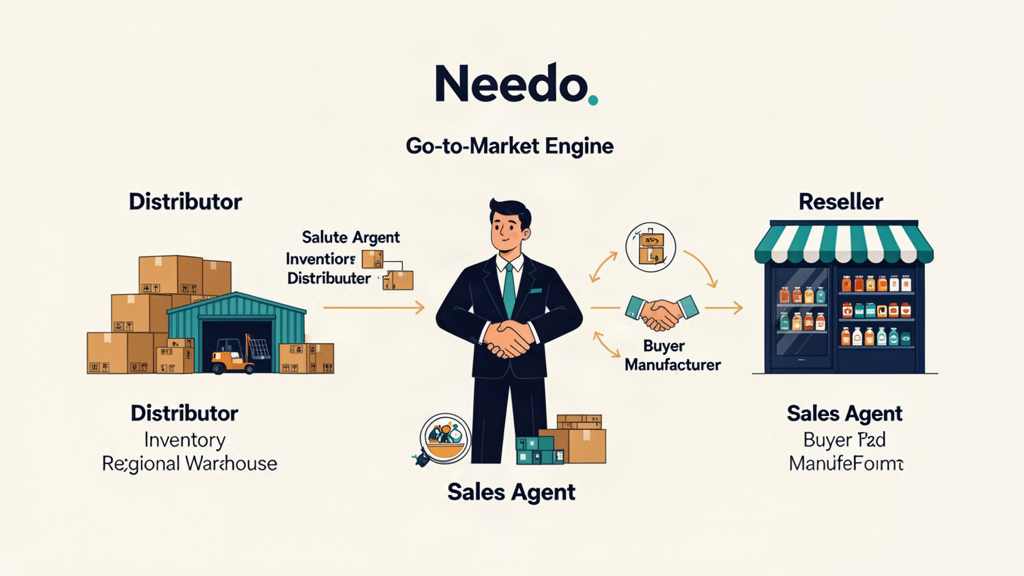
A distributor commonly purchases goods for resale and may hold inventory, build local coverage and support customers. That can improve reach and availability, but the exporter may give up some control over downstream pricing, customer data or positioning, depending on the agreement and market. A sales agent or representative commonly helps identify and develop opportunities for a commission or fee without buying the goods for its own resale account; the exact authority to negotiate or bind the exporter must be defined.
A reseller or dealer also buys and resells, but the commercial role can be narrower or more retail-focused than a full distributor's. A wholesaler may serve downstream resellers or retailers. Direct sales give the exporter more direct customer contact and control, but require the exporter to fund market development, sales operations and service. These labels are not universal legal definitions: verify the local rules and the proposed contract rather than relying on the title alone.
Model comparison
- Distributor: consider when local inventory, reach, import capability or after-sales coverage are valuable; evaluate margin, stock commitments and customer visibility.
- Sales agent or representative: consider when you want local prospecting and negotiation support while retaining the sale; define authority, commission and reporting.
- Reseller or dealer: consider when an intermediary can buy and resell to a defined customer segment; clarify territory, support and channel conflict.
- Wholesaler: consider when broad downstream distribution matters and your economics support another resale margin.
- Direct sales: consider when you can manage customer acquisition, fulfilment and service with sufficient local knowledge and resources.
Match the model to product economics and customer expectations
A stocked distributor may fit products that customers need quickly, require local service or sell through a fragmented network. A commissioned agent may fit complex equipment or business-to-business sales where a few technically capable people can reach named accounts and the exporter can handle production and fulfilment. Direct sales can be workable for concentrated accounts or digital delivery, but not if the service burden exceeds your resources. Treat these as hypotheses to test against the actual market, not rules that apply to every industry.
Build a simple economics model. Estimate gross margin after channel discounts or commissions, cost to serve, local stock or credit needs, returns and service, promotional support and the time required to reach the first order. Use your actual costs and clearly labelled scenarios. A partner that promises broad coverage but needs a discount that removes your contribution margin may be less viable than a narrower route with measurable demand.
Compare on one basis
- Expected net revenue after discount, commission and channel fees
- Inventory ownership, working capital and unsold-stock responsibility
- Who bears shipping, import, warranty and return costs
- Expected sales coverage and time to first qualified opportunity
- Customer data, lead ownership and reporting rights
- Service level, training and technical support required
- Minimum volume and evidence behind the forecast
Qualify the partner for the role you actually need
Do not score every candidate against a generic distributor checklist. For an agent, assess relevant account access, industry knowledge, conflicts, sales process, reporting and the ability to represent your offer accurately. For a stocking distributor, add warehouse and stock-control capability, import experience, financial capacity, service coverage and replenishment discipline. For a reseller, check customer segment fit, support expectations and whether the product can be sold profitably through its channel.
Ask for evidence proportionate to the commitment: legal entity details, relevant references, current product lines, territory coverage, customer types, service capability and a realistic plan. Separate a candidate's claims from what you have independently confirmed. The U.S. Department of Commerce's foreign-representative checklist is a useful starting point for assessing sales force, sales record, territory, product mix, facilities and customer profile, but adapt it to your own country, product and legal context.
Candidate evidence checklist
- Registered business identity and authorized decision-maker
- References or verifiable experience relevant to your product category
- Named territory and target customer profile
- Competing or complementary product lines and channel conflicts
- Financial, inventory or service capacity required for the proposed role
- Reporting cadence and measurable sales activity
- Local legal, licensing or registration requirements confirmed
Define the agreement before offering exclusivity
Specify territory, customer segments, product scope, sales targets, pricing and discount authority, order acceptance, marketing support, training, service levels, reporting, confidentiality, intellectual property, compliance responsibilities, payment and termination. State whether the partner can appoint sub-agents or make commitments on your behalf. Clarify who owns leads and customer records and how existing accounts or cross-territory inquiries are handled.
Avoid granting broad exclusivity based only on an optimistic forecast. If exclusivity is commercially justified, consider measurable milestones, a defined review period and a clear remedy if performance or compliance requirements are not met. Local agency and distribution laws can affect termination, commissions, competition restrictions and registration. Obtain local legal advice before signing, particularly where termination may be difficult or the partner asks for rights across several countries.
Agreement questions
- Is the partner buying and reselling, or acting on your behalf?
- Can it set resale prices or bind your business to a customer commitment?
- What are the territory, product, customer and channel boundaries?
- What minimum activity or sales performance is required and how is it measured?
- Who pays for marketing, training, stock, service and customer claims?
- How can either party end or renew the relationship, and what happens to open leads?
- Which local rules and legal reviews apply before signature?
Test the model before scaling the commitment
Where practical, begin with a limited product range, named accounts, a defined territory or a time-boxed pilot rather than an open-ended agreement. Agree the evidence that will show whether the model is working: qualified opportunities, buyer meetings, trial orders, repeat purchases, stock turns, service response or contribution margin. Pick measures that match the role; an agent's early success may be qualified pipeline, while a distributor's role may also involve inventory and fulfilment.
Review the evidence at an agreed interval and distinguish activity from outcomes. A list of contacts or a promise of market access is not the same as a qualified opportunity or a paid order. Adjust the support, territory or model when the data shows a mismatch, and keep all changes in writing.
Prepare a partner brief you can reuse
Give candidates the same core brief so their proposals can be compared fairly. Include product and target customer, territory, expected responsibilities, available sales support, service requirements, proposed commercial structure and the evidence you want returned. Do not disclose confidential pricing, customer lists or technical documents until the appropriate protections and sharing process are in place.
Copy-ready brief fields
- Product, specification and customer problem solved
- Target country, customer segment and sales channel
- Expected role: introductions, sales, importing, stocking, resale or service
- Required coverage, technical capability and after-sales support
- Proposed order, payment, stock and service responsibilities
- Commercial proposal: commission, margin, fees or other terms
- Evidence of experience, references and conflicts
- First 90-day activities, measures and review date
Use Needo to compare the model and candidate evidence
Needo can structure the choice between direct sales, agents, distributors and resellers, compare candidate proposals and prepare due-diligence questions. Provide your actual product economics, target market, service needs and constraints. The result should separate verified evidence from partner claims and identify which legal or commercial questions still need professional review before you sign.
Sources and further reading
- U.S. Department of Commerce — Sales Channels
Overview of direct and indirect export routes, including agents, representatives, distributors, intermediaries and e-commerce; adapt the framework to the target market.
- U.S. Department of Commerce — Choosing a Foreign Representative
Checklist for assessing a potential foreign representative or distributor, including sales force, territory, product mix, facilities and customer profile.
- U.S. Department of Commerce — Negotiating an Agreement with a Foreign Representative
Practical issues to address in a representative agreement; obtain advice on the law that applies to the specific country and contract.
Sources support the specific points noted above. Confirm current requirements for your product, destination and contract before committing.
Need the actual problem solved?
This guide explains the method. Needo can work from your specific requirement, compare relevant options, verify important details and help move the next step forward.
Start with your exact problem →Selling or exporting? See live buyer requirements by product · see a sample verified shortlist