NEEDО · EXPORT SALES & BUYER QUALIFICATION
How to Qualify an Export Buyer Enquiry Before Preparing a Quote
An inbound enquiry can look promising but still be too incomplete to price responsibly. Before a sales or engineering team spends hours on a detailed quote, it helps to decide whether the product fits, whether the requested quantity and delivery window are feasible, which facts are missing, and whether any issue needs a specialist review. This is not a test for whether a buyer is a good person or a bad person. It is a practical way to make the next commercial decision proportionate to the evidence and the cost of responding.
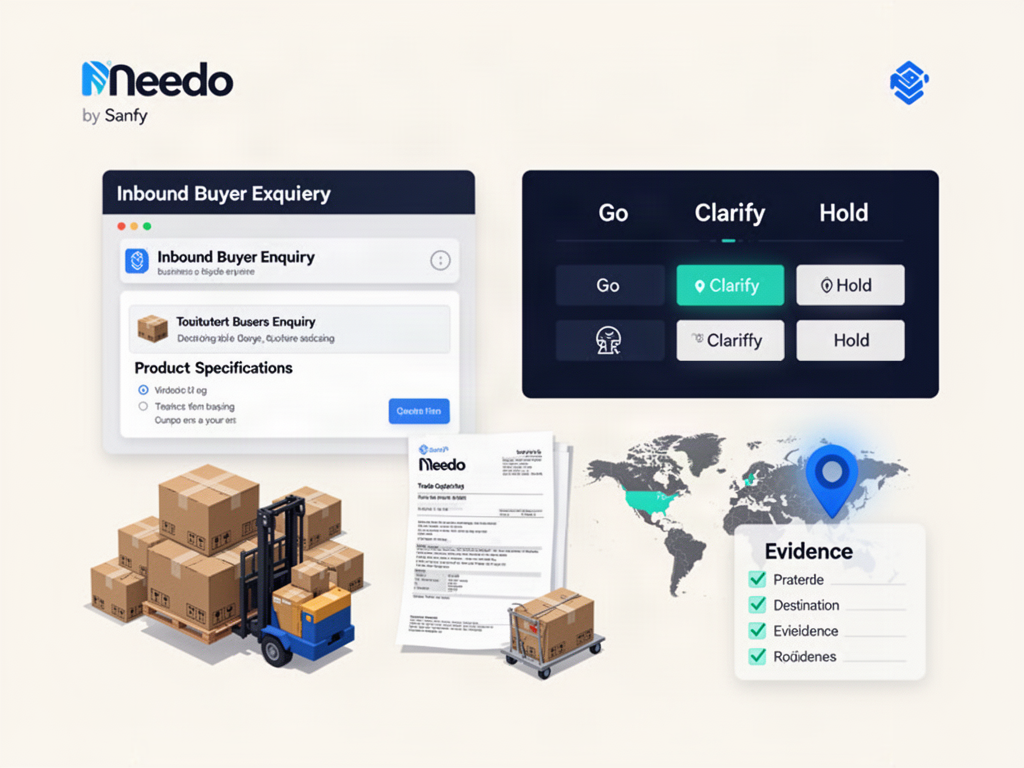
Turn the message into a decision brief
Keep the original enquiry and every attachment or revision. Extract the buyer's legal or trading name, contact role, product and specification, quantity, destination, requested delivery date, quote deadline, requested delivery basis, documents and payment expectations. Record what the buyer actually stated and what your team inferred; do not silently fill missing fields with typical values.
The brief should also state your own constraints: product variants you can supply, MOQ, capacity in the required period, certifications or export permissions that may apply, packaging options, realistic lead time and the commercial basis you can quote. A buyer enquiry becomes easier to qualify when both sides of the fit are visible.
Minimum intake fields
- Original enquiry, reference number and response deadline
- Product, grade, model, drawing or specification revision
- Quantity, variants, acceptable substitutions and MOQ
- Destination, delivery date and delivery basis
- Required documents, testing, packaging or service
- Payment request, currency and any requested credit terms
- Your capacity, product constraints and approval requirements
Test product and operational fit before researching every detail
Start with hard requirements. If the requested material, performance, size, certification or intended use is outside your capability, a polished company profile will not fix the mismatch. Separate must-have conditions from preferences, then compare the quantity, production window, packing, shipping route and delivery commitment against the facts your team can support.
A request may be viable only after a clarification—for example, if the buyer has not stated a tolerance, accepted alternative or required delivery point. Mark that as unknown rather than treating it as a failure. If the requested deadline depends on a supplier, carrier, laboratory or regulator, confirm the dependency before promising a date.
Feasibility checks
- Does the exact specification fit what you can supply?
- Can the requested quantity be produced or allocated in time?
- Are sample, tooling, inspection or documentation steps required?
- Can the destination and delivery basis be served realistically?
- Are required certificates, licences or approvals available and current?
- Which assumptions would materially change the price or deadline?
Separate buyer identity, authority and commercial intent
Use proportionate checks for the opportunity's value and risk. Compare the company name, domain, address, business activity and contact role against independent sources where available. Check whether the person appears authorized to issue the request or whether a procurement portal, purchase-order process or named department is required. A public profile or email domain can support a check, but neither proves that a specific order is approved or funded.
Distinguish three different questions: does the business exist, does this person have a credible role in the transaction, and does this particular enquiry contain a commercially plausible requirement? A real company can send an incomplete enquiry; a detailed enquiry can still contain unsupported claims. Keep the evidence for each question separate and record the date checked.
Evidence register
- Company identity and independent source
- Contact name, role and route to confirm authority
- Requirement evidence and how recently it was checked
- Known procurement process or official submission channel
- Unresolved questions and the decision each question affects
Treat unusual requests as questions to resolve, not automatic verdicts
Look for mismatches that matter to the product and transaction: a requested configuration that does not fit the stated use, a destination or end-use that is unclear where it needs to be known, an order far outside the buyer's described activity, a refusal to provide information required for the transaction, or pressure to bypass normal controls. One inconsistency is not, by itself, proof of fraud. Record it, ask a focused question and follow the applicable compliance process.
The U.S. Bureau of Industry and Security publishes Know Your Customer and Red Flags guidance under the U.S. Export Administration Regulations. That guidance is relevant to transactions within its scope; it is not a universal legal test for every country or product. Check the rules that actually apply to your exporter, item, destination, end-user and end-use, and involve a qualified compliance owner when a potential export-control or sanctions issue appears.
Pause and escalate when
- A material identity, end-use or destination inconsistency remains unexplained
- A required licence, screening or approval is uncertain
- Payment or beneficiary instructions conflict with the agreed counterparty
- The buyer asks you to omit or misstate material information
- A mandatory document or technical requirement cannot be met
Use a go, clarify, hold or no-bid decision
A short decision matrix keeps the team from confusing activity with progress. Use go when the requirement fits and the information needed to quote is sufficient. Use clarify when a small number of answers could make the enquiry actionable. Use hold when a mandatory check, specialist review or material dependency is unresolved. Use no-bid when a hard requirement cannot be met, the economics do not work under supported assumptions, or the remaining risk is outside the business's approved appetite.
Keep mandatory gates separate from weighted preferences. A high commercial score should not override a failed licence requirement, impossible delivery date or critical technical mismatch. If you use a score, define the criteria before scoring and mark missing evidence as unknown rather than assigning a reassuring number.
Example decision table
- Product and specification fit: pass / fail / unknown
- Quantity, capacity and deadline: feasible / constrained / unverified
- Identity and authority: evidence checked / clarification needed
- Compliance and documentation: pass / specialist review / blocker
- Commercial basis: enough information to price / missing inputs
- Decision: go / clarify / hold / no-bid, with owner and next action
Ask only the clarification questions that change the decision
Do not send a long questionnaire just because a field is blank. Prioritize questions that change eligibility, price, capacity, delivery or risk. If the destination, Incoterm, packaging or quantity tier changes the economics, ask before preparing a firm quote. If a field is not relevant to the product or transaction, record why it is not needed instead of making the buyer complete busywork.
A useful clarification note identifies the requirement reference, states what is missing without accusing the buyer, and asks for a specific answer by a reasonable date. Keep the draft in the approved sales workflow; this guide does not send a message or authorize outreach.
Copy-ready clarification outline
- We are reviewing your request for [product / reference].
- To confirm fit and prepare an accurate quote, please clarify [specific specification or quantity].
- Please confirm destination, required delivery date and delivery basis: [field].
- Please identify any mandatory document or acceptance requirement: [field].
- Our quotation will state the assumptions and exclusions that remain unresolved.
Worked example: a promising enquiry with missing delivery facts
Illustrative example: an overseas buyer asks for 4,000 units of a packaging component and requests a quote within two days. The exporter can make the item, but the enquiry omits the final destination, artwork revision, required test evidence and whether the buyer expects delivery to a port or warehouse. The correct first step is not to invent a freight allowance and promise a date. The team records the fit that is already supported and asks for the missing facts that materially change cost and timing.
If the buyer confirms a workable destination, revision and delivery window, the enquiry can move to pricing with assumptions documented. If the required test cannot be supplied, the team holds the request for technical review or declines it. The example is fictional and does not represent a real buyer or result; it demonstrates how to prevent unknowns from becoming accidental commitments.
Record the outcome
- Known: product family and requested quantity
- Unknown: destination, revision and test requirement
- Action: request the three missing facts
- Owner: sales lead with engineering review if needed
- Next state: clarify, then reassess quote readiness
Keep a decision trail and hand off only when ready
Save the original enquiry, evidence links, source dates, assumptions, clarification answers and final decision in the opportunity record. If the quote proceeds, hand the quote owner the exact version of the requirement, mandatory gates, cost inputs, delivery assumptions and open exclusions. If the enquiry is held or declined, record the blocker so another team member does not restart the same research without new evidence.
The goal is not to reject more enquiries or quote faster at any cost. It is to spend effort where the product fit, evidence and commercial conditions justify the next step, while keeping uncertainty visible. Needo can structure this review from the actual enquiry and your constraints; your authorized sales, finance, engineering and compliance owners retain the decision.
Sources and further reading
- U.S. Department of Commerce — Perform Due Diligence
Official U.S. export resource on evaluating prospective international business partners and transaction risk. Apply the checks proportionately and confirm requirements for your jurisdiction.
- U.S. Bureau of Industry and Security — Know Your Customer Guidance and Red Flags
U.S. Export Administration Regulations guidance describing circumstances that may require further inquiry about end-use, end-user or destination. It is specific to the U.S. export-control framework and is not a universal fraud test.
- UK Government — Crime and Fraud Prevention for Businesses in International Trade
Official UK guidance on checking trade partners and reducing international-trade fraud risk. Local legal and compliance obligations differ by country and product.
Sources support the specific points noted above. Confirm current requirements for your product, destination and contract before committing.
Need the actual problem solved?
This guide explains the method. Needo can work from your specific requirement, compare relevant options, verify important details and help move the next step forward.
Start with your exact problem →Selling or exporting? See live buyer requirements by product · see a sample verified shortlist