NEEDО · TENDER QUALIFICATION & B2B SALES
How to Qualify a Public Tender Before You Bid: A Go/No-Go Checklist
A public tender can look attractive because the contract value is large, but the headline amount says little about whether your business is eligible, can meet the specification, can deliver on time or can price the work profitably. A disciplined bid/no-bid review checks mandatory requirements first, then estimates the real cost and effort of submitting a compliant offer. The steps below are a general planning framework; the actual solicitation, amendments, portal instructions and rules of the buyer's jurisdiction take precedence.
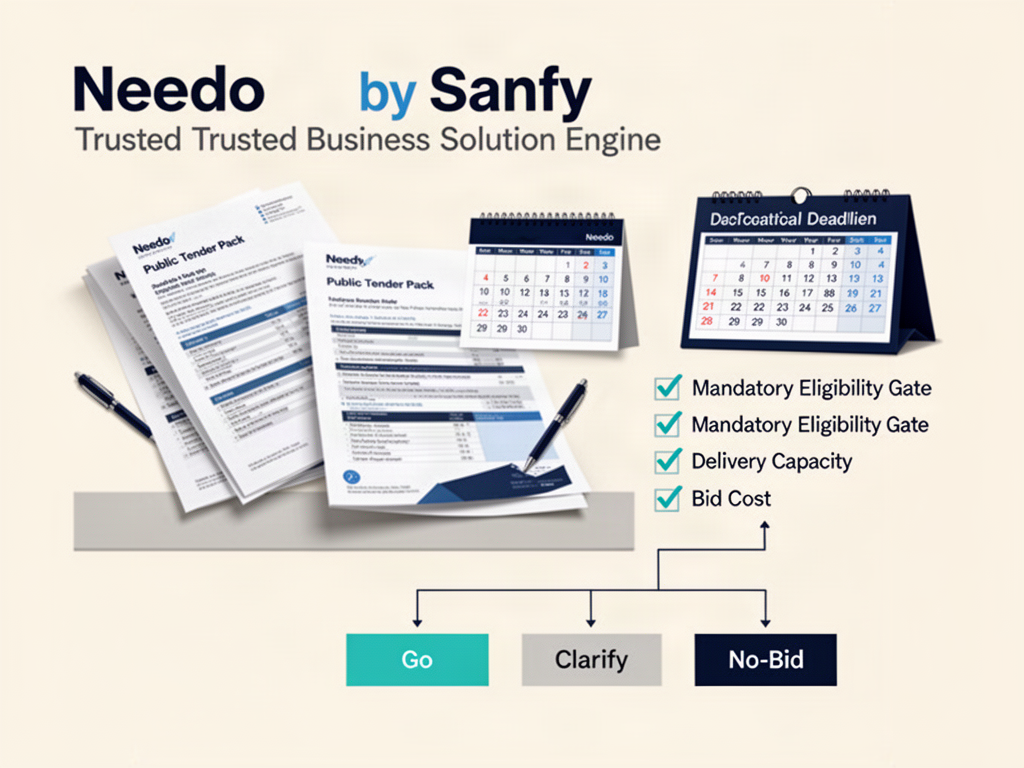
Start from the authoritative notice and the complete tender pack
Record the tender reference, buyer, publication date, question deadline, submission deadline, time zone, submission portal and the person responsible for the bid. Download the complete documents and preserve the version or date of every file. Look for later amendments, clarification notices, revised forms and updated submission instructions before deciding that the pack is complete.
A summary page or third-party listing is a discovery aid, not a substitute for the current solicitation. Some opportunities require suppliers to register in a portal, acknowledge amendments, use prescribed forms or submit separate technical and commercial files. Build the review around the official source and the latest documents available to your team.
Document-control checklist
- Official notice and tender reference saved
- Full specification, schedules, forms and contract terms obtained
- Latest amendments and clarifications checked
- Question and submission deadlines recorded with time zone
- Portal, file format, signature and upload requirements confirmed
Check mandatory eligibility before scoring the opportunity
Identify requirements that can disqualify a bid: legal entity or registration status, geography, mandatory licences, certifications, insurance, minimum experience, financial thresholds, required declarations, exclusions or bid security. Mark each as pass, fail or unknown and attach the evidence. Do not assume that a requirement is optional because it appears in an appendix or a portal checklist rather than the headline notice.
The exact eligibility conditions differ by country, buyer, contract type and procedure. For example, U.S. federal opportunities may require an active SAM.gov entity registration; that is not a universal rule for tenders elsewhere. Confirm the requirement stated in the actual notice and the current official portal guidance. If eligibility or a legal term is unclear, assign it to the responsible specialist rather than guessing.
Mandatory gate table
- Entity, registration and location requirements
- Required licences, standards, insurance or certifications
- Minimum experience, references or financial evidence
- Declarations, exclusions, bid security or bonds where specified
- Subcontractor, consortium or local-partner rules if applicable
- Every unknown has an owner and a resolution deadline
Match the scope to capability and delivery reality
Map each material requirement to evidence your business can actually provide: specification compliance, quantities, service levels, delivery locations, implementation steps, support, maintenance, documentation and acceptance tests. Separate exact compliance from proposed alternatives. If the tender does not permit alternatives or deviations, do not assume an equivalent product or method will be accepted.
Check capacity over the requested period, not only the theoretical maximum. Account for current orders, supplier dependencies, tooling, staff, subcontractors, testing, mobilisation and shipping. If a delivery date depends on a third party, obtain a credible lead-time basis before promising it. A bid that meets the paperwork but cannot be delivered may create a larger commercial problem than a timely no-bid decision.
Capability questions
- Can we meet every mandatory technical requirement as written?
- Which claims need test reports, references, certificates or samples?
- Can the quantity and delivery schedule be supported by current capacity?
- Which dependencies, subcontractors or approvals could delay delivery?
- What is excluded, ambiguous or dependent on buyer clarification?
Read the evaluation method and submission rules line by line
Find the published award criteria and understand how technical quality, price, service, experience or other factors are assessed. Do not substitute a guessed weighting for the one in the solicitation. Build a compliance matrix that maps every question and requirement to the response, supporting evidence, owner and final file. Check page limits, word counts, mandatory attachments, naming rules, signatures, file sizes, portal fields and the required submission sequence.
Use the permitted clarification channel and follow the tender's rules. In some procedures, questions and answers or amendments are shared with all bidders; in others, communication is tightly controlled. Record each answer and check whether it changes the bid requirements. The UK Government's supplier guidance and tendering guidance illustrate why specific questions, complete responses and documented communication matter, but your own tender's procedure is the controlling source.
Submission readiness
- Every criterion has a named response owner
- Claims are supported by relevant evidence rather than generic marketing language
- Required forms and declarations use the current versions
- Price and technical files follow the required separation and format
- Amendments are acknowledged where required
- A final reviewer can reproduce the compliance check before submission
Calculate the full cost of bidding and delivering
A bid can consume engineering, sales, legal, finance, estimating and operations time before any contract is awarded. Estimate the cost of document review, samples, demonstrations, site visits, partner quotes, certifications, bid security or bonding, professional review and portal preparation where applicable. Then model the delivery economics: materials, labour, subcontractors, freight, installation, warranty, service, currency exposure, financing, taxes and the costs of contractual risks that your team can reasonably estimate.
Use your actual costs and the contract terms. Do not assume the published contract value is revenue you will win, or that an expected future order volume is guaranteed. Separate known costs from estimates and test a low, base and high scenario for material uncertainties. If the margin only works under an unsupported assumption, make that a blocker rather than hiding it in the total.
Bid-cost worksheet
- Internal preparation hours by function and realistic loaded cost
- External quotes, samples, testing, travel and documentation costs
- Bid security, bond, insurance or financing costs if specified
- Delivery cost, subcontractor quotes and capacity assumptions
- Currency, tax, warranty, service and contractual exposure
- Expected margin under explicit scenarios, not a made-up win probability
Use mandatory gates plus a transparent go/no-go score
First apply pass/fail gates for eligibility, technical compliance, capacity, deadline and any required legal or safety condition. Only if those gates are satisfied should a weighted score help compare softer factors such as strategic fit, evidence strength, expected margin, workload, delivery risk and future capability. A high average must never conceal a failed mandatory requirement.
If a weighted model is useful, define its criteria before discussing the final result. Illustrative weights might give the largest share to ability to comply and deliver, with separate factors for commercial viability, evidence strength and opportunity fit. These weights are a management choice, not an industry benchmark. Show the score, the evidence and the unresolved questions together; do not present the score as a probability of winning.
Decision labels
- Bid: gates pass, evidence is available and economics are approved
- Clarify: one or more material questions may change feasibility or price
- Hold: a required approval, registration, quote or capacity confirmation is unresolved
- No-bid: a hard gate fails or the supported economics do not justify the effort
Worked example: strong product fit but a registration blocker
Illustrative example: a supplier finds a public tender for equipment that matches its product line. The deadline appears achievable and the estimated margin is positive, but the solicitation requires a registration and a current certificate that the company has not yet confirmed. The supplier should not let the attractive contract value outweigh those gates. It records the exact clauses, asks the authorized internal owner to confirm status, and checks whether the tender rules permit the missing item to be completed before the deadline.
If the requirement cannot be met in time or the solicitation makes it mandatory at submission, the decision is no-bid. If the official rules allow a timely clarification and the evidence can be obtained, the status may remain hold or clarify until that is confirmed. This is a fictional example, not a real tender or prediction of success. It demonstrates why the gate decision comes before the weighted score.
Example record
- Fit: product appears to match the stated scope
- Blocker: registration / certificate status not confirmed
- Evidence needed: current official record and applicable clause
- Owner and deadline: assigned before any bid drafting begins
- Decision: hold until the mandatory gate is resolved
Ask clarifications through the permitted route and control the deadline
Ask only questions that affect scope, eligibility, compliance, pricing or delivery. Quote the relevant clause, state the ambiguity neutrally and ask for the interpretation or information needed. Avoid informal side conversations if the procedure requires communication through the tender portal or named contact. Save the response and check whether it becomes a formal amendment or otherwise changes the submission requirements.
Create a reverse schedule from the deadline: technical inputs, supplier quotations, cost review, legal or compliance checks, draft response, independent review, final sign-off and upload buffer. Assign one owner to confirm the final portal receipt or submission status. A draft saved on a computer is not a submitted bid, and a portal upload should not be described as complete until the required confirmation is recorded.
Final bid-control checklist
- All clarification answers and amendments reviewed
- Every mandatory requirement has evidence and an owner
- Price is reconciled with the final scope and assumptions
- Authorized commercial and legal approvals recorded
- Correct files uploaded through the required route
- Submission receipt or status captured before the deadline
Use Needo to organize the tender decision
Needo can turn the notice, specification, evaluation criteria and your capability information into a requirement matrix, list missing evidence, compare the requested scope with your constraints and prepare a bid-cost worksheet using figures you provide. It can also draft clarification questions and a submission checklist so the bid owner can focus on the issues that could change the decision.
The tender documents and current amendments remain authoritative. Needo does not guarantee eligibility, estimate a real probability of winning, certify compliance or submit the bid on its own. Keep the final decision with the authorized bid, finance, technical, legal and compliance owners, and record whether the opportunity was bid, held or declined and why.
Sources and further reading
- UK Government — How to Bid for Government Contracts as an SME Effectively
Official UK supplier guidance on responding to tender questions, covering specifications, eligibility, evidence and planning. Use it as a practical reference, not as a universal rule for other buyers or countries.
- UK Government Commercial Agency — eSourcing Tool: Guidance for Suppliers
Supplier guidance for finding, registering for and responding to tenders in the relevant UK eSourcing system; the page records an update on 9 September 2026. Portal steps differ by buyer and platform.
- SAM.gov — Entity Registration
Official U.S. federal guidance on entity registration for organizations that want to bid directly on federal contracts. This is specific to the U.S. federal process and should not be applied to unrelated tenders.
Sources support the specific points noted above. Confirm current requirements for your product, destination and contract before committing.
Need the actual problem solved?
This guide explains the method. Needo can work from your specific requirement, compare relevant options, verify important details and help move the next step forward.
Start with your exact problem →Selling or exporting? See live buyer requirements by product · see a sample verified shortlist