NEEDО · SUPPLIER QUALITY
How to Review a Supplier 8D Report Before Closing a Corrective Action
A supplier can return a completed 8D form without proving that the defect has been contained, that the stated cause is correct or that the corrective action will prevent recurrence. The buyer's job is not to grade the formatting. It is to decide whether the evidence is strong enough to protect the next production run, shipment or customer. This guide is for procurement, supplier-quality and manufacturing teams reviewing a supplier's completed 8D response. It separates the evidence to inspect at each stage, shows common reasons to keep a case open and gives a worked example. Use the customer-specific quality agreement and your own escalation rules where they set stricter requirements.
Decide what the 8D must prove
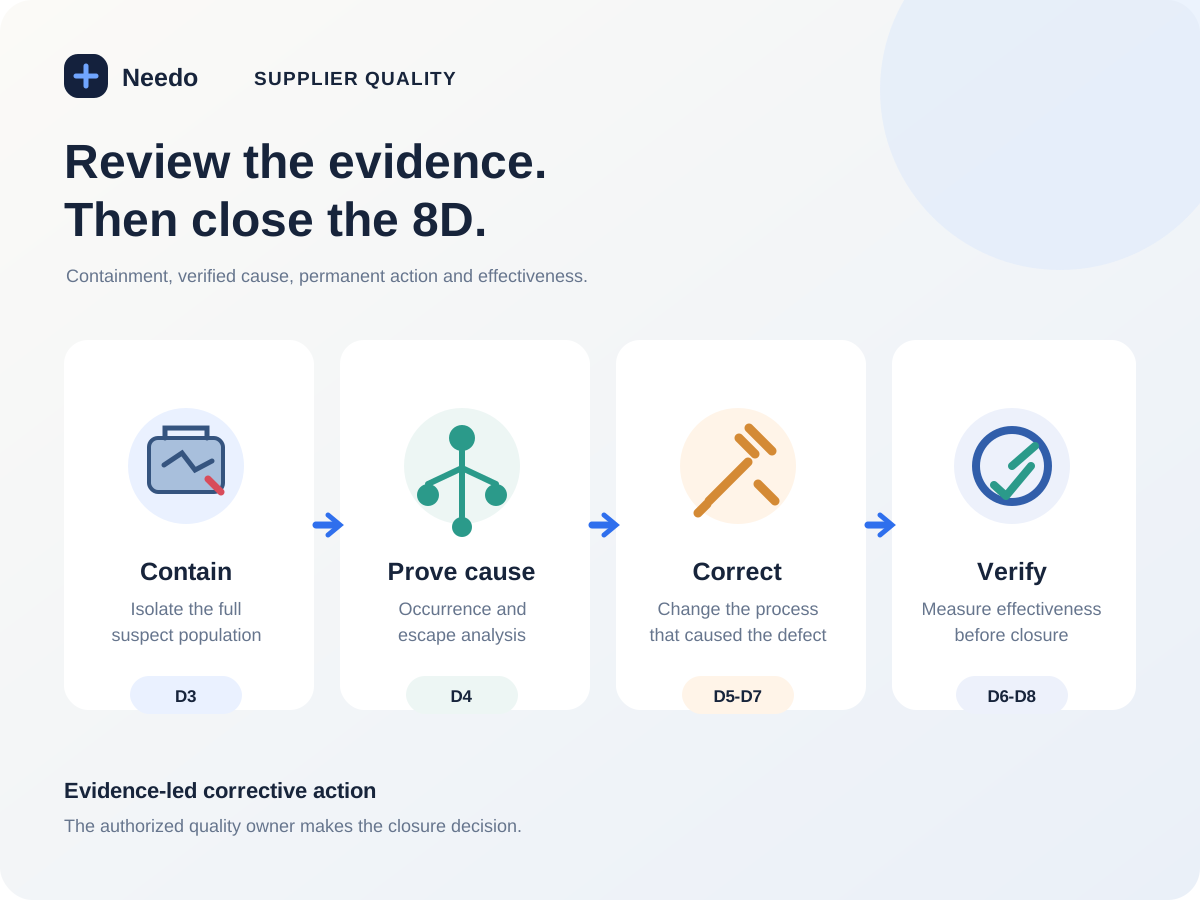
An 8D is a structured problem-solving response, not a promise that the problem has been solved. The review should establish four things: the affected output is controlled, the cause is supported by evidence, the permanent action changes the condition that produced or allowed the defect, and follow-up evidence shows that the change works. If any of those links is missing, a polished form can still leave the buyer exposed.
Different customers and suppliers use different forms. Some frameworks include a D0 planning or immediate-containment step; others begin with D1. Do not reject a response merely because the numbering differs. Compare the substance, the applicable customer-specific requirements and the supplier quality agreement. For a minor isolated issue, your procedure may permit a simpler corrective-action record; use a formal 8D when the risk, recurrence, customer requirement or complexity warrants it.
The review question at each stage
- Problem definition: can both parties identify the same defect, requirement, product and affected period?
- Containment: can the supplier show what was isolated, checked, corrected or stopped and where the clean point begins?
- Cause: is the occurrence cause supported, and has the escape or detection failure been examined?
- Correction: does the selected action address the verified cause rather than only the visible symptom?
- Effectiveness: is there objective follow-up evidence against agreed acceptance criteria?
- Prevention: have similar products, lines, sites and control documents been considered?
Check D2: the problem statement must be measurable
A useful problem statement identifies the requirement and the observed result. It should state the part or service, specification and revision, lot or serial range, process or site, date and point of detection, defect mode, quantity inspected, quantity affected and the evidence used. A statement such as "dimension out of spec" is not enough if it omits the drawing characteristic, tolerance, measurement method or affected population.
Compare the supplier's statement with your own incoming inspection, production records, customer complaint and purchase-order requirements. Differences in defect terminology can hide different interpretations. Ask the supplier to reconcile the counts and time window rather than accepting a number that cannot be traced to records.
Problem-definition evidence
- Part number, description, revision, supplier site and process are consistent.
- The contractual or technical requirement is identified, including the correct revision.
- Measured results include units, method, sample context and actual values where relevant.
- Affected and inspected quantities have a traceable source.
- The date range, detection point and customer impact are clear.
- Unknowns and assumptions are explicitly marked for investigation.
Check D3: containment covers the whole suspect population
Containment is temporary protection while the investigation continues. Look for the population definition: supplier stock, work in progress, finished goods, goods in transit, customer stock and any sub-tier material that could be affected. The supplier should identify how each location was searched, how suspect product was segregated and how it is prevented from being shipped or used accidentally.
A clean point is not simply the date a new inspection started. It should connect the corrective control to identifiable production, inspection or shipment records. Check who performed the sort, the acceptance rule, equipment or gauge used, quantities checked, rejected quantities, disposition approvals and traceability of released material. If the supplier says all stock is clean, ask for the records that support that statement.
Containment questions
- What exact lots, serials, dates, machines and locations are suspect?
- Has the supplier checked its own stock, work in progress, finished goods and sub-tier material?
- Were shipments stopped or controlled, and were affected customers notified where required?
- What inspection or rework method was used, by whom and with what acceptance criteria?
- How are quarantined items physically and electronically controlled?
- What record identifies the first verified clean lot or shipment?
Check D4: separate occurrence cause from escape cause
The occurrence cause explains why the defect was created. The escape cause explains why the existing process failed to detect or prevent it before the next process or customer. These are related but different questions. A report that says only "operator error" or "insufficient training" usually needs more investigation: what process condition allowed the error, why the control did not prevent it and what evidence demonstrates the proposed cause?
A fishbone diagram or 5 Whys chain can organize hypotheses, but the tool is not proof. Ask what data, controlled trial, process observation, measurement or record supports the conclusion and what plausible alternatives were tested or ruled out. The Special Processes Institute guidebook stresses a verified causal chain and evidence rather than a quick symptom fix; ASQ also describes D4 as identifying why the problem occurred and why it went unnoticed.
Evidence that strengthens a cause claim
- The cause is linked to the specific defect mechanism and the affected process conditions.
- The analysis explains both occurrence and detection or escape.
- The supplier shows the records or tests that confirm the cause, not just a brainstorming list.
- Alternative explanations were considered and rejected with reasons.
- Human factors are considered as part of the system where relevant, not used as a convenient endpoint.
- The causal chain explains why the proposed action should prevent recurrence.
Check D5 and D6: actions must address the cause and prove effectiveness
D5 should show why the selected permanent action is expected to remove the verified cause. D6 should show that the action was implemented as planned and that it works under the conditions that matter. Do not treat an action plan, a revised procedure or a training attendance sheet as proof of effectiveness by itself.
For each action, record the cause addressed, owner, due date, implementation evidence, affected site or product, validation method and result. The verification plan should define the measure, data source, sample or observation period, acceptance threshold and who reviews the result. Choose the window and sample based on defect severity, process volume, recurrence pattern and customer requirements; there is no universal number of lots that proves every process is stable.
Action-to-evidence check
- Each permanent action maps to a verified occurrence or escape cause.
- The action changes a process, control, design or system condition rather than only reminding people to be careful.
- Implementation is supported by dated records, approved revisions or observed process evidence.
- Validation covers the relevant machine, shift, material, site and operating range.
- Effectiveness criteria were defined before results were reviewed.
- The monitoring period is sufficient for the risk and opportunity for recurrence.
Check D7: prevent the same failure elsewhere
A local fix may not protect other products or locations that share the same process, tool, material, software, supplier or control method. D7 should show how the team searched for similar exposure and decided whether the corrective action should be deployed elsewhere. The answer may be that no other process is affected, but the report should explain how that conclusion was reached.
Where the evidence requires it, check whether the supplier updated the process risk analysis, PFMEA, control plan, inspection plan, work instruction, maintenance schedule, training content, supplier flow-down or change-control record. A document revision is only useful if the revised control is implemented and used at the relevant workstations.
Systemic-prevention evidence
- Similar parts, lines, tools, sites and sub-tier processes were considered.
- The supplier documented where the action was deployed or why it was not applicable.
- Affected risk and control documents were updated where required.
- Owners and effective dates are visible.
- The buyer's customer-specific requirements and approval rules were considered.
Check D8 and closure: do not close on promises
Formal closure should follow the required review of implementation and effectiveness evidence. Some 8D formats use D8 to recognize the team and close the activity; the buyer's own process may also require a signed closure record, customer acceptance or a separate approval. The key is that closure follows the evidence gate, not merely the supplier's submission date.
Keep the case open or move it to a controlled clarification state if containment is incomplete, the causal analysis is unverified, the action does not address the cause, the effectiveness window has not elapsed or similar processes remain unassessed. If an interim control must stay in place, name its owner, review date and exit criteria. Record any accepted residual risk through the authorized process.
Reasons to hold the report open
- The affected population or clean point cannot be reconciled.
- The report gives a symptom or person as the root cause without process evidence.
- The escape cause is missing or not tested.
- The permanent action is incomplete or does not map to the cause.
- Effectiveness is asserted but not measured against defined criteria.
- Required systemic updates or customer approvals are missing.
Worked example: a machined feature is repeatedly out of tolerance
Illustrative example: incoming inspection finds a machined diameter outside the drawing tolerance on several lots. The supplier initially proposes retraining the operator and adding a final inspection. That may improve detection temporarily, but it does not yet explain why the diameter drifted or why the existing control failed to detect it.
A stronger investigation compares measurements by machine, tool age, shift and time since setup. The evidence points to tool wear as the occurrence mechanism and an inspection frequency that did not detect the drift early enough as the escape cause. The permanent action could include a validated tool-life control and a revised in-process measurement plan. The supplier then shows implementation records and capability or trend evidence over a risk-appropriate period, updates the relevant control documents and checks other machines using the same tool or program. The buyer closes only after the agreed evidence is reviewed. This example is illustrative; the actual cause and acceptance criteria must come from the process and product evidence.
Use Needo to review the report without replacing the quality owner
Needo can compare the supplier's 8D response with your nonconformance record, purchase order, drawing or specification, inspection results and customer-specific requirements. It can organize the evidence by discipline, distinguish stated claims from demonstrated facts, identify missing occurrence or escape analysis, map actions to causes and draft focused clarification questions.
Start with the actual documents and ask for a section-by-section review with a proceed, clarify or hold recommendation. The authorized supplier-quality or engineering owner must confirm technical conclusions, approve risk acceptance and close the case. Needo does not certify product, independently perform the supplier's root-cause investigation or approve a corrective action on your behalf.
Sources and further reading
- ASQ — Eight Disciplines (8D)
ASQ explains the D1-D8 sequence, including quantifiable problem definition, containment, verified occurrence and escape causes, corrective action and prevention.
- Special Processes Institute — 8D RCCA Problem Solving Guidebook, Rev 4 (24 December 2025)
A current open-use guidebook covering the causal chain, containment, root-cause verification, corrective-action effectiveness, lessons learned and formal closure.
- AIAG — CQI-20 Effective Problem Solving Guide, 2nd edition
AIAG describes its structured problem-solving guide for better problem statements, team participation, analysis, review and sustainable improvements. The full manual is a paid publication.
- ASQ — Problem Solving Resources
ASQ's general problem-solving guidance emphasizes evidence-based problem definition, root-cause diagnosis, implementation and sustaining results.
Sources support the specific points noted above. Confirm current requirements for your product, destination and contract before committing.
Need the actual problem solved?
This guide explains the method. Needo can work from your specific requirement, compare relevant options, verify important details and help move the next step forward.
Start with your exact problem →Selling or exporting? See live buyer requirements by product · see a sample verified shortlist