NEEDО · SUPPLIER QUALITY & INCOMING INSPECTION
How to Verify a Supplier's Certificate of Analysis Before Accepting a Batch
A supplier Certificate of Analysis can look complete and still be the wrong evidence for the material or finished goods you are about to receive. It may refer to a different lot, use a test method outside the laboratory's accredited scope, report results against the supplier's internal limits rather than your purchase specification, or describe a sample that cannot be traced to the shipment. The useful question is not simply whether a CoA exists. It is whether the report identifies the exact batch, contains results relevant to your acceptance criteria and can be relied on for the decision you are making. This guide is a procurement review workflow, not a laboratory test, product certification or regulatory determination.
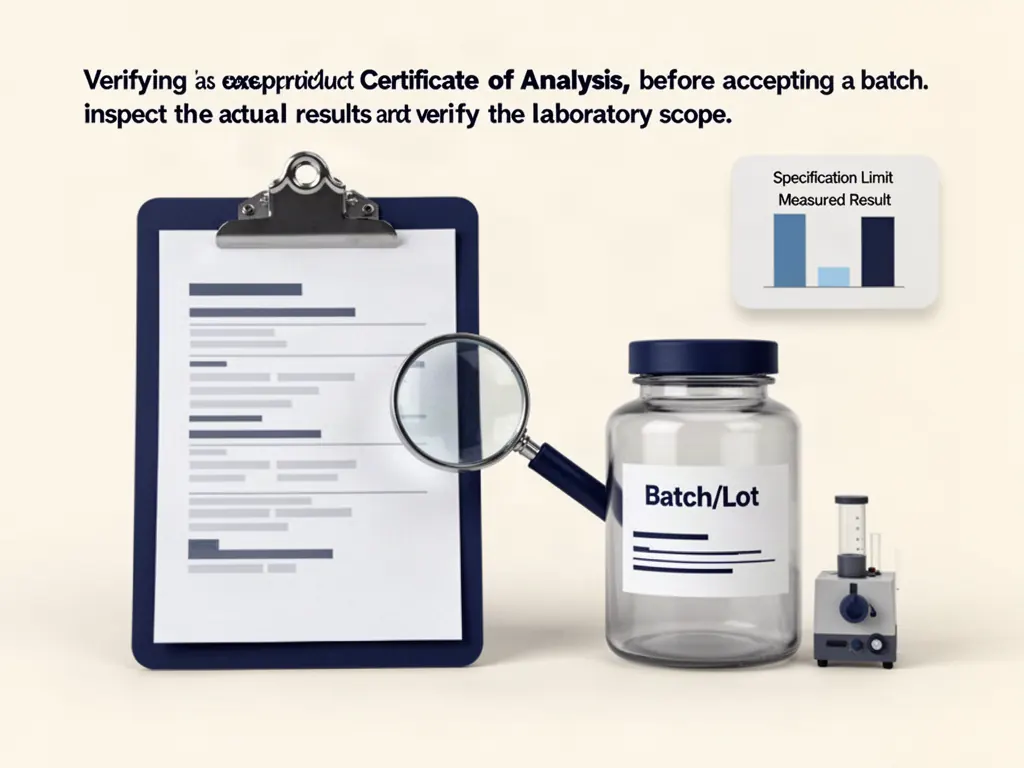
Know what the CoA is—and what it is not
A Certificate of Analysis is a document that reports analytical or test results for an identified product, material or sample. Its format and required fields depend on the product, supplier, contract, test program and jurisdiction. Some suppliers issue a batch-specific CoA from their own quality-control laboratory; others attach an external laboratory report or combine both. Do not assume that every industry uses one universal CoA format.
Keep the CoA separate from related documents. A product specification states the requirements or target limits. A laboratory test report describes the testing performed and the results. A certificate of conformity may state that a product or batch conforms to a defined requirement. A safety data sheet describes hazards and safe handling for applicable substances. These documents can support one another, but they answer different questions. A supplier's pass statement is not a substitute for comparing the actual result with the specification you approved.
Identify the document you actually need
- CoA: results associated with a named product, sample or batch.
- Test report: the testing activity, methods, results and information needed to interpret them.
- Product specification: the buyer's or contract's measurable requirements and revision.
- Certificate of conformity: a statement against a specified requirement or scheme; check its issuer and scope.
- Safety data sheet: hazard, handling, storage and emergency information where applicable.
Match the report to the exact product and physical batch
Start with identity, not the test values. Compare the supplier's legal name and manufacturing site with the approved vendor record, purchase order, delivery note, container or carton labels and product specification. A group company, distributor, exporter or contract laboratory may legitimately appear on a document, but the relationship should be clear. Record who manufactured the material, who sampled it, who tested it and who issued the report.
The batch or lot identifier is especially important. A report for the right product family but a different lot does not establish the quality of the goods you received. Check product name, grade, SKU, formulation or material designation, batch or lot number, sample ID, manufacturing date where relevant, sampling date, test date, report date and quantity. If the supplier combines multiple lots, ask for the lot-level mapping and the sampling basis rather than assuming one result represents every lot.
Identity fields to reconcile
- Supplier legal entity, manufacturing site and any approved subcontractor.
- Product name, grade, SKU, formulation, revision or material designation.
- Batch or lot number on the CoA matches the physical label and shipment records.
- Sample ID and sampling date connect to the batch being received.
- Purchase order, delivery note and quantity identify the same transaction.
- Report number, issue date, revision and any superseded document are recorded.
Compare actual results with your own acceptance criteria
Read the test table line by line. For each parameter, identify the test method, specification limit, actual measured result, unit and any qualification such as not detected, below quantification limit or estimated value. Compare the result with the current buyer-approved specification and contract, not only the supplier's internal pass/fail column. A supplier can legitimately use a wider internal release limit than the limit your process or customer requires.
Check that the units and basis match. A moisture result expressed as a percentage on a wet basis is not automatically comparable with a dry-basis limit. A concentration reported in milligrams per kilogram cannot be compared with a limit in milligrams per litre without the relevant density or conversion assumptions. If a method has a detection or quantification limit, make sure it is suitable for the threshold you need to assess. Do not convert a missing or below-limit result into zero.
Where the report states measurement uncertainty, rounding or a decision rule, preserve it in the review. If the result is close to a limit, your contract or quality procedure should determine whether uncertainty, retesting or a guard band is relevant. Needo can show the arithmetic and identify a comparison gap, but the responsible quality owner must apply the approved acceptance rule.
Result-by-result review
- Parameter name and test method match the approved specification.
- Result, unit and reporting basis are clear and comparable.
- The correct minimum, maximum, range or qualitative criterion is used.
- Detection and quantification limits are suitable for the required threshold.
- Measurement uncertainty, rounding and decision rules are not hidden.
- Every failed, borderline, omitted or not-tested parameter is visible.
Check the laboratory and the scope of accreditation
ISO/IEC 17025 sets requirements for the competence, impartiality and consistent operation of testing and calibration laboratories. Accreditation is granted for a defined scope, not as a blanket guarantee that every service a laboratory offers is accredited. Read the laboratory's name, address, accreditation body, accreditation number and current scope. Confirm that the scope covers the relevant test method, material or sample matrix, measurement range and location where the work was performed.
The International Laboratory Accreditation Cooperation (ILAC) provides a search for accreditation bodies that are signatories to the ILAC Mutual Recognition Arrangement. Those accreditation bodies maintain or link to directories of accredited laboratories and their scopes. Use the relevant national accreditation body's official directory and contact route. A laboratory's general claim that it is ISO/IEC 17025 accredited does not prove that the specific test on your CoA was within scope.
Accreditation can strengthen confidence in a laboratory's technical competence for the activities covered by its scope. It does not prove that the sample came from your shipment, that the report has not been altered, that every result is correct for your contract, or that the goods are suitable for every intended use. Those are separate evidence questions.
Laboratory scope checklist
- Laboratory legal name and physical testing location are identified.
- Accreditation status is checked through the relevant accreditation body.
- The current scope includes the actual method and material or matrix.
- The test range and any exclusions cover the reported result.
- Subcontracted tests are identified and assessed separately.
- A missing public database record is treated as unresolved, not automatic proof of invalidity.
Establish who sampled and tested the material
A test result is only as representative as the sample and sampling process behind it. Ask who selected the sample, where and when it was taken, how it was sealed or identified, how it was transported and whether the sample was taken from the actual batch offered for delivery. For bulk, blended or multi-container materials, the sampling plan can materially affect what the result represents. A sample selected by the supplier may be appropriate for routine release, but a high-risk or disputed transaction may require a buyer-approved or independent sampling arrangement.
Distinguish in-house quality-control results from independent laboratory results. Neither is automatically unacceptable; the required evidence depends on your contract, product risk and regulatory obligations. If an external lab performed the test, reconcile the laboratory report number and sample ID with the supplier's CoA. If only selected parameters were tested externally, identify which results remain supplier-reported.
Questions about sample representativeness
- Was the sample drawn from the exact lot or production batch being shipped?
- Who collected it, and what sampling plan or procedure was used?
- Was the sample sealed, labelled and traceable through transport to the laboratory?
- Were multiple locations, containers or sub-lots combined, and how?
- Does the sample condition or date affect the test's relevance?
- Is independent sampling or retesting proportionate to the transaction risk?
Check report status, subcontracting and amendments
Look for a clear final or preliminary status. A preliminary report may contain only selected results or may be issued before all tests are complete. Do not treat it as a final release document unless your approved process explicitly permits that use and the incomplete work is identified. Check that the report has an authorized issue or approval status and that the version supplied is the latest one.
Testing may be subcontracted. The report should identify subcontracted results where the applicable reporting requirements call for it. Ask which laboratory performed each material test and check the relevant scope. If a report has been corrected or amended, retain the supplement or replacement report and its reference to the original. A changed result without a traceable amendment history should be clarified before it is relied on.
NATA's explanation of test reports is a useful example of these controls: it distinguishes preliminary reporting, subcontracted results and formal amendments. Its rules apply to NATA-accredited organisations and should not be assumed to be identical to every accreditation body's requirements, but the document illustrates why report status and revision history matter.
Document-control checks
- Final, preliminary or draft status is explicit.
- Every subcontracted test and performing laboratory is identified.
- Report number, revision and issue date are consistent.
- An amended report references the original and explains the change where required.
- The authorized issuer or signatory is identifiable.
- The report received is the current version approved for the batch decision.
Make an accept, clarify, hold or retest decision
A useful CoA review ends with a documented decision, not a vague statement that the certificate looks fine. Use accept only when the document is traceable to the correct product and batch, the required tests are present, the results meet the approved acceptance criteria and any required laboratory or regulatory evidence is in place. Use clarify when a field, method, unit, sample identity or scope question can reasonably be resolved. Use hold when the batch cannot be linked to the report, a required parameter is missing, a result falls outside the agreed limit or the evidence is materially inconsistent.
Retesting should follow the contract and quality procedure. Decide who selects the new sample, which laboratory or method is acceptable, whether the original result remains part of the record and what happens to the goods while the result is pending. Do not repeatedly test until a passing result appears without an approved investigation and sampling rationale. A retest does not erase the original evidence.
Decision labels
- ACCEPT: batch identity and required evidence match, with results within approved limits.
- CLARIFY: a material field or method needs a documented answer before release.
- HOLD: batch identity, a required result, scope or acceptance criterion is unresolved or failed.
- RETEST: an approved investigation requires a new representative sample and defined method.
- ESCALATE: a regulated, safety-critical or contractual question needs the designated quality or compliance owner.
Worked example: the supplier's pass is not the buyer's pass
Illustrative example only: a buyer receives a shipment of a food ingredient. The CoA identifies the correct supplier and product, and the batch number matches the drum labels. The supplier's report shows moisture at 8.2 percent and marks the result as passed because its internal release limit is 9.0 percent. The buyer's approved purchase specification sets a maximum of 7.5 percent.
The document is genuine-looking and the supplier may have applied its own quality procedure correctly, but the batch does not meet the buyer's stated acceptance limit. The reviewer records the actual value, unit, method, supplier limit and buyer limit, then places the batch on hold under the buyer's procedure. The supplier is asked to confirm the specification revision and sampling details. Any retest is agreed in writing with a defined sample and method. The example does not establish any universal food limit; the actual contract and product requirements govern.
What the reviewer records
- Correct product and batch identity: matched.
- Supplier internal limit: 9.0 percent maximum.
- Buyer acceptance limit: 7.5 percent maximum.
- Reported result: 8.2 percent; above the buyer's limit.
- Decision: hold and clarify under the approved quality process.
- Next evidence: specification revision, sampling record and agreed retest if authorized.
Copy-ready CoA verification checklist
Use this checklist with the purchase order, product specification, physical labels and any external laboratory report. Add the reviewer, source and date checked beside each material result. Mark items not applicable with a reason rather than leaving them blank.
- Approved product specification and revision identified.
- Supplier legal entity and manufacturing site reconciled.
- Product, grade, SKU or formulation match the purchase order.
- Batch or lot number matches the physical shipment labels.
- Sample ID, sampling date, test date and report date are traceable.
- Every required test parameter is present.
- Methods, units, limits, results and detection limits are comparable.
- Measurement uncertainty or decision rule is considered where relevant.
- Laboratory identity, accreditation body and scope checked where required.
- Subcontracted tests and their laboratories identified.
- Preliminary, final or amended report status confirmed.
- Results compared with the buyer's criteria, not only supplier pass/fail.
- Accept, clarify, hold, retest or escalate decision recorded with an owner.
Use Needo to review the CoA against the batch and purchase specification
Needo can organize the supplier CoA, purchase order, current specification, batch label and laboratory report into a field-by-field review. Ask it to extract the actual test values and units, compare them with your limits, identify missing parameters, reconcile the batch and sample identifiers, research the laboratory's published accreditation scope and prepare the questions that remain unresolved. It should show the source and date for each external check and keep supplier claims separate from independently supported facts.
The responsible quality or compliance owner must decide whether the evidence is sufficient for release and apply the organization's approved acceptance procedure. Needo does not perform a laboratory test, authenticate a report solely from a logo or QR code, certify a product, issue a CoA or authorize goods release. The value is a clearer evidence file and a faster route to the right technical question.
Sources and further reading
- ISO — ISO/IEC 17025:2017, General Requirements for the Competence of Testing and Calibration Laboratories
Official standard page describing the competence, impartiality and consistent operation requirements for testing and calibration laboratories; the page says the 2017 edition was reviewed and confirmed in 2023.
- ILAC — Accredited Conformity Assessment Bodies
Explains the ILAC MRA signatory system, laboratory accreditation scopes and why a report should be checked against the relevant laboratory activity and scope.
- ILAC — Signatory Search
Directory for finding the relevant accreditation body by economy and accreditation activity, with links to national directories where available.
- NATA — Test Reports Explained
Explains report content, scope-limited use of accreditation endorsements, preliminary reports, subcontracted testing and amendments for NATA-accredited organisations.
Sources support the specific points noted above. Confirm current requirements for your product, destination and contract before committing.
Need the actual problem solved?
This guide explains the method. Needo can work from your specific requirement, compare relevant options, verify important details and help move the next step forward.
Start with your exact problem →Selling or exporting? See live buyer requirements by product · see a sample verified shortlist