NEEDО · PROCUREMENT OPERATIONS
Three-Way Match: How to Reconcile a Supplier Invoice, PO and Goods Receipt
A supplier invoice can be arithmetically correct and still request payment for the wrong item, price or quantity. A three-way match compares three records: the approved purchase order (PO), the goods-received note or receiving record (GRN), and the supplier invoice. The goal is to check that the organization ordered the goods, received or accepted the quantity being billed, and is being invoiced on the agreed commercial basis. This guide shows how to build a line-level comparison, handle partial deliveries and document exceptions without inventing universal tolerance rules. Your contract, accounting policy and local tax requirements remain authoritative.
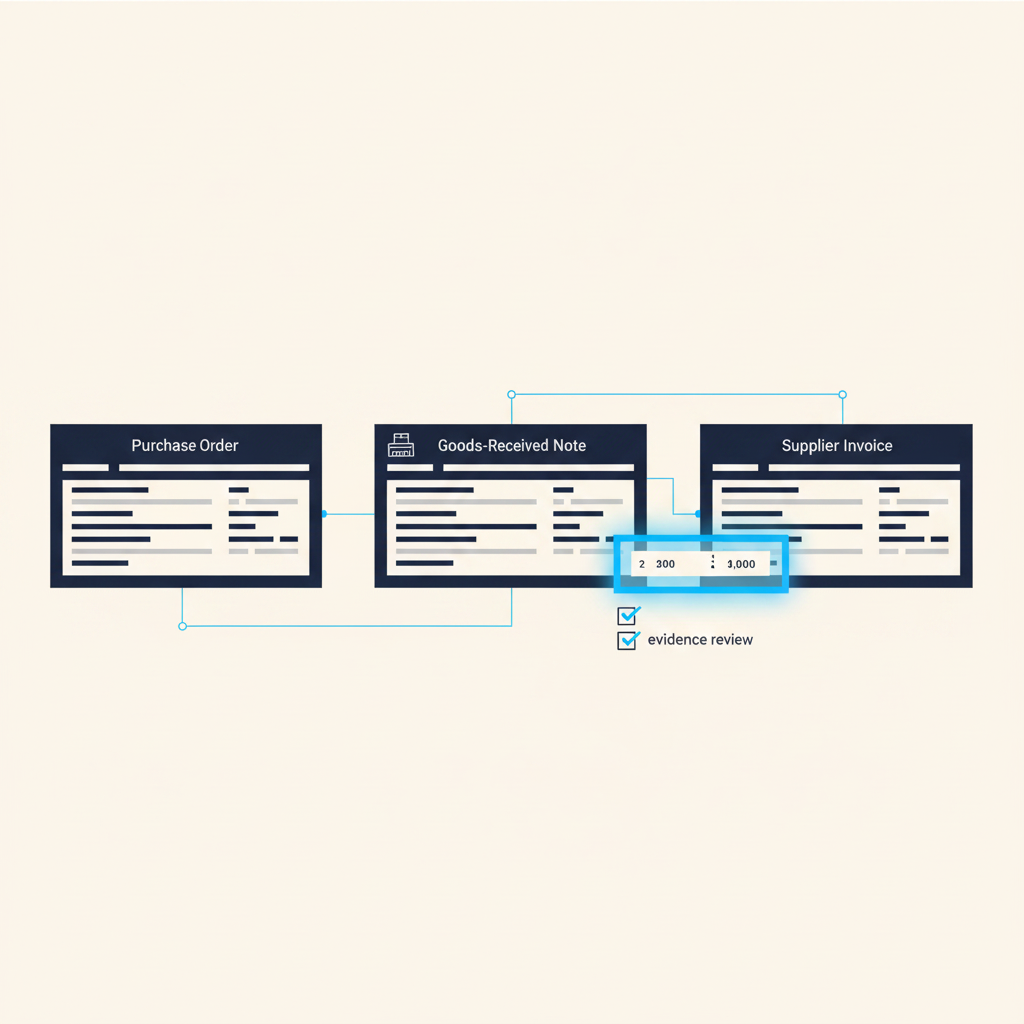
Understand what each of the three documents proves
The purchase order records what an authorized buyer agreed to order: supplier, item, specification, quantity, unit, price, delivery location, schedule and relevant terms. The goods-received note or receiving report records what the receiving team says arrived and, depending on the process, what was accepted, rejected or held for inspection. The supplier invoice requests payment for a stated quantity and amount under the supplier's invoice terms.
A two-way match compares the PO with the invoice. A three-way match adds the receiving record so accounts payable can check whether the quantity billed is supported by the receipt evidence. HM Revenue & Customs' Procure-to-pay guidance describes a typical process in which a GRN is raised when goods arrive and sent to accounts payable, and notes that an invoice may be matched to the PO and, in a three-way process, the GRN. That is UK VAT-control guidance, not a universal accounting rule for every jurisdiction or purchase type.
The three records at a glance
- PO: what was authorized and on what commercial terms
- GRN / receiving report: what was recorded as delivered, inspected or accepted
- Invoice: what the supplier is asking the buyer to pay
- Contract or amendment: what may explain an approved change to the original PO
Normalize the fields before comparing line items
Start with the supplier legal entity, supplier-master ID, PO number and revision, invoice number, invoice date and currency. Then match each line using the item or SKU, description, specification revision, unit of measure, ordered quantity, received quantity, accepted quantity, invoiced quantity, unit price and extended amount. Compare freight, insurance, packaging, taxes, discounts and other charges separately so they are not hidden inside a unit-price difference.
Units matter. A PO for 100 cartons is not automatically comparable with an invoice for 100 pieces. Check conversion factors, pack sizes, decimal precision and whether the supplier has quoted per kilogram, per thousand, per case or per item. If a line has been split across deliveries, compare cumulative receipts and cumulative invoicing rather than treating one GRN as the complete order.
Build a consistent comparison table
- PO line / item / specification revision
- Ordered quantity and unit of measure
- Quantity received, accepted, rejected and still open
- Invoice quantity, unit price, currency and line total
- Approved amendments, credits, taxes and additional charges
- Source document, revision, date and reviewer
Resolve a quantity mismatch without guessing
Illustrative example: a PO authorizes 100 units at $10 each. The receiving record shows 96 accepted units and four units still outstanding. The supplier invoice bills 100 units for $1,000. The arithmetic on the invoice is correct, but the receipt evidence currently supports only 96 accepted units. Record the four-unit difference and check whether the contract permits advance, milestone or staged billing. If it does not, ask the supplier for a corrected invoice, a credit note or the missing delivery evidence before the invoice is treated as fully matched.
Do not change the GRN to 100 merely to make the invoice match. The receiving record should reflect what actually arrived and the result of the required inspection. If a partial delivery is expected, keep the PO open for the remaining quantity and match each receipt to its own delivery record. The correct exception treatment depends on the contract, receiving policy and approved system workflow.
Quantity questions to ask
- Was the shipment partial, split across packages or delivered to more than one site?
- Does the delivery note identify the same PO line and item revision?
- Were any units rejected, damaged, quarantined or sent back?
- Is the invoice billing delivered quantity, accepted quantity or a contractual milestone?
- Is there an approved amendment or credit note that explains the difference?
Check price, currency and extra charges separately
A second illustrative example: the PO lists 100 units at $10, while the invoice lists 100 units at $10.25. The $25 line difference may be an error, an approved amendment, a price escalation clause, a currency or rounding issue, or a charge that belongs on a separate line. Do not assume which explanation applies. Compare the accepted quote, PO revision, contract, supplier acknowledgement and any signed change before accepting the higher amount.
Check whether freight, insurance, tooling, packaging, customs or handling charges were included in the agreed price or separately authorized. Verify that the currency, exchange-rate basis, tax code, tax rate and delivery basis match the applicable documents and local rules. HMRC's guidance also notes that credit notes and adjustments should be recorded accurately against the related transaction. A credit note is not simply a negative invoice to be ignored; it must be linked to the original invoice and processed under the applicable accounting and tax rules.
Common price exceptions
- Unit price differs from the approved PO or quote
- Currency or unit-of-measure conversion is inconsistent
- Freight or handling appears twice or was not authorized
- Discount, rebate or credit note is missing
- Tax treatment or tax calculation needs jurisdiction-specific review
- An amended price has no traceable approval
Handle partial receipts, repeat invoices and credit notes
A single PO can be fulfilled through multiple deliveries. Maintain a cumulative view of ordered, received, accepted, rejected, invoiced, credited and remaining quantities for each line. Link each GRN to the shipment or delivery note it represents. Before matching a new invoice, check whether a previous invoice already billed the same delivery or whether a credit note has already reduced the balance.
Search for exact and near-duplicate invoices using supplier identity, invoice number, date, amount, currency, PO reference and line details. A repeated invoice number may be a duplicate, a corrected document or a legitimate recurring charge; inspect the original and the supplier's explanation before deciding. HMRC's procurement controls state that an invoice should be recorded only once and that changes to GRN records after invoice receipt should be blocked or tracked. Keep a clear audit trail rather than editing the source documents to force a match.
Cumulative receipt and invoice ledger
- PO quantity: total quantity authorized
- Receipts: each delivery and GRN reference
- Accepted / rejected: quantity status after required checks
- Invoices: each invoice and line quantity already billed
- Credits: supplier credit notes, returns and approved adjustments
- Open balance: remaining quantity or value, with the calculation shown
Do not confuse receipt with full quality acceptance
A receiving record may confirm that cartons arrived and that an initial count was completed. It does not necessarily prove that every unit meets every technical requirement, that concealed damage is absent, or that a separate inspection or test has passed. The U.S. Postal Service receiving guidance, for example, tells receiving personnel to compare goods with delivery documents and contract requirements, inspect quantity and visible condition, note discrepancies and hold damaged goods for further action. That is a USPS process example; your own contract and receiving procedure define the actual acceptance steps.
For services, there may be no physical GRN. Use the contract, statement of work, milestone acceptance, timesheet, service-entry sheet or other authorized evidence that the service was delivered. Do not invent a goods receipt for a service simply to satisfy a software workflow. Keep commercial matching, physical receipt and technical acceptance distinct where the process requires them.
Apply only approved tolerance and exception rules
A tolerance is a control defined by the organization, contract or configured system. It may be expressed as an amount, percentage, quantity or combination, and may differ by category, risk or approval level. Do not assume that a small price difference or one missing unit is automatically acceptable. If a variance falls inside an approved tolerance, record the rule and the required approval; if it exceeds the rule or the rule is unknown, route the item for review.
Oracle NetSuite's three-way-match workflow is one software example: it compares vendor bills with purchase orders and item receipts, flags quantity and amount differences and applies configured tolerances. Its documentation also describes product-specific limitations, including a limitation for partially received item receipts. That is a reminder to understand your own ERP configuration; it is not a universal rule that every three-way-match system handles partial receipts the same way.
A useful exception status
- Matched: the required fields agree within the approved policy
- Pending receipt: invoice quantity exceeds the recorded receipt and the contract does not yet support payment
- Price exception: invoice price or charge differs from approved terms
- Quality hold: receipt exists but required inspection or acceptance is incomplete
- Document gap: PO, GRN, invoice or amendment is missing or inconsistent
- Escalated: an authorized owner must decide under contract and policy
Create a decision record that another reviewer can reproduce
For every exception, record the exact line, source document, revision, value expected, value observed, variance, formula and evidence needed to resolve it. Name the person responsible for contacting the supplier, the internal approver and the due date. If the supplier sends a corrected invoice or credit note, preserve the earlier version and link the correction to it. If the PO is amended, retain the approval and effective date rather than replacing the original history.
The final disposition should say whether the invoice is matched, partially matched, held, disputed, corrected or escalated under the organization's process. It should not say approved for payment unless the authorized person and system actually approve it. Keep payment release separate from document analysis and do not allow a high overall match score to hide a failed mandatory requirement.
Copy-ready exception note
- Supplier / supplier ID: [legal entity and internal ID]
- PO / revision and invoice: [references]
- Line and item: [SKU, description and revision]
- Ordered / received / accepted / invoiced: [quantities and units]
- PO price / invoice price / variance: [currency and calculation]
- Evidence reviewed and missing: [document names and dates]
- Contract or tolerance rule applied: [policy reference]
- Next action / owner / due date / payment status: [record]
Use Needo to assemble the reconciliation
Needo can compare a PO, supplier invoice, receiving report, delivery note and approved amendment; extract line-level fields; calculate differences using the figures supplied; identify duplicate or missing evidence; and prepare questions for the supplier and accounts-payable owner. Ask it to keep ordered, received, accepted, invoiced and credited quantities separate, show the units and arithmetic, and apply only the tolerance policy you provide.
Needo does not post invoices, edit ERP records, create or alter GRNs, determine tax treatment, approve exceptions or release payment. Use the comparison as a review aid and leave the final accounting, contractual and payment decision with the authorized people in your organization.
Sources and further reading
- HM Revenue & Customs — Procure to Pay (Part 4)
Updated 27 July 2026; explains purchase-order controls, goods-received notes, two- and three-way invoice matching, duplicate-invoice controls, credit notes and supplier-payment controls in the UK VAT-compliance context.
- U.S. Postal Service — Receiving Process
Official receiving-process example covering checks against supplier delivery documents and contract requirements, quantity and condition inspection, discrepancy recording and holding damaged goods.
- Oracle NetSuite — 3 Way Match Vendor Bill Approval Workflow
Software-specific example of comparing vendor bills with purchase orders and item receipts, using configured quantity and amount tolerances and routing exceptions; the documented workflow has a partial-receipt limitation.
Sources support the specific points noted above. Confirm current requirements for your product, destination and contract before committing.
Need the actual problem solved?
This guide explains the method. Needo can work from your specific requirement, compare relevant options, verify important details and help move the next step forward.
Start with your exact problem →Selling or exporting? See live buyer requirements by product · see a sample verified shortlist