NEEDО · EXPORT MARKET RESEARCH
How to Choose an Export Market for Your Product: A Practical Scorecard
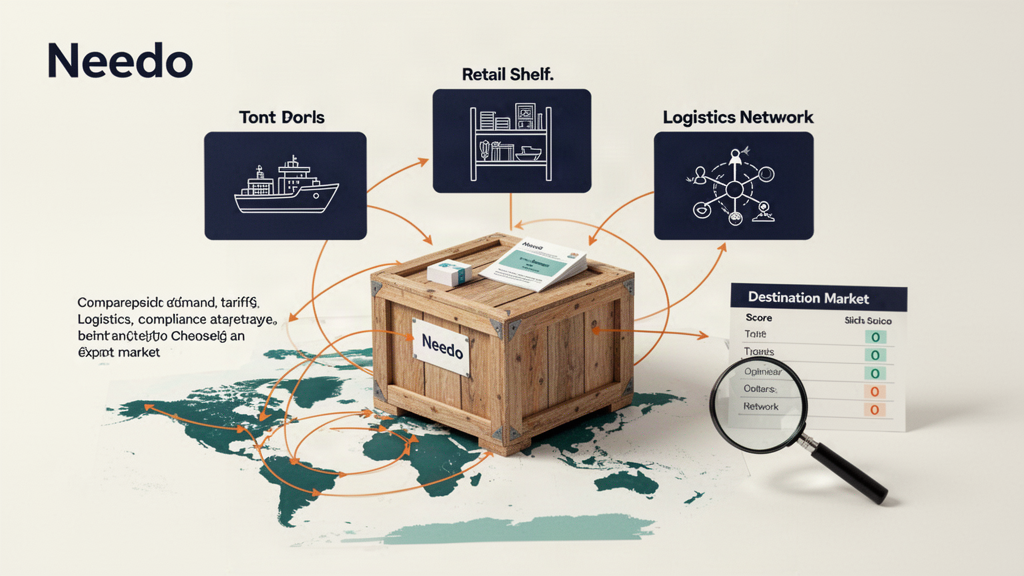
The largest importing country is not automatically the best first market for your product. A destination can show substantial trade activity and still be a poor fit if your product faces difficult requirements, expensive delivery, entrenched competitors, weak channel access or payment risks that your business cannot absorb. Market selection is a prioritization exercise: compare a small number of plausible destinations with the same criteria, identify deal-breakers early, then validate buyer demand before committing major resources. This guide gives you a transparent scorecard and a research sequence; it does not rank countries without product-specific evidence.
Define the product and the decision before comparing countries
Start with the actual item, not a broad industry label. Record the product's function, materials, model or grade, intended use, relevant technical details, typical order quantity, price range, production capacity and any known certification or labelling constraints. Where a customs classification matters, document the evidence behind the likely code and mark uncertain classifications for confirmation; an incorrect code can distort both trade comparisons and market-access checks.
Next, define what makes a market worth pursuing for your business. A large manufacturer with an established export team may accept a different lead time, compliance cost and order size from a small first-time exporter. Decide whether the immediate goal is a pilot order, repeat wholesale demand, a distributor relationship or long-term diversification. Those goals affect how much weight you give to market size, logistics, channel access, working capital and the time needed to qualify buyers.
Inputs to gather first
- Product description, specification and likely HS code with confidence level
- Country of origin and current export markets
- Target buyer type and intended application
- Minimum viable order size and production capacity
- Target price and the delivery basis you can support
- Required certifications, testing or product adaptations already known
Build a shortlist with trade data, not a country popularity list
Use official trade statistics to see which destinations report imports in the relevant product category, from which partner countries and over what period. The UN Comtrade database provides product- and partner-level trade statistics where reporting data is available. The International Trade Centre's Trade Map and related Market Analysis Tools can help examine trade patterns and potential markets. Check the classification, years, reporting coverage, units and whether the data are provisional or revised before comparing numbers.
Start with three to five candidate markets rather than scoring every country in the world. Look for a useful combination of meaningful imports, a plausible trend, relevant buyer segments and an export route your business can serve. Do not interpret a rise in aggregate imports as proof that a specific importer wants your product or that your business can win a share. Trade statistics are a screening signal; buyer-level evidence and commercial fit must be validated separately.
Trade-data questions
- Are you comparing the same product classification and level of detail?
- Which years and partner countries are available for each destination?
- Is import value increasing, flat or volatile, and what do quantity data show?
- Could re-exports, price changes or classification changes explain the pattern?
- What do the data not tell you about individual buyers, quality or price acceptance?
Check tariffs and market-access barriers early
Before investing in a market, check the tariff and non-tariff conditions that apply to your product, origin and destination. The International Trade Centre's Market Access Map provides tools for examining applied tariffs, preferences, trade remedies and other market-access information. A trade agreement or a low headline tariff is not enough by itself: confirm the applicable product code, origin rules, evidence needed to claim a preference and any additional measures that could change the economics.
Product requirements can be a deal-breaker even when import demand looks attractive. Depending on the item, the research may need to cover permits, safety or technical standards, testing, labelling, language, packaging, restricted ingredients or sector-specific approval. Requirements differ by product and jurisdiction, so use official regulator or customs sources and ask a qualified broker or adviser to resolve material uncertainty. Treat a possible prohibition, unachievable certification or unworkable compliance cost as a veto, not merely a low score that high demand can cancel out.
Market-access checks
- Tariff rate and the valuation basis used by the destination authority
- Rules of origin and evidence needed for any preference
- Product-specific permits, standards, testing and labelling
- Trade remedies, quotas or restrictions that may apply
- Lead time and cost to obtain required approvals
- Official source, date checked and unresolved questions
Compare the economics of serving each market
A market is commercially relevant only if the offer can reach the customer at a workable total cost and service level. Estimate the product cost, export packing, inland movement, origin handling, international freight, insurance, destination charges, duty and tax where applicable, distributor or channel margin, after-sales support and financing needs. Keep the seller's quoted price separate from the buyer's landed cost, and use the same delivery basis and quantity when comparing countries.
Use current provider quotations for material logistics assumptions and record their date, route, shipment size and validity. If you only have indicative rates, label the result as a scenario and test how the ranking changes when freight, currency or order quantity moves. A destination with slightly lower demand may be more practical if it is easier to serve, while a large market may be unsuitable if the minimum order, compliance burden or delivery economics exceed your capabilities. Do not treat an estimate as a final commercial offer.
Economics to compare
- Estimated landed cost at the buyer's destination
- Transit time, reliability and shipment-size constraints
- Channel margin, local stock or service expectations
- Working-capital and payment-cycle requirements
- Cost of samples, market adaptation, translation and compliance
- Sensitivity to exchange rate, freight and quantity changes
Assess competition and your actual route to buyers
Look beyond national import totals to understand how your product reaches customers. Identify relevant competing origins, local manufacturers, distributors, marketplaces or procurement channels, and compare offers on specification, delivery, quality evidence, service and price basis. A lower-cost competitor may not be directly comparable if it supplies a different grade or delivery scope. Likewise, a premium offer needs a defensible reason for a buyer to choose it.
Then look for evidence that you can reach the right type of buyer. Public RFQs, tender notices, trade-fair exhibitor and visitor networks where permitted, credible distributor enquiries and direct conversations can reveal more specific demand than a broad company directory. Respect platform rules and privacy expectations when researching or contacting prospects. A directory entry, website, trade-data record or social post does not prove that a company is currently buying; record the signal, date and next permitted verification step.
Buyer-access questions
- Which buyer types actually use this product and at what quantity?
- Is there a visible current requirement, RFQ or credible channel introduction?
- Can your business serve the language, service and response expectations?
- What evidence supports a distributor or agent's claimed access?
- What low-cost test would confirm interest before a large commitment?
Use a weighted scorecard, with explicit vetoes
A simple scorecard makes the assumptions visible. Score each candidate market from 1 (poor) to 5 (strong) on agreed criteria, multiply by the weights and total the results. The weights below are an illustrative starting point, not an official formula or a validated prediction. Adjust them to your product, risk tolerance and business model, and retain the raw evidence behind every score so the ranking can be challenged and updated.
Example weights: demand and trade evidence 25%; market access and compliance 20%; landed-cost and logistics fit 15%; reachable buyer/channel evidence 15%; competition and differentiation 10%; payment and working-capital risk 10%; internal capacity and strategic fit 5%. Before using the total, apply vetoes for a legal restriction, an unachievable mandatory approval, a clearly uneconomic price or an operational constraint you cannot resolve. A market with a fatal barrier should not win because it scores well on unrelated dimensions.
Scorecard columns
- Market and product classification used
- Criterion, weight, score and short rationale
- Source URL, date, data coverage and confidence
- Deal-breakers and missing evidence
- Estimated cost to validate and next action
- Owner and review date for each open item
Validate the top market before scaling
A scorecard narrows the work; it does not finish it. Pick the strongest one or two markets and define a small validation test: confirm the key compliance questions, request current freight assumptions, speak with a few plausible buyers or channel partners, and test whether the specification, quantity, delivery time and price range are acceptable. Use a product sample, limited pilot or narrowly defined offer when appropriate, with clear terms and no unsupported claims about performance or availability.
Set a decision rule before you run the test. For example, require evidence of buyer fit, a workable landed-cost range, a feasible compliance path and a named next step before expanding the effort. Keep negative responses and reasons as evidence; do not reinterpret silence as demand. If the test reveals a blocker, update the scorecard or move to the next market rather than continuing because the initial ranking looked promising.
Pilot decision
- What must be confirmed before any commercial commitment?
- Which buyer or channel signal would justify a second step?
- What is the maximum time and money at risk in the test?
- What result would make you pause or reject the market?
- Which assumptions will be refreshed after the test?
Turn market research into an actionable export brief
The useful output is a decision record, not a list of countries. Keep the shortlisted markets, source links, score rationale, cost assumptions, compliance questions, buyer evidence, key risks and next steps together. Mark what is verified, what is an estimate and what remains a question. That makes it easier to revisit the decision when trade data, freight prices, rules or buyer feedback change.
Needo can help assemble a product-specific market comparison, research official trade and market-access sources, structure an adjustable scorecard and prepare the questions to resolve before you invest. Provide the product, origin, capacity, target buyer and constraints you actually have. Ask it to show the evidence and uncertainty rather than returning a confident country ranking without the underlying data. Confirm legal, customs and financial decisions with the appropriate professional when the stakes warrant it.
Sources and further reading
- United Nations — UN Comtrade Database
Official product- and partner-level trade statistics. Data availability varies by reporting country and period; inspect classification, units and release status before comparing markets.
- International Trade Centre — Market Analysis Tools
Official overview of Trade Map, Market Access Map, Export Potential Map and related trade and market intelligence tools.
- International Trade Centre — Market Access Map
Tool for researching and comparing applied tariffs, trade remedies, regulatory requirements and preferential market-access conditions by product and market.
- U.S. Department of Commerce — Market Diversification Tool
A U.S.-oriented tool for comparing potential export markets; useful as a methodology example, but not a universal market ranking for exporters in every country.
Sources support the specific points noted above. Confirm current requirements for your product, destination and contract before committing.
Need the actual problem solved?
This guide explains the method. Needo can work from your specific requirement, compare relevant options, verify important details and help move the next step forward.
Start with your exact problem →Selling or exporting? See live buyer requirements by product · see a sample verified shortlist