NEEDО · EXPORT LOGISTICS & COMMERCIAL TERMS
How to Choose the Right Incoterm for an Export Quote
Choosing an Incoterm is not a matter of picking the three letters a buyer requested. The rule must fit the transport mode, the point where the seller actually hands over the goods, the party arranging carriage, each side's customs capability and the insurance arrangement. A term that looks familiar can still create a mismatch between the quote, booking, transport document and purchase order. This guide uses the Incoterms® 2020 framework. It is a practical selection method, not the full rule text or legal advice. Confirm the final rule, named place and contract wording with the buyer, freight provider and qualified trade adviser before accepting a material order.
Start with the transport mode, not the acronym
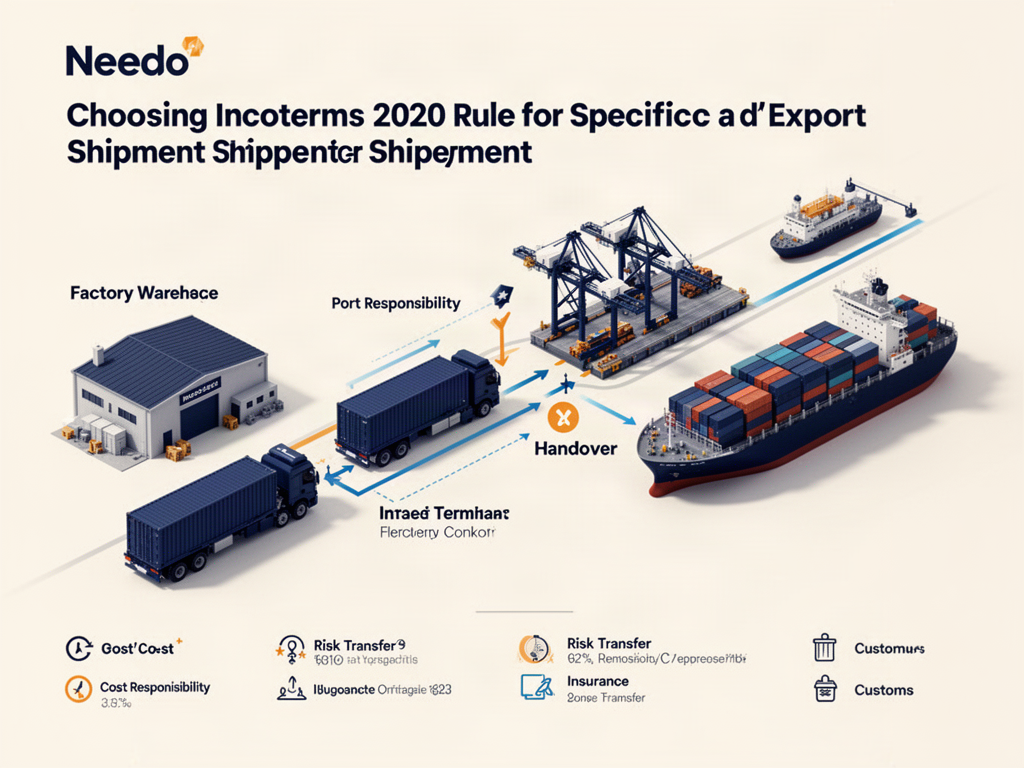
Incoterms® 2020 contains 11 rules. Seven can be used with any mode or combination of modes: EXW, FCA, CPT, CIP, DAP, DPU and DDP. Four are for sea and inland-waterway transport: FAS, FOB, CFR and CIF. That distinction matters before you compare cost or risk. A shipment that moves by truck to a port, sits in a container terminal and then travels by sea is a multimodal movement even though the longest leg is on a vessel.
For containerized cargo handed to a carrier at a terminal, ICC selection guidance commonly points parties toward FCA, CPT or CIP rather than treating FOB as the default simply because the goods will travel by sea. The practical question is where delivery occurs under the rule, not just which vehicle eventually carries the cargo. Check the actual loading and handover arrangement.
First-pass mode check
- Air, road, rail, courier or a combination of modes: compare the any-mode rules.
- Containerized cargo handed to a carrier or terminal before vessel loading: examine FCA, CPT or CIP as appropriate to the carriage and insurance plan.
- Traditional bulk or break-bulk cargo delivered on board a vessel: the sea and inland-waterway rules may be relevant.
- Do not select FOB, CFR or CIF for a road-only or air shipment.
Identify the delivery point and the moment risk transfers
The delivery point is not always the destination to which freight is paid. Under an F rule, the seller delivers at the agreed handover point in the origin country and the buyer normally arranges the main carriage. Under a C rule, the seller pays for carriage to a named destination, but delivery and risk transfer can occur earlier, when the goods are handed to the carrier or loaded on board, depending on the rule.
Under DAP, DPU and DDP, the seller takes responsibility for bringing the goods to the named destination point. DPU also requires the seller to unload there. These are not interchangeable promises. If the quote says only “delivered,” the parties may disagree about whether the price includes unloading, import clearance, duties or a final-mile appointment.
Write down the physical handover
- Name the exact factory gate, warehouse, terminal, port, airport or destination location.
- For FCA, specify the point within the named place where delivery to the carrier occurs.
- For FOB, identify the named port of shipment and confirm the rule is suitable for the actual sea shipment.
- For DAP or DPU, confirm the destination address and who is responsible for unloading.
- For DDP, confirm the seller can lawfully and practically handle import clearance and the associated taxes and duties in the destination country.
Separate who pays for carriage from where risk transfers
The C rules are easy to misunderstand because the seller pays for main carriage to a named destination, but risk does not necessarily remain with the seller until that destination. Under CPT and CIP, risk generally transfers when the goods are handed to the carrier at the agreed delivery point. Under CFR and CIF, risk transfers when the goods are on board the vessel at the port of shipment, even though the seller pays freight to the named destination port.
This distinction affects the buyer's insurance arrangements, the seller's quote build-up and the evidence needed if goods are damaged in transit. Ask the forwarder to identify the actual carrier handover or on-board event and make sure the parties' cargo-insurance arrangements begin at the point that matters to them.
Questions for a C-rule quote
- Which carrier receives the goods and at what exact place?
- Who contracts and pays for the main carriage?
- At what event does risk pass to the buyer?
- Who arranges cargo insurance, for what amount and with what cover?
- Which transport document proves the delivery event and supports any letter-of-credit requirement?
Check customs capability before offering EXW or DDP
EXW can leave the buyer responsible for loading at the seller's premises and export clearance. That may be impractical when the buyer is outside the exporting country and cannot complete local export formalities. FCA often provides a clearer allocation when the seller can clear the goods for export and hand them to a carrier at an agreed point.
DDP places substantial responsibility on the seller, including import clearance and applicable import duties and formalities. A seller should not quote DDP simply because a buyer asks for a delivered price. Confirm whether the seller can act as importer or otherwise complete the destination-country requirements, register where required, recover or account for taxes correctly and manage local delivery. If those facts are not established, compare DAP or another workable structure instead of promising a service the seller cannot perform.
Compare the insurance obligation under CIF and CIP
CIF and CIP both include an insurance obligation for the seller, but the required cover is not identical under Incoterms® 2020. ICC explains that CIP requires a higher level of cover, generally equivalent to Institute Cargo Clauses (A) or similar, while CIF retains the lower default cover associated with Institute Cargo Clauses (C) or similar. Parties can agree on different or additional cover, but they should state that clearly and check the actual policy.
Do not treat the word “insurance” in a quote as proof that the full cargo value, every risk, every route or every loss scenario is covered. Check the insured party, sum insured, currency, commodity, packing, route, deductible, exclusions, claims process and whether the cover begins at the correct risk-transfer point. If the buyer wants broader protection under CIF, record the agreed variation and confirm it with the insurer.
Insurance evidence to request
- Policy or certificate details and the insurer or underwriter.
- Insured value, currency, beneficiary or party entitled to claim.
- Coverage clauses, exclusions, deductible and any special conditions.
- Route, transshipment, commodity and packing fit.
- Effective date and evidence that cover attaches at the required point.
Use the full rule, named place and version in the contract
Write the three-letter rule, the precise named place or port and the version. For example, a contract may state “FCA [full named terminal or address], Incoterms® 2020.” Avoid a bare “FOB” or “CIF” without a named port and version. The named point can affect the delivery obligation and the allocation of loading, handling and risk.
Do not copy a term from an old invoice or previous shipment without checking whether the mode, route, cargo and parties' capabilities are the same. Incoterms versions can be agreed by the parties, but the version should be stated clearly. The 2020 rules remain the current ICC edition identified in the official ICC materials checked for this guide on 8 November 2026.
Align the term with the quote, purchase order and transport documents
Incoterms allocate specified delivery tasks, costs and risks. They do not identify the goods or price, decide when ownership/title passes, set payment timing, resolve quality disputes, define every remedy for delay or replace the sales contract. Those matters must be addressed elsewhere in the agreement.
Before issuing the final quote, reconcile the selected rule with the buyer's PO, commercial invoice, booking instructions, cargo-insurance arrangement and any documentary-credit conditions. A bank document requirement may call for a transport document or on-board notation that the proposed delivery arrangement does not produce in the expected way. Ask the bank or trade-finance adviser to confirm documentary requirements before promising a document the seller or carrier cannot issue.
Document reconciliation checklist
- The quote, PO and contract use the same Incoterms rule, named place and version.
- The product, quantity, packaging and shipment mode match the booking.
- Freight, insurance, loading, unloading and customs responsibilities are assigned.
- The invoice and transport instructions use consistent party and delivery details.
- Any letter-of-credit transport-document requirements have been checked with the bank.
- Payment, title, acceptance and dispute terms are separately documented.
Worked examples: containerized goods and bulk cargo
Illustrative container example: an Indian exporter sells packaged food to a buyer in the United States. The goods are stuffed at the exporter’s premises, moved by truck to a port terminal and shipped in a container. The buyer has a nominated forwarder, while the seller can complete export clearance. The parties compare FCA at a precisely named handover point with CPT or CIP to a named destination. They do not select FOB merely because the ocean vessel is the main leg. They then check who arranges insurance and whether the buyer's import broker and delivery appointment are covered.
Illustrative bulk example: an exporter sells a bulk commodity loaded directly on board a vessel at a named port. The parties compare FOB, CFR and CIF depending on who contracts for the sea carriage and whether the seller is arranging the insurance required by CIF. They separately confirm the exact port, loading evidence, insurance cover and payment documents. Neither example establishes the right term for every shipment; the actual contract and operating facts decide.
A pre-quote decision checklist
Before you send a binding offer, make sure the commercial team can explain the rule in operational terms. If the buyer and seller cannot identify the delivery point, the risk-transfer event and who is responsible for each customs step, the term is not ready to be placed on the quote.
- Transport mode and whether the cargo is containerized or bulk are known.
- The seller's and buyer's export/import clearance capabilities are confirmed.
- The exact delivery point and named place are written down.
- Carriage, terminal handling, loading and unloading responsibilities are clear.
- Risk-transfer timing is understood by both parties.
- Insurance responsibility, cover level and policy evidence are agreed.
- The selected rule, named place and Incoterms version appear consistently in the quote and contract.
- Payment, title, quality, delay and dispute terms are separately addressed.
Use Needo to compare viable Incoterms for your shipment
Needo can compare the rules that fit your route, mode, cargo, delivery point and each party's operating capabilities. Give it the quote, PO, buyer instructions and any letter-of-credit wording so it can show the responsibility differences, highlight assumptions and prepare the questions that must be resolved before the offer is accepted.
The useful output is not a generic list of all 11 rules. It is a short, evidence-aware comparison for the actual shipment, with the named place and risk-transfer point made explicit. Have your logistics, finance and legal owners confirm the final wording.
Sources and further reading
- International Chamber of Commerce — Incoterms® 2020
ICC's official overview of the 11 rules, their allocation of cost, risk and obligations, and the 2020 changes including FCA and insurance requirements.
- U.S. Department of Commerce — Know Your Incoterms
Explains the 11 Incoterms® 2020 rules, their mode groupings and important matters the rules do not determine, including title and payment.
- UK Government — Customs Valuation: Incoterms
Provides practical descriptions of delivery and risk points for FCA, FOB, CFR, CIF, DAP, DPU and DDP. Confirm the destination country's current customs treatment separately.
- ICC Italia — Incoterms® 2020 Selection Guidance
ICC's Italian national committee explains the distinction between any-mode and sea/inland-waterway rules and provides a practical selection flow for containerized, multimodal and bulk shipments.
Sources support the specific points noted above. Confirm current requirements for your product, destination and contract before committing.
Need the actual problem solved?
This guide explains the method. Needo can work from your specific requirement, compare relevant options, verify important details and help move the next step forward.
Start with your exact problem →Selling or exporting? See live buyer requirements by product · see a sample verified shortlist