NEEDО · INTERNATIONAL LOGISTICS
How to Compare Freight Forwarder Quotes: A Like-for-Like Checklist
A freight quote can look cheaper because it covers less. One forwarder may include origin handling and destination delivery while another lists only the main carriage. To make a defensible choice, compare the same shipment, route, service level and delivery basis, then record what is included, excluded, estimated or still unknown. This guide provides a practical comparison process; it does not supply live freight rates.
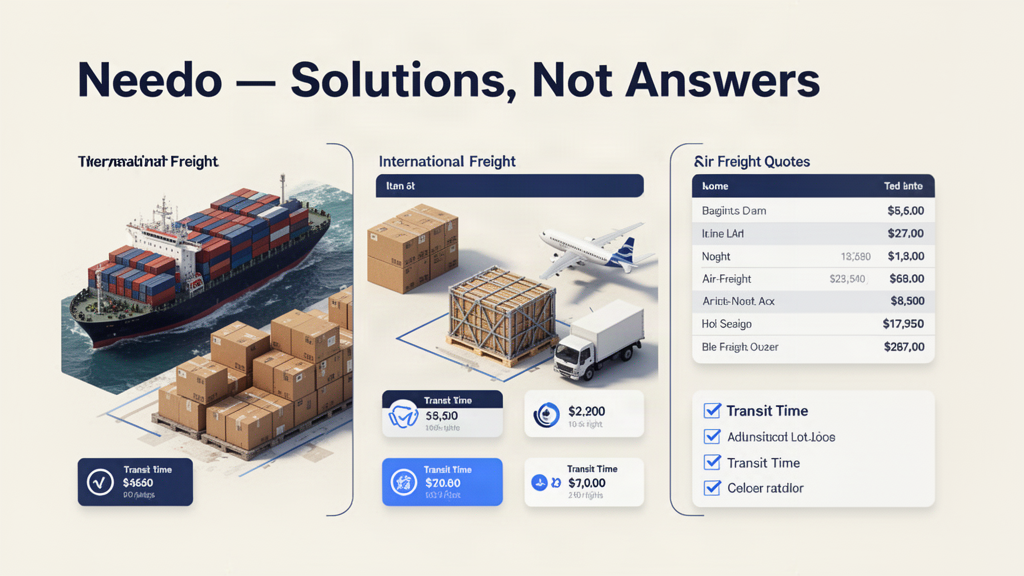
Create one shipment brief for every forwarder
Send every provider the same shipment facts. Record the origin and destination addresses or ports, cargo-ready date, commodity description, package count, dimensions, gross weight, stackability, hazardous or temperature-controlled status where relevant, and whether you need door-to-door, port-to-port or another service. If the shipment is not ready, label the measurements and date as estimates.
For less-than-container-load, air and other chargeable-weight services, dimensions can affect the rated weight or volume. Ask the forwarder to state the rating basis and any assumptions. Do not compare quotes prepared from different cargo measurements as though they were equivalent.
Shipment brief checklist
- Origin and destination, including named place or port
- Mode and service: air, ocean FCL/LCL, road, rail or multimodal
- Package count, dimensions, gross weight and commodity
- Cargo-ready date, required delivery window and flexibility
- Pickup, export handling, customs clearance and final delivery required
- Insurance request, special handling and documentation needs
Normalize the service and delivery basis
Check whether each quote is for the same route and service. A direct sailing and a transshipment route may have different timing and disruption exposure; an airport-to-airport quote is not equivalent to a door-delivered service. Ask what event starts the transit-time estimate and whether it includes weekends, customs clearance or last-mile delivery.
Record the agreed delivery term and named place where Incoterms® apply. The term allocates specified responsibilities, costs and risks between seller and buyer; it does not make every line in a freight quote automatically comparable. If the commercial contract and transport quote use different assumptions, resolve that mismatch before ranking the options.
Normalize these fields
- Same origin, destination and route type
- Same transport mode, equipment and service level
- Same delivery scope and named place
- Same cargo dimensions, weight and handling assumptions
- Same requested ready date and delivery window
- Same quote currency, validity period and shipment basis
Compare the full charge list, not just the headline rate
Build a line-by-line table. Depending on the route and service, charges may include pickup, origin handling, export documentation, main carriage, fuel or security surcharges, terminal handling, destination handling, customs brokerage, duties or taxes where quoted, delivery, storage and other accessorial services. Not every shipment has every charge, and names differ by provider, so ask for the definition and billing basis rather than assuming two similar labels mean the same thing.
Mark each line as included, excluded, estimated, conditional or not applicable. Check whether a charge is per shipment, container, bill of lading, kilogram, cubic metre, delivery stop or day. Watch for the same handling or documentation item appearing in two places. A missing destination fee is not a saving if it will be billed later.
Comparison table columns
- Charge name and provider's definition
- Amount, currency and billing unit
- Included, excluded, estimated or conditional
- Source or written confirmation and quote date
- Possible overlap with another line
- Question or action needed before booking
Compare timing, reliability and free-time conditions
Price is only one input. Record estimated transit time, route and transshipment points, departure frequency, cargo cut-off, booking lead time, tracking, escalation contact and what happens if the sailing or flight is rolled. Ask whether the estimate starts at cargo pickup, port departure or another milestone and when the provider will confirm the schedule.
For ocean freight, check any stated free time, demurrage, detention, storage and equipment-return conditions that could affect your shipment. Confirm the applicable rules and amounts in the actual quote or carrier terms. Do not invent an average delay or assume that a quoted transit time is a guarantee.
Service questions to resolve
- What is the planned route and are transshipments involved?
- When does the transit-time estimate start and end?
- What are the cargo cut-off and booking deadlines?
- What tracking and exception notifications are included?
- What free time and delay-related charges apply, if any?
- Who handles a missed sailing, damage claim or customs hold?
Keep insurance and liability separate from freight price
Ask what cargo insurance, if any, is offered and what it covers, the insured value basis, exclusions, deductible and claims process. Do not assume that the carrier's or forwarder's liability is the same as full cargo insurance. Confirm the actual policy or contractual terms for the shipment and obtain qualified advice for high-value or sensitive cargo.
Also check which party is responsible for export and import formalities, customs information, permits and documents. The U.S. Department of Commerce explains that freight forwarders may assist with transport arrangements, documents and cost estimates, but responsibilities and regulation depend on the service and jurisdiction. For U.S. ocean transportation intermediaries, check the applicable Federal Maritime Commission licensing or registration resources rather than applying U.S. rules globally.
Before you approve
- Insurance provider, scope, exclusions and claim requirements
- Liability terms and written service conditions
- Customs-clearance scope and documents required
- Responsibilities for duties, taxes and final delivery
- Applicable licensing or registration checks for the jurisdiction
- Any unresolved compliance or special-cargo requirement
Copy-ready request for a comparable freight quote
Use the same request for each forwarder and replace every bracket with confirmed information. Ask the provider to itemize charges and identify assumptions; do not ask them to guarantee a rate or schedule they cannot support.
Freight RFQ template
- Subject: Freight quote request — [origin] to [destination] — [cargo-ready date]
- Cargo: [commodity, package count, dimensions, gross weight and special handling]
- Service: [mode, FCL/LCL or other service, pickup and final delivery scope]
- Required window: [cargo-ready date and target arrival date, if flexible]
- Delivery basis: [agreed term and named place, if applicable]
- Please itemize: [origin charges, main carriage, destination charges and accessorials]
- Please state: [currency, billing units, quote validity and rate conditions]
- Please confirm: [route, transit-time basis, cut-offs, free time and tracking]
- Please list: [excluded charges, customs scope, insurance and claim terms]
- Please identify: [information still needed to make this quote firm or comparable]
Choose with a documented decision, not a single score
First remove options that fail mandatory requirements such as the required delivery scope, cargo handling or documentation. Then compare normalized cost, service fit, timing, clarity and unresolved risk. A weighted score can help organize preferences, but a high score must not hide a missing cost or failed mandatory condition.
Keep the source quote, its date, assumptions, questions and final version together. Reconfirm material charges and schedule before booking because rates, capacity and surcharges can change. Needo can structure the shipment brief, normalize quote details and prepare clarification questions; you should review the evidence and confirm commercial terms before committing.
Final go/no-go checklist
- All providers priced the same shipment and service scope
- Included and excluded charges are visible
- Currency and billing units have been normalized
- Transit-time basis and schedule conditions are understood
- Insurance, liability and customs responsibilities are clear
- Unknowns have an owner and resolution date
- The selected quote is current and confirmed before booking
Sources and further reading
- U.S. Department of Commerce — Shipping Options
Explains freight-forwarder roles in transport arrangements, documentation, quotations and shipment logistics; the guidance is U.S.-focused.
- International Chamber of Commerce — Incoterms® Rules
Reference for agreed delivery responsibilities, costs and risks; use the exact rule and named place in the transaction.
- Federal Maritime Commission — Ocean Transportation Intermediaries
U.S.-specific explanation of ocean freight forwarders and NVOCCs and the relevant regulatory framework.
- U.S. Federal Maritime Commission — Licensed Freight Forwarders
Official lookup resource for U.S.-based ocean freight forwarders where that regulatory check applies.
Sources support the specific points noted above. Confirm current requirements for your product, destination and contract before committing.
Need the actual problem solved?
This guide explains the method. Needo can work from your specific requirement, compare relevant options, verify important details and help move the next step forward.
Start with your exact problem →Selling or exporting? See live buyer requirements by product · see a sample verified shortlist