NEEDО · EXPORT COMPLIANCE & PRODUCT CLASSIFICATION
ECCN vs HS Code vs SCOMET: How to Prepare an Export-Control Classification Review
An HS code and an export-control classification answer different questions. A customs tariff code helps describe goods for customs, duty and trade-statistics purposes. An ECCN, SCOMET entry or another national control-list reference addresses strategic export controls under a particular jurisdiction. A product can need both types of analysis, and one code does not prove the other. This guide explains the technical evidence an exporter should collect and the official routes to use. It does not assign a legal classification or determine whether a licence is required.
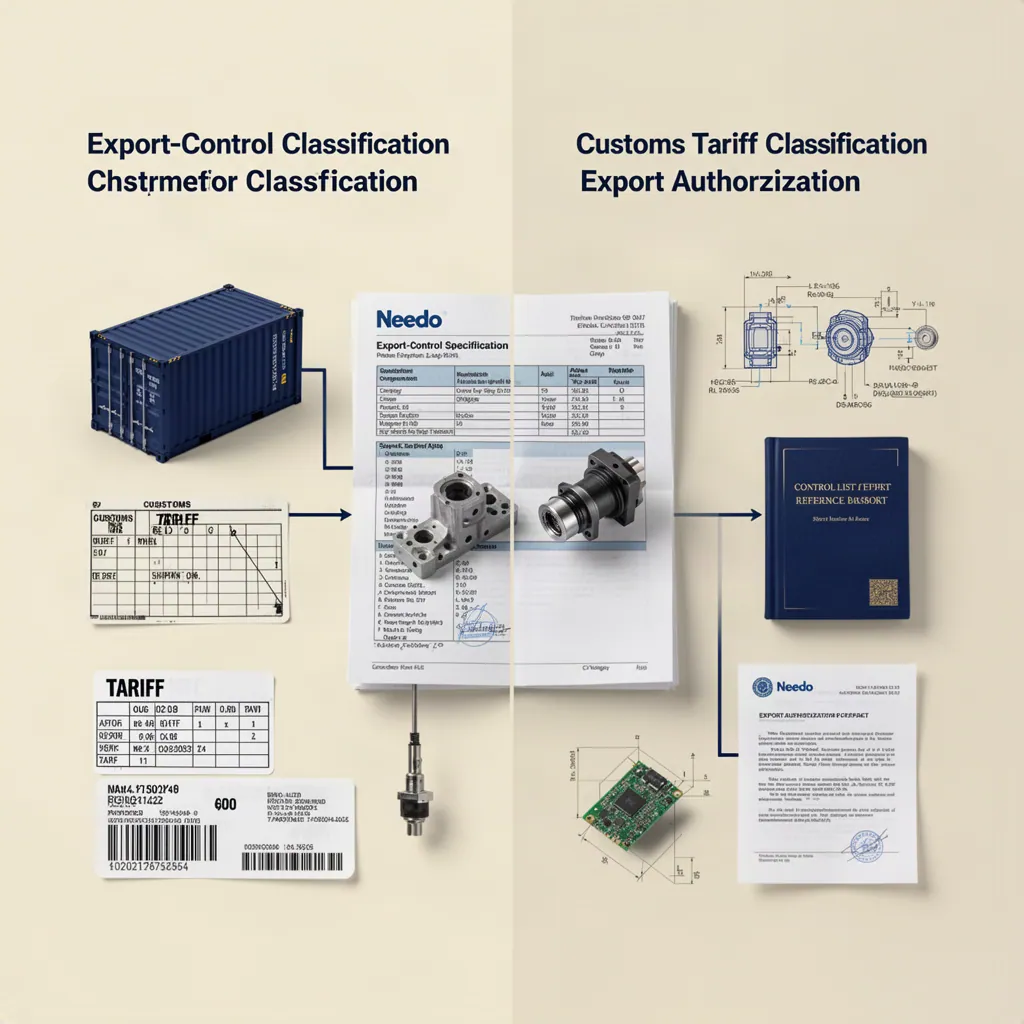
1. Do not use one code for two different decisions
Start by writing down the decision you are trying to make. HS or national tariff classification is used in customs processes and can affect duty, trade measures and statistical reporting. Export-control classification asks whether an item, software or technology is described by a strategic or dual-use control list under a specific legal regime. The same physical product may therefore have a customs tariff code and a separate export-control reference.
For the United States, BIS expressly states that an Export Control Classification Number is distinct from and unrelated to a Harmonized Tariff System code or Schedule B number. ECCN is used for items subject to the US Export Administration Regulations; it is not a universal code for every exporter. India uses SCOMET for specified special chemicals, organisms, materials, equipment and technologies. The UK and EU have their own control-list frameworks. Do not copy a code from an invoice, customs declaration or another country's database and treat it as a strategic-control decision.
Keep the references separate
- HS or national tariff code: customs description and tariff treatment
- ECCN: a US EAR export-control classification, if the item is subject to the EAR
- SCOMET: India's strategic export-control list and authorization framework
- UK strategic control-list entry: the relevant UK military or dual-use control reference
- EU dual-use list entry: the relevant Annex I or other applicable EU control provision
- Other national control lists: assess when the export, origin, route or parties bring them into scope
2. Establish which jurisdiction and item regime may apply
Before searching a list, identify the exporter, manufacturer, country of origin, place of export, destination, transit route and any planned re-export. Consider whether the product contains controlled-origin components, software or technology; whether a US person or US-origin item is involved; and whether a transfer, brokering or technical-assistance activity is part of the transaction. The rules can apply beyond the country where the seller is registered.
A product that is ordinary in one market may be controlled in another because lists, thresholds, national controls and licensing policies differ. UK guidance explains its consolidated list of strategic military and dual-use items and directs exporters to official control-list and classification services. Canada's January 2026 Export Control List guide is another jurisdiction-specific example. Use the current authority for the exporter and transaction rather than treating a global web result as a universal classification.
Jurisdiction worksheet
- Exporter and manufacturing locations
- Country of origin and any controlled-origin content
- Destination, transit, installation and ultimate end-use countries
- Software, technology, technical assistance or re-export involved
- Any relevant US, UK, EU, Indian, Canadian or other legal connection
- Date and source of the jurisdictional analysis
3. Build a technical product file before searching control lists
A product name or marketing description is rarely enough for export-control classification. Collect the exact manufacturer, model, variant, configuration, drawing revision and technical datasheet. Record the product's function, operating range, materials, dimensions, precision, power, speed, pressure, temperature, frequency, sensitivity, radiation characteristics or other parameters that may be relevant to the applicable list. The controlling technical thresholds vary by item category, so do not assume a similar model has the same classification.
Include embedded software, encryption, source code, technical data, firmware, remote access, development tools and any special design or modification. If the product is a component, describe the system into which it is incorporated and the function it performs. Preserve the manufacturer's written classification statement if one exists, but record who issued it, which model and configuration it covers, the jurisdiction, date and basis. A family-level statement may not cover every variant.
Technical evidence checklist
- Manufacturer, exact model, variant, serial range and configuration
- Datasheet, drawings, materials, tolerances and performance values
- Software, encryption, firmware and technical data supplied with the item
- Special design, modification, intended integration or operating environment
- Manufacturer's ECCN, SCOMET or other classification statement, if supplied
- Previous licence, ruling or authority decision and its precise scope
4. If the US Export Administration Regulations may apply, review the ECCN route
BIS explains that an ECCN is a five-character alphanumeric designation on the Commerce Control List. First determine whether the item or activity is subject to the EAR. Then review the CCL and relevant technical parameters. BIS describes three routes: obtain the classification from the manufacturer or producer and verify it against the current list; self-classify when the exporter has the necessary technical and regulatory competence; or request an official classification from BIS through SNAP-R under the applicable procedure.
If an item is subject to the EAR but is not described on the CCL, it may be designated EAR99. EAR99 is not a universal no-licence guarantee. BIS explains that a licence may still be required for certain destinations, end users or end uses, and restricted-party controls can apply even where an item is not listed on the CCL. Keep item classification separate from the transaction-level licence analysis.
Questions to close for an ECCN review
- Has the exporter established whether the item is subject to the EAR?
- Does the manufacturer's ECCN cover this exact model and configuration?
- Which CCL entry and technical characteristics support the proposed result?
- Is a self-classification supported by a documented order-of-review rationale?
- Should the exporter request a formal BIS classification or specialist review?
- Have destination, end user, end use and restricted-party controls been checked separately?
5. Check the relevant national list, including UK and Indian routes where applicable
For UK exports, the government publishes strategic export-control guidance and a consolidated list covering military and dual-use goods, software and technology. The guidance was updated April 23, 2026 and points exporters to the control-list classification service and SPIRE end-user advice service. Check the current list and licensing route for the actual exporter and transaction.
For Indian exporters, Chapter 10 of the Foreign Trade Policy describes the SCOMET framework and authorization routes. The Department of Atomic Energy also explains that nuclear-related items and certain dual-use goods fall within controlled categories. Do not assume every industrial product is SCOMET-controlled, but do not infer that an item is outside the list merely because its customs HS code is ordinary or it has a civilian use.
The EU Dual-Use Regulation establishes a separate regime for dual-use exports, brokering, technical assistance, transit and transfer. Member State authorities implement relevant licensing and catch-all measures. Other countries, including Canada, publish their own control lists and guidance. The correct list, licensing authority and technical thresholds depend on the transaction's legal scope.
Official starting points
- UK: consolidated strategic control list, classification service and SPIRE
- India: DGFT SCOMET list, Foreign Trade Policy Chapter 10 and relevant licensing authority
- EU: Regulation (EU) 2021/821, Annex I and the competent Member State authority
- Canada: Export Control List and current permit guidance
- Other countries: the exporter's current official strategic-trade control authority
6. Keep item classification separate from the final licence decision
A classification reference is an input to the licence analysis, not the final answer. Licensing may depend on destination, end user, end use, ownership or control of a party, transit, re-export, sanctions, military or proliferation concerns, and the availability and conditions of an exception or general authorization. Some regimes also impose catch-all controls on items not specifically listed when the exporter knows or is informed about a prohibited or sensitive end use.
The UK's April 22, 2026 Sanctions End-Use Controls guidance is one current example of a targeted mechanism addressing diversion through third countries after an exporter receives an official notice. BIS's EAR guidance separately discusses red flags and end-user or end-use restrictions. Neither example means every ordinary export needs a licence; both show why the product code cannot be the sole shipment-release test.
Before shipment, confirm separately
- Item classification and the source supporting it
- Destination and transit controls
- Buyer, consignee, intermediary and ultimate end user
- Intended end use and any catch-all or diversion concern
- Licence, exception or authorization conditions and their scope
- Any notice, change or re-export that requires a fresh review
7. Ask the manufacturer and authority questions that produce usable evidence
When a manufacturer supplies a code, ask for the jurisdiction, exact model and configuration, control-list entry, technical rationale, date of assessment and whether the statement covers software, accessories and technology. Ask whether a later engineering change, firmware update, material substitution or new performance option changes the classification. If the supplier only provides an HS code, explain that you need a separate export-control assessment where applicable.
If the technical file is incomplete or two plausible entries remain, do not guess from a search snippet. Ask the manufacturer or developer for the missing technical values and use the official authority's classification-request route where available. Preserve the question, response, documents and date. A classification should be traceable to the version of the item and control list that was reviewed.
Manufacturer request template
- Please identify the export-control jurisdiction covered by your statement.
- Please provide the ECCN, SCOMET or other national control-list reference, if determined.
- Please identify the exact model, variant, firmware and configuration covered.
- Please provide the technical basis and list entry or parameters considered.
- Please state the date of review and whether accessories or software are excluded.
- Please notify us if a product or control-list change may affect the statement.
8. Worked example: an industrial pump with a digital controller
Illustrative example only: an exporter has a centrifugal pump with a digital controller and a standard customs tariff classification. A buyer asks for the HS code and assumes that this proves no export licence is needed. The exporter should not accept that conclusion. It identifies the country of export and origin, the precise pump model, operating limits, materials, controller functions, software and destination. It then checks whether any export-control regime applies and whether the technical parameters fit a relevant control-list entry.
The manufacturer may provide a classification statement, but the exporter checks the model and configuration against the current official source. The exporter then separately reviews the buyer, ultimate end user, intended process, destination and any authorization conditions. The example does not assign an HS code, ECCN or SCOMET category; those require the actual technical file and applicable jurisdiction.
Decision record
- Customs tariff code: recorded separately with its customs rationale
- Export-control reference: pending until the applicable list and technical parameters are reviewed
- Missing evidence: exact controller specification and manufacturer's classification basis
- Next action: obtain technical file and request competent review if uncertainty remains
- Shipment status: hold until the responsible export-compliance reviewer closes the required checks
9. Use Needo to prepare a classification evidence file
Needo can organize the product's technical attributes, compare manufacturer statements with official control-list references, separate customs classification from strategic export controls and prepare questions for the relevant authority or compliance specialist. It can show which facts are missing and which assumptions must not be treated as confirmed.
Needo does not assign a binding ECCN, SCOMET category or national control-list code; it does not certify that an item is uncontrolled, determine that a licence is unnecessary or authorize export. Do not share classified, controlled, export-restricted or confidential technical information unless your organization has approved the disclosure. Redact sensitive details and use the competent authority or qualified export-control professional for the final determination.
Sources and further reading
- U.S. Bureau of Industry and Security — Classify Your Item
Official BIS guidance confirming ECCN is distinct from HS and Schedule B codes, describing manufacturer classification, self-classification and formal BIS requests, and explaining the EAR99 limitation.
- U.S. Department of Commerce — How Do I Determine My ECCN?
Exporter guidance on ECCN, EAR99, destination and end-user restrictions, and when to request a formal determination.
- UK Government — UK Strategic Export Controls
UK control-list and licensing guidance, updated April 23, 2026, including official classification and end-user advice routes.
- UK Government — Export Controls for Dual-Use Items, Software and Technology
Explains UK dual-use control categories, control lists and licensing requirements for relevant goods, software and technology.
- India Department of Atomic Energy — Export Control FAQs
Official explanation of India's SCOMET list and authorization framework for specified controlled goods and technologies.
- Global Affairs Canada — A Guide to Canada's Export Control List, January 2026
The January 2026 Canadian Export Control List guide and official permit reference for Canadian transactions.
- European Union — Regulation (EU) 2021/821 on Dual-Use Items
Current consolidated EU dual-use export, brokering, technical-assistance, transit and transfer framework, with the version dated September 21, 2026.
Sources support the specific points noted above. Confirm current requirements for your product, destination and contract before committing.
Need the actual problem solved?
This guide explains the method. Needo can work from your specific requirement, compare relevant options, verify important details and help move the next step forward.
Start with your exact problem →Selling or exporting? See live buyer requirements by product · see a sample verified shortlist