NEEDО · IMPORT & EXPORT OPERATIONS
How to Import a Product into India: A Step-by-Step Guide
To import a product into India you need an Importer-Exporter Code (IEC) from the DGFT, the correct ITC-HS classification for your goods, a reliable overseas supplier, and a customs clearance process through ICEGATE on which you pay the applicable customs duty, IGST and other charges before taking delivery. This guide walks the whole process end to end and the documents at each step. Rules, duty rates and restrictions change and depend on the exact product, so confirm the current position for your goods with official sources or a licensed customs broker before you commit.
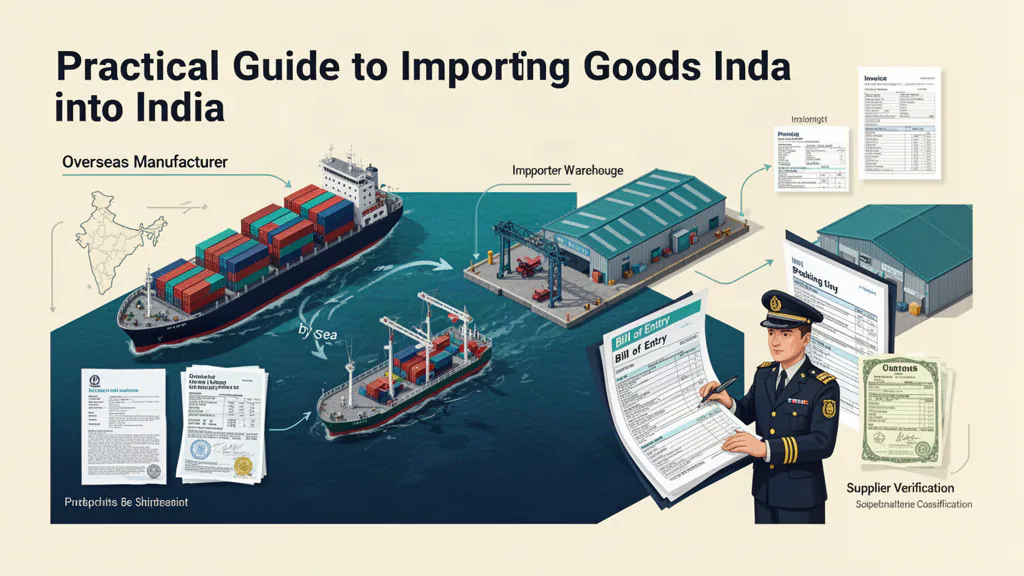
Do I need an IEC to import into India?
An IEC is generally required for commercial import activity. Customs guidance describes it as a 10-character alphanumeric code allotted by the Directorate General of Foreign Trade (DGFT), linked to the importer's PAN. The Foreign Trade Policy and the Foreign Trade (Exemption from Application of Rules in Certain Cases) Order contain specific exemptions and permanent IEC categories, including certain personal-use and government cases. Do not assume an exemption applies to a commercial shipment without checking the exact importer and purpose.
Apply and confirm the IEC details before the goods ship. Keep the legal name, PAN, bank and GST records consistent, and confirm whether the importer needs ICEGATE registration or an authorized Customs Broker for the planned filing. An IEC is not a product licence: restricted goods and goods covered by other laws may need separate authorization or agency clearance.
Step 1 checklist — IEC
- Apply for or confirm the IEC through the DGFT portal
- Check the exact IEC exemption only if the importer and purpose qualify
- Match the legal entity and PAN details across commercial documents
- Confirm ICEGATE access or Customs Broker arrangements
- Check separate product licences and other-agency registrations
Classify your product and check if it is restricted
Every imported product has an ITC-HS code (India uses an 8-digit classification based on the international Harmonized System). The code decides your duty rate and whether the goods are freely importable, restricted (need a licence or permission) or prohibited. Getting it right matters: a wrong code can mean the wrong duty, a held shipment or a penalty.
Check the Indian Trade Classification (ITC-HS) and the DGFT import policy for your code to see the 'free / restricted / prohibited' status and any conditions. Some products also need clearances from other authorities, such as FSSAI for food, drug controls or plant and animal quarantine. Check whether a current BIS Quality Control Order (QCO) covers the exact product and model, note its scope and commencement date, and review any notified import exemption; do not assume every product requires BIS certification. Confirm the applicable approvals before you order.
Step 2 checklist — classification
- Find the correct 8-digit ITC-HS code for your goods
- Check the import policy: free, restricted or prohibited
- Identify any licence or other-agency clearance required
- Note the applicable duty structure for the code
Find and verify a reliable overseas supplier
Shortlist suppliers that genuinely make or export your exact product, then verify before paying. Confirm the legal entity, check references, request samples or a lab report for material goods, and start with a small trial order on secure payment terms. Advance-payment fraud and misdescribed goods are common, so treat an impressive website or catalogue as a starting point, not proof.
Verify bank details through an independent route before you pay, and never change beneficiary details based only on an email. For a first order, protect yourself with inspection or staged payment rather than full advance to an unverified supplier.
Step 3 checklist — supplier
- Confirm the supplier is a real, operating manufacturer or exporter
- Request samples, certificates or a lab report for material goods
- Verify bank details independently before paying
- Start with a trial order and secure payment terms
How much customs duty will I pay? Work out landed cost first
Estimate the total landed cost, not just the supplier price. Depending on the tariff item, valuation, exemptions and current notifications, an import assessment may include Basic Customs Duty (BCD), Social Welfare Surcharge (SWS), IGST and other applicable levies such as a trade-remedy or product-specific duty. The components and rates are not identical for every product. Add freight, insurance, port, handling, customs-broker and inland-delivery costs.
Use the exact ITC-HS tariff item, assessable-value rules and current Customs Tariff or notification to build the worksheet. If claiming preferential duty, check the relevant trade agreement, product-specific origin rule and valid origin evidence. Do not copy a rate from a similar product or assume an online calculator is a binding assessment; ask the Customs Broker or authority to confirm the exact goods.
Step 4 checklist — landed cost
- Confirm the tariff item and assessable-value inputs
- Identify BCD, SWS, IGST and any additional levy or exemption that actually applies
- Add freight, insurance, port, broker and inland-delivery charges
- Check the origin rule and evidence before claiming preferential duty
- Compare suppliers on total landed cost, not ex-works price alone
Agree Incoterms, payment terms and a clear contract
Agree who is responsible for cost and risk at each stage using an Incoterm (for example FOB, CIF or DAP) and a named place. Do not assume a quoted price includes freight, insurance or duties unless the documents say so. Put specification, quantity, packing, delivery date, acceptance criteria and payment terms in writing.
For payment, match the instrument to the risk: a letter of credit or partial advance for a large or first order, and clear terms for currency, bank charges and documents. The contract and Incoterm determine what can go wrong and who pays for it, so settle them before production starts.
Step 5 checklist — terms
- Choose the Incoterm and named place deliberately
- Confirm what the price does and does not include
- Write down specification, packing, dates and acceptance
- Match payment terms to the risk of the order
Arrange shipping and get the documents right
Your shipment will travel by sea or air with a transport document (Bill of Lading for sea, Air Waybill for air) and supporting trade documents. The core set commonly includes the commercial invoice or invoice-cum-packing-list and the transport contract. Depending on the goods and claim, you may also need a separate packing list, certificate of origin, import authorization, product certificate or other-agency permit. Mumbai Customs guidance and ICEGATE describe e-SANCHIT as the electronic route for supporting records uploaded with the Bill of Entry.
Keep the description, model, quantity, value, currency, origin and package data consistent across the purchase order, invoice, packing list and transport document. A certificate of origin is not automatically required for every import, but it may be essential for a preferential-duty claim or another specific requirement. Keep the original source and document reference for each claim.
Step 6 checklist — documents
- Commercial invoice or invoice-cum-packing-list
- Packing details and Bill of Lading or Air Waybill
- Certificate of origin where required or used for a preference claim
- Applicable DGFT authorization and product-agency certificates
- e-SANCHIT upload and document-reference checklist
- Consistent model, quantity, value, origin and package details
When should the Bill of Entry be filed?
Section 46 of the Customs Act generally requires the importer to present the Bill of Entry before the end of the day (including holidays) preceding the day the carrying aircraft, vessel or vehicle arrives at the customs station. The section also permits presentation up to 30 days before the expected arrival. The Board has prescribed different timelines for specified modes and circumstances, so confirm the applicable regulation for the actual route and customs station with the broker.
This is a pre-arrival process, not a document to start only after the goods land. CBIC Circular No. 08/2021-Customs describes mode- and consignment-specific cutoffs, including arrival-day exceptions for certain short-haul sea consignments and airport or land-station cases; the exact port, route and current notification matter. The 30-day advance-filing option continues. Confirm the applicable cutoff with the broker and current customs notice before shipment. Late presentation may attract charges unless the proper officer accepts sufficient cause or a notified exception applies.
Step 7 checklist — filing window
- Confirm expected arrival date and customs station
- Check the current Bill of Entry timeline for sea, air or land transport
- Prepare the invoice, transport document and supporting e-SANCHIT references
- Ask the broker to confirm filing and query-response ownership
- Keep proof of filing, assessment, duty payment and out-of-charge
Customs clearance and paying duty
The importer or its authorized Customs Broker files the Bill of Entry electronically through ICEGATE or the applicable customs service channel. Customs assesses the classification and value, the importer pays the assessed duty, and the goods may be examined or referred to a participating government agency. Release follows only after the required customs and agency processes are complete and an out-of-charge order is issued.
Review the Bill of Entry before filing and reconcile the declared product, quantity, origin, assessable value, tariff item, exemption and duty. Do not understate value or use a guessed code to reduce duty. Keep the assessment, payment and release records with the purchase and transport documents.
Step 8 checklist — clearance
- Appoint and brief an appropriately licensed Customs Broker if needed
- Review the Bill of Entry and supporting document references
- Pay the assessed duty through the official process
- Complete examination and any required agency release
- Retain the assessment, payment and out-of-charge records
Take delivery, reconcile and keep records
After customs release, arrange transport from the port or airport to your location, inspect the goods against the purchase order and technical specification, and reconcile the invoice, Bill of Entry, duty paid and any variance. Claim import IGST input tax credit only if the importer and transaction satisfy the applicable GST conditions. Keep the IEC, invoice, Bill of Entry, duty-payment proof, transport documents, certificates and inspection records for accounts and audit.
Treat the first shipment as evidence about the supplier and your import process. Record any classification query, damage, quantity variance, document correction or unexpected charge, then update the supplier specification and broker instructions before the next order.
Step 9 checklist — after clearance
- Reconcile goods, invoice, Bill of Entry and duty
- Record shortages, damage, quality and document variances
- Claim eligible import IGST credit only after GST review
- Retain IEC, invoice, Bill of Entry, payment and transport evidence
- Update the next-order checklist with lessons learned
Common mistakes to avoid
Most import problems are avoidable: ordering before checking the import policy and duty, using the wrong HS code, paying an unverified supplier in full advance, or assuming a low ex-works price is the final cost. Each can turn a profitable import into a loss or a stuck shipment.
Build the landed cost, confirm the goods are importable, verify the supplier, and get the documents consistent — before you pay. For anything regulated or high-value, use a licensed customs broker and confirm the current rules for your exact product.
- Ordering before checking import policy, licences and duty
- Wrong or guessed ITC-HS code
- Full advance payment to an unverified supplier
- Treating ex-works price as the landed cost
- Inconsistent values or descriptions across documents
Worked example: importing an industrial pump from Germany
An Indian buyer wants 200 industrial pump assemblies from a German supplier. Before paying a deposit, the buyer should collect the exact model, intended use, material, flow and pressure specifications, country of origin, supplier legal entity, quotation, Incoterm, packing details, freight and insurance estimate, destination port and expected arrival date. The buyer should not select a tariff item from the word pump alone: the exact construction and function matter.
Needo can organize the classification evidence, compare supplier and freight quotes, map possible BIS or other product requirements, prepare the landed-cost worksheet and list the Bill of Entry documents. The worksheet should leave duty blank or marked unverified until the exact tariff item, valuation and current notifications are confirmed. This example is a process illustration, not a classification or duty ruling.
Copy-ready facts to request before ordering
- Manufacturer, seller and actual manufacturing-site legal names
- Exact model, datasheet, material, function and product photographs
- Country of origin and any certificate or origin-rule evidence
- Quantity, unit price, currency, Incoterm and named place
- Packing dimensions, gross/net weight and transport mode
- Freight, insurance, destination port and estimated arrival
- Applicable licences, QCO or agency evidence and current exemptions
- Invoice, packing list, transport document and Bill of Entry filing owner
Use Needo to prepare your import
Give Needo the product, technical file, supplier quotation, destination, quantity and shipping terms. It can organize supplier research, classification evidence, import-policy checks, product-approval questions, landed-cost inputs and the customs handoff into one evidence-led import plan.
Needo researches public sources and prepares a decision aid; it does not file customs entries, issue an IEC, provide a binding classification or duty ruling, or guarantee clearance. Use current official notifications and a qualified Customs Broker for the final tariff, valuation, licence and clearance decisions.
Sources and further reading
- DGFT — Apply for Importer-Exporter Code
Official DGFT portal for IEC application and importer/exporter services. Check current eligibility, required records and any applicable exemption.
- DGFT — ITC(HS) Import and Export Policy
Official source for the ITC-HS tariff item and current free, restricted or prohibited import-policy status; confirm the exact product and latest notification.
- CBIC — Customs Act, 1962, Section 46
Statutory text for electronic Bill of Entry presentation, the general pre-arrival filing deadline and the ability to file up to 30 days before expected arrival, subject to notified timelines.
- Mumbai Customs Zone III — Procedure for Clearance of Imported Goods
Official customs guidance describing the 10-character alphanumeric IEC, listed IEC exemptions and permanent IEC categories, Bill of Entry filing through ICEGATE and e-SANCHIT supporting documents.
- ICEGATE — e-SANCHIT
Official Indian Customs service for electronic storage and handling of supporting documents used in customs processes.
- CBIC — Circular No. 08/2021-Customs
Official clarification of Section 46 pre-arrival Bill of Entry filing, mode- and consignment-specific deadlines, and continued advance filing up to 30 days before expected arrival.
- ICEGATE — Official Help and FAQs
Official operational guidance for Bill of Entry status, e-SANCHIT document references, ICEGATE filing and customs-system enquiries.
- Bureau of Indian Standards — Products under Compulsory Certification
Current BIS product list and Quality Control Order references. Check the exact product, order, commencement date and any applicable import exemption.
- FSSAI — Food Import Clearance System
Official portal for FSSAI food-import clearance where the imported product falls within the applicable food-safety requirements.
- U.S. International Trade Administration — India Import Requirements and Documentation
Country guide last published 20 April 2026 describing India's general free-import policy, restricted and prohibited goods, licences and documentation context.
Sources support the specific points noted above. Confirm current requirements for your product, destination and contract before committing.
Need the actual problem solved?
This guide explains the method. Needo can work from your specific requirement, compare relevant options, verify important details and help move the next step forward.
Start with your exact problem →Selling or exporting? See live buyer requirements by product · see a sample verified shortlist