NEEDО · EXPORT DOCUMENTATION
How to Prepare an Export Commercial Invoice and Reconcile It Before Dispatch
The final commercial invoice is more than a payment request. It is a transaction record that the buyer, carrier, customs broker and importing customs authority may use to identify the goods, understand the sale and assess the information declared for clearance. The practical task is to make the invoice accurate for the transaction and consistent with the documents that describe the same shipment—without copying a generic template that may not fit the destination.
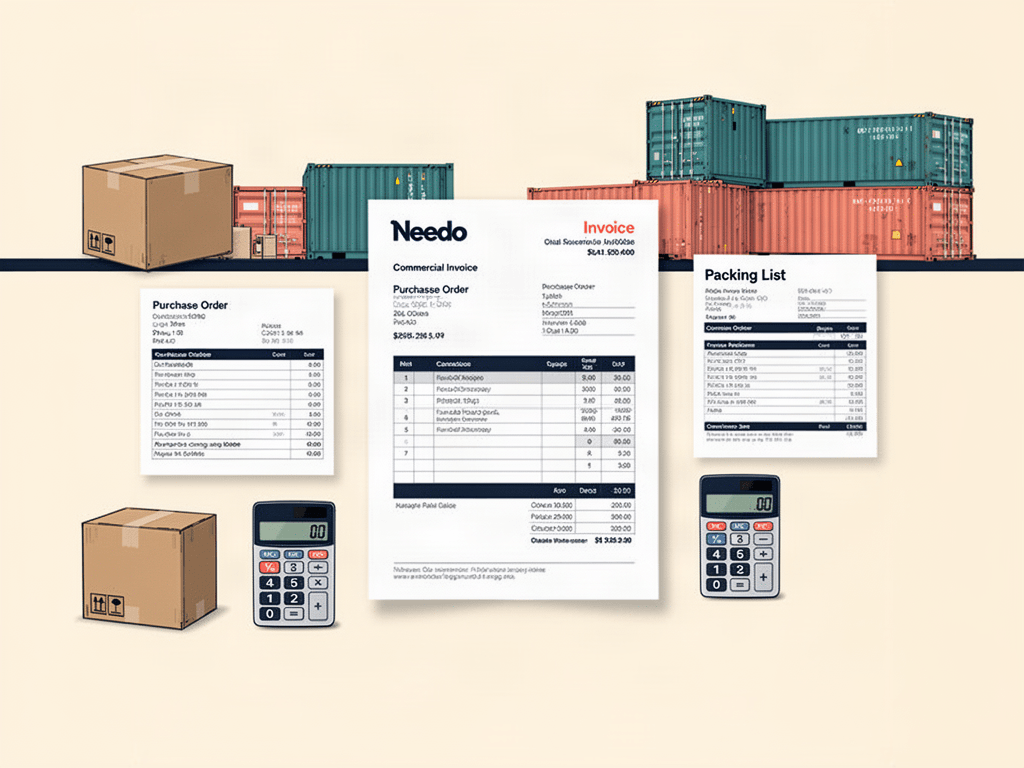
Understand what the commercial invoice is—and what it is not
A commercial invoice records the goods sold, the parties to the transaction and the amount payable under the agreed commercial terms. It is commonly used in export and import clearance and may also support payment, insurance or documentary-credit processes. The importing country can prescribe its own data, format, language, copy count or certification rules, so there is no single universal invoice form that is correct for every shipment.
A pro forma invoice normally describes a proposed transaction before shipment or final billing. The final commercial invoice should reflect the transaction that was actually agreed and the goods being shipped. If the buyer's order changed after the pro forma invoice, carry the approved changes into the final invoice rather than treating the earlier document as an authority to ignore them. Needo's existing pro forma invoice guide explains the earlier quotation stage; this guide focuses on the final invoice and its reconciliation.
Keep the document roles separate
- Pro forma invoice: proposed sale terms or quotation-stage document, subject to the parties' agreement.
- Purchase order or sales contract: the buyer's order and the agreed commercial basis, including approved amendments.
- Commercial invoice: the seller's final transaction invoice for the goods covered by the shipment.
- Packing list: package-level contents, marks, quantities, weights and dimensions; it supports cargo checks but is not a substitute for the commercial invoice.
- Transport document: evidence and terms for the carriage, with details that should be consistent with the shipment instructions.
Confirm the parties and reference documents first
Use the correct legal names and addresses for the exporter or seller and the buyer. Add the consignee or final delivery party when it is different from the buyer and when the destination or transaction requires it. Distinguish the bill-to, ship-to, buyer, seller, exporter, importer of record and notify party instead of assuming that one company fills every role.
Record the invoice number and issue date, the purchase-order number and date, and the relevant contract or pro forma reference. If an order amendment changed quantity, price, product revision, delivery location or payment terms, identify the approved amendment and use the current version. A reference number is useful only if it points to the right document.
Party and reference checks
- Seller/exporter legal name, address and relevant registration or customs identifier where required.
- Buyer/importer legal name and address, plus consignee or final recipient when different.
- Invoice number, issue date, purchase-order number and contract or pro forma reference.
- Current approved order revision and written amendments.
- Consistent buyer, seller and delivery-party details across the invoice and shipping instructions.
Describe each product line so it can be identified
Use a specific commercial description rather than a broad label such as parts, samples or machinery. Identify the product, model or SKU, material or composition where relevant, function or grade, and any characteristic that distinguishes it from a similar item. Keep the description consistent with the purchase order, packing list, product documents and the customs declaration data prepared by the authorized party.
State the quantity and unit of measure for each line, such as pieces, sets, kilograms or cartons. If the product is sold by weight but packed in units, show the commercial quantity and package information in the appropriate fields. If the shipment contains different models, materials, origins or tariff classifications, do not combine them into one vague line simply to shorten the invoice.
Include a tariff or HS code only when the code has been checked for the relevant customs territory and purpose. The international Harmonized System uses six-digit subheadings, while national schedules may add further digits. A supplier's suggested code or a code used for another country's import entry is not automatically correct for this shipment.
Line-level description checklist
- Product name plus model, SKU, part number or grade.
- Material, composition, function or technical characteristic needed to distinguish the goods.
- Quantity, unit of measure and unit price for each line.
- Country of origin based on the applicable origin rules and supporting evidence—not simply the dispatch country.
- HS or commodity code only with a recorded source and jurisdiction-specific check.
- Separate lines for materially different goods, origins or tariff treatments where required.
Recalculate values, currency and charges
Recalculate every line extension from quantity multiplied by unit price, then apply agreed discounts, surcharges and other adjustments. Confirm the invoice currency, rounding method and total. If freight, insurance, packing, commissions, royalties or other amounts are relevant to the agreed price or customs valuation, show them in the manner required for the transaction and destination. Do not silently include or omit a charge because another supplier's template handled it differently.
The amount the buyer owes under the contract and the value used for customs purposes are related but not always identical concepts. Customs valuation rules can require additions, exclusions or a different treatment of particular costs. If the invoice price includes freight or insurance, identify the amount and basis clearly and have the authorized importer or broker confirm the customs-value treatment for the destination.
State the agreed payment method and terms accurately. If a letter of credit or documentary collection applies, compare the invoice wording, amount, currency, dates, goods description and required references with the actual instrument. Do not change the document to make it appear compliant if that would make it false; request an amendment or clarification through the bank and responsible parties.
Arithmetic example — illustrative only
- 200 units × USD 18.50 = USD 3,700.00 goods value.
- An approved USD 100.00 discount gives USD 3,600.00 net goods value.
- If the agreed invoice basis separately shows USD 280.00 freight and USD 40.00 insurance, show those amounts as separate lines and calculate the displayed total transparently.
- The example does not decide customs value, tax treatment or the amount payable under a real Incoterm or letter of credit; those depend on the contract, destination rules and documentary instructions.
Reconcile the invoice against the shipment documents
Do a field-by-field reconciliation before release. The purchase order and approved amendments establish what was ordered. The final invoice states what is being billed. The packing list describes how the goods are packed. The transport booking or draft transport document identifies the shipment and route. Differences can be legitimate, such as a partial shipment or approved substitution, but they should be explained and supported rather than left for the importer or customs broker to discover.
Compare product identity, quantity, units, package count, gross and net weights, marks, origin, invoice number, currency, delivery basis and consignee. If an order is split across containers or dispatch dates, make the shipment scope explicit. Do not copy the total order quantity onto an invoice for a partial shipment unless the agreed billing arrangement actually calls for it.
If a letter of credit applies, use its exact documentary conditions and the bank's current instructions. A document can be commercially accurate and still contain a discrepancy against the credit. The exporter should identify any conflict before presenting documents, then obtain the required clarification or amendment from the responsible bank and buyer.
A practical reconciliation matrix
- PO / amendment versus invoice: item, revision, quantity, unit price, currency and payment terms.
- Invoice versus packing list: product descriptions, quantities, package count, marks and weights.
- Invoice versus transport instructions: shipper, consignee, destination, route and shipment references.
- Invoice versus letter of credit: exact names, dates, amounts, descriptions, presentation terms and required statements.
- Origin and HS references versus the supporting product, origin and classification evidence.
- Every difference has an owner, an explanation and an approved correction or exception.
Check destination-specific invoice requirements before dispatch
Ask the importer and customs broker which invoice requirements apply to the actual destination, commodity, customs procedure and transaction date. Some markets or product categories require a prescribed form, a particular language, a stated number of copies, specific declarations, consular or chamber certification, or additional fields. Other markets accept the exporter's own invoice if the required information is present. Do not assume that a rule described for one country applies to another.
The U.S. Department of Commerce advises exporters to check reliable destination-country sources before preparing the invoice. UK export guidance lists fields such as seller and buyer details, invoice and related-document references, prices, currency, quantities, weights, HS code where relevant, Incoterms, origin and transport details. These are useful planning references, not a substitute for the importing authority's current instructions.
Keep the final invoice, supporting order and amendment records, product evidence, packing details and customs instructions together. The exact retention period and records required depend on the relevant tax, customs, accounting and trade-agreement rules.
Questions to resolve with the importer or broker
- Is a prescribed invoice format or language required for this destination?
- Are original copies, certification, legalization or a specific declaration required?
- Which party supplies the final tariff code and origin statement, and what evidence supports them?
- How should freight, insurance, discounts, assists or other charges be shown and valued?
- Are there documentary-credit or bank presentation conditions?
- Which supporting records must be retained, by whom and for how long?
Use a final release checklist instead of relying on a template
A template can remind the exporter which fields to review, but it cannot determine the correct facts. Before issuing the invoice, compare it with the current order and shipment, verify the arithmetic, confirm the destination's requirements and route unresolved classification, origin, valuation or documentary-credit questions to the responsible specialist. If a material field is unknown, mark it as unresolved and hold the document where the transaction or law requires it.
Before the invoice is issued
- Parties, consignee and document references are correct.
- Every product line is identifiable and matches the approved order.
- Quantities, units, prices, discounts, charges and totals have been recalculated.
- Currency, Incoterm, named place and payment terms match the agreement.
- Origin, HS code and customs-value inputs have a source and responsible reviewer.
- Packing, weight, marks, route and shipment details reconcile or have a documented explanation.
- Destination, bank and documentary requirements have been checked.
- The final version, approver and issue date are recorded.
Use Needo to reconcile your actual export invoice
Give Needo the approved purchase order, final invoice, packing list, relevant amendments and destination country. It can build a line-level comparison, recalculate extensions and totals, identify inconsistent parties or shipment references, list missing fields and prepare questions for the importer or broker. Ask it to show the source document for every comparison and to keep unknown facts visible.
Have the exporter, importer, customs broker, finance owner or bank review any decision that requires their authority. Needo does not issue a customs ruling, certify an invoice, determine a binding customs value, approve a letter-of-credit presentation or submit a customs declaration. The useful outcome is a reviewable invoice pack with discrepancies resolved before dispatch.
Sources and further reading
- U.S. Department of Commerce — Commercial Invoice
Explains the commercial invoice's role in export and import clearance and why destination-country requirements should be checked before preparing it.
- Business.gov.uk — How to Create a Commercial Invoice for Export
UK export guidance with a field-by-field invoice checklist covering parties, references, price, currency, quantities, weights, HS code, Incoterms, origin and additional charges.
- U.S. Department of Commerce — Common Export Documents
Distinguishes pro forma invoices, final commercial invoices and packing lists, including the packing list's role in checking cargo.
- Canada Border Services Agency — Memorandum D1-4-1: Invoice Requirements
Canadian invoice-requirements reference; the page states its content is under review since 21 October 2024 during the CARM transition, so confirm the current CBSA procedure before relying on it.
Sources support the specific points noted above. Confirm current requirements for your product, destination and contract before committing.
Need the actual problem solved?
This guide explains the method. Needo can work from your specific requirement, compare relevant options, verify important details and help move the next step forward.
Start with your exact problem →Selling or exporting? See live buyer requirements by product · see a sample verified shortlist