NEEDО · EU TRADE COMPLIANCE & SUPPLY-CHAIN TRACEABILITY
EUDR Supplier Geolocation Data: What to Request Before 30 December 2026
The EU Deforestation Regulation (EUDR) is approaching a key application date: 30 December 2026 for medium and large operators and traders, with most micro and small enterprises applying from 30 June 2027. The rules cover specified products linked to cattle, cocoa, coffee, oil palm, rubber, soy and wood—not every product in those broad categories. EU operators may need non-EU suppliers to provide plot or establishment locations, production dates, product quantities, supplier details and evidence that the relevant commodities are deforestation-free and legally produced. Non-EU producers are not automatically the regulated operator merely because they supply an EU customer, but their information may be essential to the customer's due-diligence file. This guide explains what to request, how to organize it and how to avoid confusing a supplier data pack with the legal due-diligence statement. It reflects European Commission implementation material available on 15 November 2026; check the current Annex I product codes and role-specific rules before relying on it.
1. Check the exact product code before asking every supplier for EUDR data
EUDR scope is defined by the relevant commodities and products listed in Annex I of Regulation (EU) 2023/1115, including their Combined Nomenclature or Harmonised System codes. The headline commodities are cattle, cocoa, coffee, oil palm, rubber, soya and wood, together with specified products made from them. A product's marketing description alone does not establish that it is in scope. Check the exact CN/HS code, product composition and current Annex I wording before issuing a broad supplier questionnaire.
The Commission adopted a delegated act updating product scope on 17 September 2026. The Commission's current implementation page says products newly added through that act apply from 30 December 2027, not the December 2026 date for the existing scope. That distinction matters when preparing supplier requests: do not apply a future product inclusion early or assume a product is covered merely because it contains a commodity in its name.
Scope information to record
- Exact product description, CN/HS code and current Annex I reference.
- Relevant commodity contained in or used to make the product.
- Country and, where relevant, region or part of country of production.
- Quantity and unit of measure for each product or lot.
- Any processing, blending or product-code change that affects the supply-chain role.
2. Identify the supply-chain role and the deadline that applies
The EUDR distinguishes upstream operators from downstream operators and traders. An upstream operator is generally the actor placing a relevant Annex I product on the EU market for the first time or exporting it from the EU. A downstream operator or trader handles a product that has already undergone upstream due diligence, with obligations that differ according to its activity and company size. A company can have more than one role in different transactions, so map the actual flow rather than assigning one label to the whole business.
The Commission's current implementation pages list 30 December 2026 for medium and large operators and traders, and 30 June 2027 for most micro and small enterprises. Micro and small operators already covered by the EU Timber Regulation have the earlier 30 December 2026 date. A non-EU farm, mill or manufacturer is not directly subject to EUDR solely because it supplies an EU buyer, unless it itself places relevant products on the EU market or exports them from the EU. It may nevertheless be asked for the origin and production data the EU operator needs.
Role questions for the importer or buyer
- Who first places this relevant product on the EU market or exports it from the EU?
- Has the product already undergone upstream due diligence before this transaction?
- Is the company acting as an upstream operator, downstream operator, trader or more than one role?
- What is the company's size category and does the EUTR transition rule apply?
- Which supplier must provide the plot, establishment and production records for this lot?
3. Request the Article 9 information from the source that knows the production location
The Commission's due-diligence guidance lists product description, quantity, country of production, geolocation of the plots where the relevant commodities were produced, and the date or time range of production among the information collected by the upstream operator. It also includes supplier and buyer identity details, evidence that the products are deforestation-free and evidence that the commodities were produced in accordance with relevant laws in the country of production. The exact fields depend on the product and role, so use the legal text and current Commission FAQs alongside this checklist.
Ask the person or organization that can identify the actual production origin. A trader, broker or exporter may hold invoices but not know which farms or plots supplied a mixed lot. If information must pass through a cooperative, aggregator, mill or processor, record each link and ask how the final lot can be traced back to every relevant production plot or cattle establishment. Do not treat a supplier's head-office address or the port of dispatch as the geolocation of production.
Core supplier data fields
- Product trade name, type, description, quantity and relevant commodity.
- Country of production and the region or part of country where required.
- Geolocation of all relevant plots; for cattle-related products, the relevant establishments where cattle were kept.
- Date or time range when the relevant commodity was produced, harvested or raised.
- Name, postal address and email of the supplier and the relevant buyer or downstream recipient.
- Verifiable evidence of deforestation-free production and legality in the country of production.
4. Collect plot geolocation in a format that can be traced and reused
Geolocation is not an optional descriptive field. The Commission explains that the operator must obtain the geolocation of all plots where the relevant commodities were produced, together with the production date or time range. Where a product contains commodities from different plots, the information must cover all those plots. For cattle-related products, the relevant geolocation refers to the establishments where the cattle were kept; for other relevant products in Annex I, it refers to the plots of land.
Ask the supplier to identify the plot or establishment, the coordinate reference and the method used to capture the location. Keep the original coordinates and any boundary file; do not silently convert a farm name, village centre or collection warehouse into a production location. The Commission's Information System supports coordinates entered individually or in bulk and describes GeoJSON as a supported format for bulk coordinate data. Confirm the current technical instructions before preparing the upload file, especially where a supplier provides multiple plots or a polygon boundary.
Plot register fields
- Unique plot or establishment ID and the supplier or producer responsible for it.
- Latitude/longitude or plot boundary geometry in the required format.
- Country, region and production date or time range.
- Commodity, crop or relevant product linked to the plot.
- Area or establishment details where applicable, source of the location and date last checked.
- A link from the plot record to the harvest, collection, processing and shipment lot.
5. Link farms, harvests, processors and shipment lots
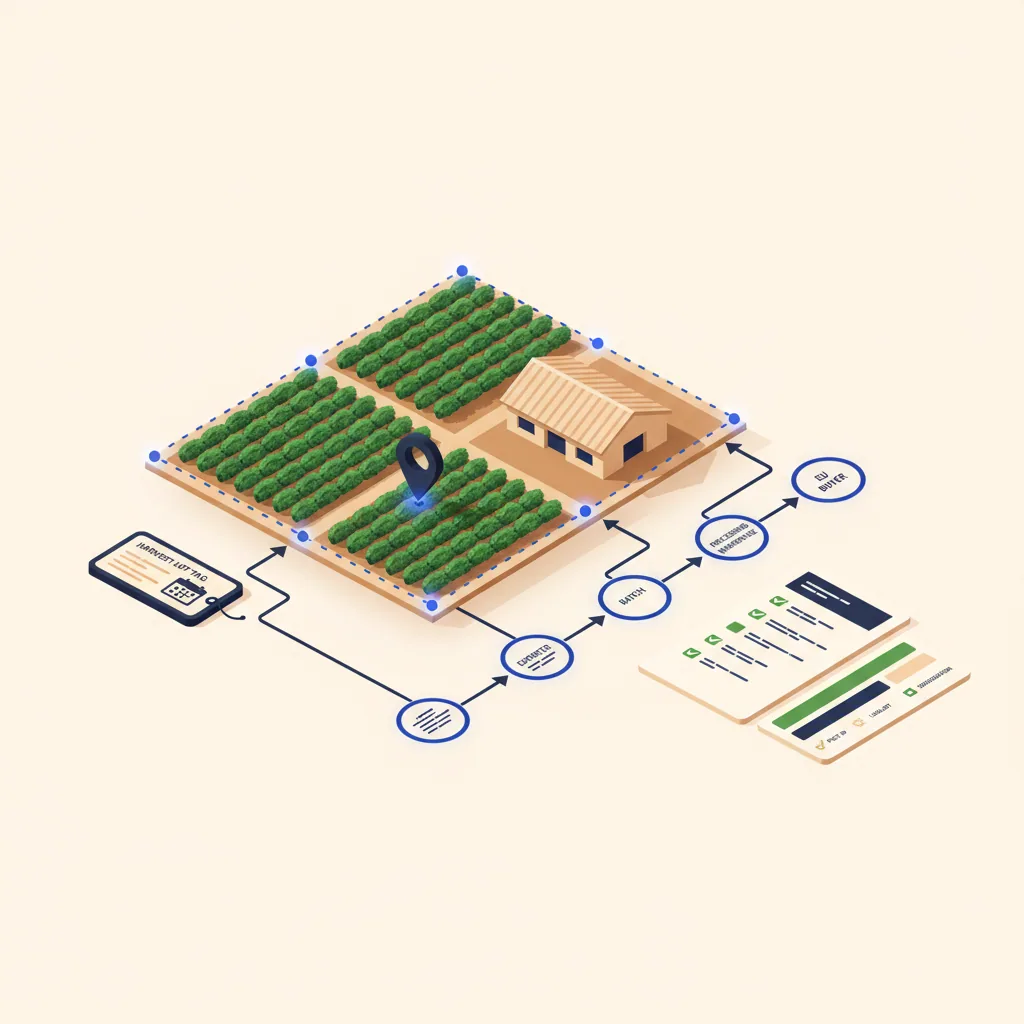
A set of coordinates is not a complete traceability system if the importer cannot tell which goods came from which locations. Build a chain that connects each supplier, producer, plot or cattle establishment to the relevant commodity, harvest or production period, collection point, processor, storage or blending step and final shipment lot. If goods from several plots are mixed, preserve the complete set of source locations and explain the allocation or lot-control method used to connect them to the exported product.
Keep the evidence trail at the level needed to distinguish a known source from an unknown or unlinked source. A purchase invoice can show who sold the goods, but it may not establish where the commodity was grown or harvested. A farm map can show a location, but it may not prove that the shipped batch came from that plot. Reconcile both the physical chain and the documents, and record any point where identity, quantity or origin stops matching.
Traceability records to reconcile
- Producer and plot/establishment records.
- Harvest, collection, purchase and weighment records where relevant.
- Cooperative, aggregator, mill or processor receipts and lot references.
- Storage, blending, transformation and batch-allocation records.
- Commercial invoices, packing lists, shipment lots and the final product description.
6. Ask for evidence of deforestation-free production and legality
The EUDR's deforestation-free criterion concerns land that has not been subject to deforestation after 31 December 2020; for wood, the Regulation also addresses forest degradation. The upstream operator must obtain adequately conclusive and verifiable information that the relevant products are deforestation-free and that the commodities were produced in accordance with relevant legislation in the country of production. The legality assessment is country- and commodity-specific; do not assume that one generic certificate proves every relevant legal requirement.
Depending on the product and country, useful evidence may include land-use or tenure records, harvest or production permissions, applicable forest or environmental permits, tax or trade records, processor licences and other records that support the legal right to produce the commodity. Certification schemes and third-party audits can be useful information, but the Commission's guidance treats them as possible evidence inputs rather than an automatic substitute for the operator's due diligence. Record which requirement each document supports, its issuer, validity period, scope and the plot or lot it relates to.
Evidence review questions
- Does the document identify the same producer, plot, establishment, commodity and period as the shipment?
- Does it support the specific legal requirement in the country of production, rather than merely show general company registration?
- Can the issuing body, record number, validity and scope be checked through an appropriate source?
- Does the evidence cover every plot or relevant establishment linked to the goods?
- Are there gaps, conflicting maps, unsupported claims or substantiated concerns that require escalation?
7. Apply country-risk simplification carefully
The Commission explains that where all relevant commodities and products come from countries or parts of countries classified as low risk, the upstream operator may use simplified due diligence and may not need to complete the full risk-assessment and mitigation steps under Articles 10 and 11. That does not remove the obligation to collect the relevant Article 9 information. The operator must still consider supply-chain complexity and the risk of circumvention or mixing with goods of unknown origin or from standard- or high-risk areas.
If the operator becomes aware of relevant information or a substantiated concern suggesting non-compliance or circumvention, the simplified route is no longer enough and the full due-diligence obligations must be completed. Do not mark a product low risk solely because one supplier or country is labelled low risk. Keep the country benchmark, product origin, plot records, chain complexity and any mixing or diversion concerns in the evidence file.
Risk decision fields
- Current Commission country or regional risk classification and date checked.
- Whether every relevant commodity in the product has the same origin and risk category.
- Supply-chain complexity, intermediaries, processing and mixing risks.
- Any substantiated concern, contradictory evidence or unknown-origin input.
- Reason for using simplified or full due diligence and the responsible reviewer.
8. Understand what downstream buyers must retain after the 2025 simplification
The 2025 EUDR amendment changed how responsibilities are distributed. The Commission's current roles page explains that downstream operators and traders generally do not have to carry out the upstream due-diligence process or submit their own due-diligence statements. They must collect and keep specified information about suppliers and buyers for at least five years and notify buyers and competent authorities if they discover that a product might not comply. Large downstream operators and traders also have Information System registration and limited verification duties where they become aware of possible non-compliance; SME downstream operators and traders have lighter requirements.
The first downstream operator or trader buying from an upstream operator or micro/small primary operator must collect and retain the due-diligence statement reference number or simplified-declaration identifier for at least five years. The Commission says that identifier does not have to be passed on to the next buyer. This is why the buyer should identify its actual role before sending a supplier request: asking every downstream customer to prepare a new due-diligence statement can create unnecessary work and misstate the current responsibility split.
Role-specific handoff
- Upstream operator: complete applicable due diligence and submit the due-diligence statement or simplified declaration.
- First downstream operator or trader: obtain and retain the upstream reference number or identifier for at least five years.
- Other downstream operators and traders: retain the information required for their role and notify relevant parties if they learn of possible non-compliance.
- Large downstream actors: check current Information System registration and concern-triggered verification requirements.
- Non-EU supplier: provide accurate origin and production evidence requested by the EU customer; do not claim that the supplier itself is the EU declarant unless its role actually makes it so.
9. Use the TRACES Information System correctly
The EUDR Information System is a specialised tool on the TRACES platform. It allows operators and authorised representatives to create due-diligence statements and simplified declarations and submit them to the relevant authorities. The Commission states that submissions made in the production environment have legal value and can be checked by competent authorities. The acceptance environment is for training and testing; submissions there do not have legal value and cannot demonstrate compliance.
The Information System supports plot locations entered individually or in bulk, including GeoJSON for bulk coordinate data. Keep the original supplier file, the transformed upload file, the validation result and the final statement reference together. Needo can help organize and check the data structure, but the operator or authorised representative must use the official production system and take responsibility for the legal declaration.
Before an official submission
- Confirm the correct production environment and user role.
- Validate product, quantity, country, supplier, buyer and geolocation fields.
- Check the current technical file format and any GeoJSON validation requirements.
- Retain the submitted statement or simplified-declaration identifier and its source records.
- Do not treat an acceptance-server test submission as a legal filing.
10. Copy-ready supplier data request
Send a product-specific request to the supplier or upstream producer that can identify the origin. Replace the bracketed fields, attach a clear lot list and ask the supplier to explain any unavailable information. If the supplier is an intermediary, ask it to identify the upstream producer or cooperative that holds the production-location records.
Supplier request checklist
- Please confirm the product description, Annex I CN/HS code, relevant commodity, quantity and country/region of production.
- Please provide the geolocation of every relevant plot or cattle establishment and the production date or time range.
- Please identify the producer, supplier, any cooperative or processor, and the person responsible for the location records.
- Please provide the plot or establishment IDs and the original coordinate or boundary file; identify the format and coordinate reference used.
- Please explain how each plot is linked to the supplied batch, including collection, processing, storage, blending and shipment references.
- Please provide the available evidence that the relevant commodity is deforestation-free and was produced legally in the country of production.
- Please identify any certification or audit evidence, its issuer, scope, validity and the specific plots or lots it covers.
- Please mark missing, conflicting or unavailable data explicitly and provide the reason, owner and expected resolution date.
11. Worked example: coffee sourced through a cooperative
Illustrative scenario: an EU roaster buys green coffee from an exporter that purchases through a cooperative. The exporter can provide the invoice, export documents and warehouse lot, but the EU buyer needs production locations. The cooperative maps each member farm to a producer ID, plot location and harvest period. The exporter links the cooperative delivery tickets and lot records to the warehouse batch, then links that batch to the shipment and product description. The EU operator checks the current CN code, its role, the country-risk classification and whether any mixing or unknown-origin input remains.
If a plot coordinate is missing or a warehouse batch cannot be traced to its source farms, the buyer does not mark the record complete simply because the cooperative is known. It asks for the missing location or a documented explanation, records the unresolved lot and keeps the product out of a positive due-diligence conclusion until the responsible operator has enough evidence. This example is illustrative and is not a claim about a real Needo customer or a real coffee supplier.
Decision record
- Verified: exporter, cooperative and shipment lot identities are linked.
- Supplier-stated: farm locations and harvest periods received, pending review.
- Open: two farm polygons and one batch-allocation record remain missing.
- Next move: request the missing source records and keep the affected lot on hold for the operator's due-diligence decision.
12. Use Needo to prepare the EUDR supplier evidence file
Needo can turn the product, supplier and shipment facts into a role-aware data request, plot register, lot-to-plot traceability matrix and evidence-gap report. It can compare supplier files, identify missing coordinates or dates, check whether each document is linked to the relevant product and prepare a structured handoff for the EU operator or authorised representative. It can also help distinguish upstream due-diligence work from the narrower record-keeping tasks of downstream operators and traders.
Needo does not certify that land is deforestation-free, independently verify remote-sensing or land-use evidence, issue a due-diligence statement, submit a legal declaration or replace the operator's risk assessment. The responsible operator must evaluate the current legal text, country and commodity evidence, and competent-authority instructions before placing or exporting relevant products.
13. Final EUDR supplier-data checklist
The objective is not to collect the largest number of files. It is to make every relevant product and lot traceable to the required production information and evidence, with the correct supply-chain role and responsible owner recorded. A blank coordinate, unknown plot, unsupported legality claim or unlinked mixed lot should remain visible until resolved.
Before the applicable deadline
- Exact Annex I product code and relevant commodity confirmed.
- Upstream, downstream, trader and first-downstream roles identified.
- Company-size and EUTR transition deadline checked against current Commission guidance.
- All relevant plot or cattle-establishment locations and production dates collected.
- Product quantity, supplier, buyer and country-of-production data reconciled.
- Every lot linked through collection, processing, storage, mixing and shipment records.
- Deforestation-free and country-of-production legality evidence reviewed for scope and relevance.
- Risk category, simplified/full due diligence route and any concerns documented.
- TRACES production filing and five-year record-retention responsibilities assigned to the correct actor.
Sources and further reading
- European Commission — Understand Due Diligence under the EUDR
Official Article 9 information, plot geolocation and production dates, deforestation-free and legality evidence, risk assessment and simplified due-diligence guidance.
- European Commission — Roles and Responsibilities under the EUDR
Current role definitions, downstream and trader record-keeping, first-downstream reference-number retention, company-size duties and the 30 December 2026 / 30 June 2027 application dates.
- European Commission — EUDR Information System
Official TRACES Information System, production versus acceptance environments, due-diligence statements and support for bulk GeoJSON geolocation data.
- European Commission — Implementing the EU Deforestation Regulation
Official implementation hub covering product scope, current deadlines, guidance, FAQs, country benchmarking and supply-chain resources.
- European Commission — FAQ on EUDR Implementation, published 21 August 2026
The Commission's current FAQ publication page and downloadable implementation questions. Check the latest FAQ and legal text for product-specific or role-specific questions.
Sources support the specific points noted above. Confirm current requirements for your product, destination and contract before committing.
Need the actual problem solved?
This guide explains the method. Needo can work from your specific requirement, compare relevant options, verify important details and help move the next step forward.
Start with your exact problem →Selling or exporting? See live buyer requirements by product · see a sample verified shortlist