NEEDО · SAAS VENDOR DUE DILIGENCE
How to Review a SOC 2 Report Before Choosing a SaaS Vendor
A SaaS vendor may send a SOC 2 report as soon as procurement asks about security. That is useful evidence, but it is not a universal security certificate and it does not automatically cover every product, region, data flow or control your organization depends on. A report can be well prepared and still be out of scope for the service you plan to buy; it can have a clean opinion while containing exceptions that matter to your use case; and it can assume that your own team operates controls that nobody has assigned. This guide gives buyers a structured way to review the report and turn it into a vendor decision. It is not a security audit, legal opinion or substitute for your organization's risk policy.
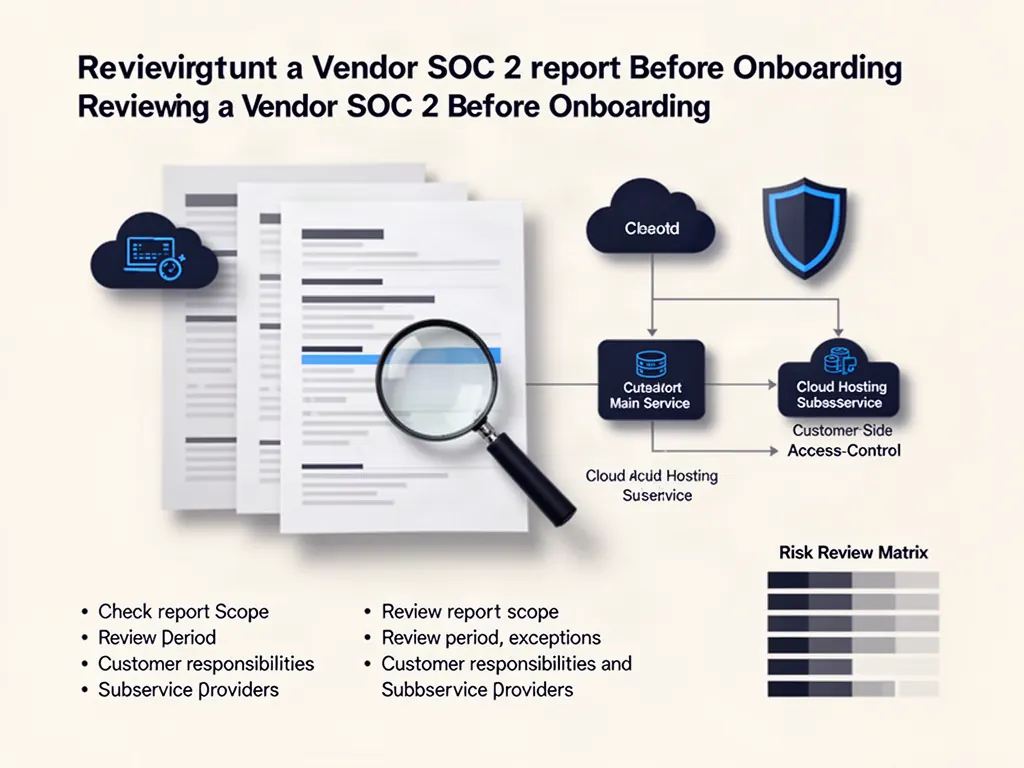
Understand what a SOC 2 report does—and does not—say
SOC 2 is an examination and reporting framework developed by the American Institute of Certified Public Accountants (AICPA) for controls relevant to security, availability, processing integrity, confidentiality and privacy at a service organization. It is not a product certification or a blanket statement that a company is secure. The report describes a defined system and the controls examined against the selected Trust Services Criteria. The exact service, environment, period and categories matter.
Ask for the actual report through the vendor's approved confidential-sharing process, not only a website badge, sales slide or statement that the company is SOC 2 compliant. A full report may contain restricted-use language and sensitive operational details. Share it only with people authorized under your agreement or NDA, and avoid uploading customer secrets or unrelated personal data into a review workflow.
Do not treat these as equivalent
- A SOC 2 report is not the same as an ISO 27001 certificate.
- A SOC 2 report is not a penetration-test report or vulnerability scan.
- A SOC 2 report does not automatically cover every product or region a vendor sells.
- A SOC 2 report does not replace your contract, privacy review or security assessment.
- A marketing badge or vendor questionnaire is not the full service auditor's report.
Confirm the vendor, product and system boundary
Start with the system description and the legal entity named in the report. Confirm that the organization being assessed is the entity contracting with you, or document the parent, subsidiary or affiliate relationship. Then find the specific product, service, platform, environment and locations in scope. A vendor may operate several products but have examined only one service or a particular hosting environment.
Compare the report's description with the service you will actually use. Map where your data enters, which features process it, where it is stored, which support teams or subcontractors can access it, and which regions or environments are involved. If the report does not describe a material part of your service, record that as a scope gap and ask for the right evidence. Do not infer that a whole company is covered because its name appears on the cover.
Scope questions
- Does the report name the exact legal entity and product we will contract for?
- Are the production environment, hosting region and relevant service components included?
- Does the description cover the data types and processing activities we will use?
- Are support, customer success, backup, disaster recovery and privileged-access paths described where material?
- Which material systems or locations are explicitly outside the examination?
Check Type I or Type II and the covered period
A Type I report addresses whether controls were suitably designed at a specified date. A Type II report addresses design and operating effectiveness over a defined period. The report itself should state the examination type and the dates covered. For a vendor whose controls must operate consistently over time, a Type II report may provide more evidence about operation, but the right requirement depends on your risk tier, procurement policy and the service being purchased.
Record the period end date and compare it with the date of your review. Do not invent a universal expiry date for SOC 2 reports; your organization should set its own freshness and reassessment requirements. If there is a gap between the end of the report period and today, ask what evidence covers that interval. A bridge or gap letter is typically a management statement about changes since the report period. It is not a new auditor examination and should not be described as equivalent to a fresh Type II report.
Period and continuity checks
- Report type, issue date, start date and end date recorded.
- The period is appropriate for the vendor's criticality and your internal policy.
- Changes since period end are described and supported where possible.
- A bridge letter identifies the period covered, signer and any material changes or incidents.
- The next report or reassessment date is assigned to an owner.
Read the opinion and the testing exceptions
Read the service auditor's opinion and the basis for any qualification, adverse opinion or disclaimer. Then read the testing section and the exceptions. A clean or unmodified opinion does not necessarily mean that every control test had zero exceptions. The report may contain a specific exception that the auditor judged not to change the overall opinion. The buyer still needs to decide whether that exception affects the service, data or risk being assessed.
For each exception, capture the control, criterion, test performed, sample or instance information, result, vendor explanation, remediation status and any compensating control. Distinguish a control that failed once and was corrected from a recurring or unresolved failure. Do not rely only on a vendor's summary of remediation; identify whether the report contains auditor-tested evidence, management's response or a later independent retest.
Exception review fields
- Control identifier and Trust Services Criteria mapping.
- What the auditor tested and the period or sample involved.
- Exact exception and whether it is isolated, recurring or unresolved.
- Vendor response, corrective action, owner and completion date.
- Evidence that remediation was independently tested, if available.
- Impact on our use case and any compensating control we can operate.
Check which Trust Services Criteria categories are in scope
The five Trust Services Criteria categories are security, availability, processing integrity, confidentiality and privacy. A report may include the categories relevant to the service; do not assume that every category is included. Security is the common baseline, while the additional categories should be assessed against what the vendor actually does for you.
For a service that stores business records, confidentiality may matter. For a payment or data-processing service, processing integrity may matter. For a platform that supports a critical business process, availability may matter. For a service processing personal information, privacy commitments and your separate privacy obligations need attention. If a category your use case depends on is not in scope, that is a question to resolve—not proof that the vendor has no controls in that area.
Current-criteria note checked on 7 November 2026: the AICPA resource library lists a proposed 2027 SOC 2 Trust Services Criteria and Description Criteria exposure draft dated 26 October 2026. It is labelled as a proposal, not an in-force replacement. When reviewing an issued report, record the criteria version cited in that report and do not re-grade it against an exposure draft unless the applicable professional requirements have actually changed.
Match categories to the business use
- Security: protection against unauthorized access and system compromise.
- Availability: whether the service meets its stated availability commitments.
- Processing integrity: whether processing is complete, valid, accurate, timely and authorized.
- Confidentiality: protection of information designated confidential.
- Privacy: handling of personal information under the service's stated commitments.
- Out-of-scope category: record the gap and request targeted evidence or a compensating control.
Extract Complementary User Entity Controls and assign owners
A SOC 2 report can describe controls that the vendor assumes its customers will operate. These are Complementary User Entity Controls (CUECs). They matter because the vendor's controls and your own controls may need to work together. Common examples include timely removal of former employees, protecting credentials, reviewing access rights, configuring security settings or notifying the vendor about relevant events.
Do not file CUECs as generic boilerplate. Copy each one into your vendor record, translate it into an action your organization understands, assign an internal owner and identify the evidence that will show it operates. If nobody owns a required customer-side control, the report may not provide the assurance your team assumes it does.
CUEC mapping
- Exact CUEC wording and report reference captured.
- Internal process or technical control that satisfies it identified.
- Owner and evidence source assigned.
- Control is implemented for the users and data involved.
- Any CUEC that cannot be met is recorded as an open risk or contract question.
Review subservice organizations and fourth-party dependencies
A SaaS provider may rely on cloud hosting, payment processors, identity providers, support platforms, monitoring services or other subservice organizations. The report should explain how material subservice organizations are treated. Under an inclusive method, relevant controls may be included in the service organization's description and examination. Under a carve-out method, the subservice organization's controls are excluded from that examination and the vendor describes the relevant dependencies and complementary subservice organization controls.
A carve-out is not automatically a failure; it means the vendor's report does not provide the same direct testing evidence for that provider. Identify the material dependencies and ask whether separate assurance, contractual commitments or other evidence is available. The review should focus on dependencies that can affect your data, availability, security or business continuity rather than demanding every document from every minor tool.
Dependency questions
- Which hosting, identity, payment, support or data-processing providers are material?
- Are they included or carved out in the report?
- For a material carve-out, what separate assurance or control evidence is available?
- Are relevant subservice controls and responsibilities explained?
- Does the vendor monitor material providers and respond to incidents or service changes?
Connect the report to your contract and real operating risk
A SOC 2 report is one input to a vendor decision. Compare it with your data classification, user access model, service criticality, regulatory obligations, geographic restrictions and exit requirements. Review the contract and service terms for breach notification, incident cooperation, audit or assurance rights, data return and deletion, subcontractor changes, retention, backup, recovery, service levels and termination assistance. The report may not answer every one of those questions.
For technology supply chains, NIST's July 2026 due-diligence quick-start guide describes research into suppliers and products as part of informed acquisition decisions and scopes its assessment to ICT suppliers. Use that as a broader risk-management reference, not as a substitute for your organization's policy or a requirement that every SaaS provider meet the same checklist.
Questions beyond the SOC 2 report
- Which data categories and users will the service handle?
- Which regions, subprocessors and support locations are involved?
- How are incidents reported, investigated and communicated?
- What recovery objectives, backup arrangements and service levels are contractually committed?
- How will our data be exported, returned or deleted when the contract ends?
- Which risks require a privacy, legal, architecture or security specialist review?
Make a proceed, clarify, mitigate or hold decision
Avoid a single SOC 2 pass/fail score that hides the use case. Proceed when the report covers the relevant system and period, material exceptions are understood, customer-side controls are owned and the remaining contract and operational risks are acceptable under your policy. Clarify when the vendor can provide missing scope, period or subservice information. Mitigate when a gap can be covered by a documented technical, contractual or procedural control. Hold or reject when a material requirement cannot be supported or an unresolved issue exceeds your risk appetite.
Record the decision owner, report version, evidence date, accepted exceptions, compensating controls, renewal trigger and next review date. A vendor can be suitable for a low-risk workflow but unsuitable for a service handling sensitive or business-critical data. The decision must match the actual use.
Decision labels
- PROCEED: report scope and evidence are adequate for the stated use and policy.
- CLARIFY: request a specific missing report section, period, scope or dependency detail.
- MITIGATE: document the control, owner, evidence and residual risk.
- HOLD: a material gap, exception or contract issue remains unresolved.
- REASSESS: revisit when the service, data, region, report period or subprocessor changes.
Copy-ready SOC 2 vendor review checklist
Use this checklist as a review record, not as a certification of the vendor. Keep the report under the confidentiality terms that govern it and record the source, reviewer and date.
- Vendor legal entity and exact product or service matched.
- System description and production environment cover the service we will use.
- Report type, issue date and covered period recorded.
- Trust Services Criteria categories in scope match the use case.
- Auditor opinion and basis reviewed.
- Every relevant testing exception captured and assessed.
- Vendor remediation statements distinguished from auditor-tested evidence.
- CUECs mapped to internal controls, owners and evidence.
- Subservice organizations and inclusive or carve-out method identified.
- Material fourth-party assurance gaps addressed.
- Bridge or gap letter reviewed as management representation.
- Contract, privacy, incident, availability, retention and exit questions resolved.
- Risk decision, approver, accepted exceptions and reassessment date recorded.
Use Needo to turn the report into a reviewable vendor decision
Needo can help extract the report's system boundary, period, criteria, opinion, testing exceptions, CUECs and subservice organizations, then compare those findings with your actual service use, data and contract requirements. Give it the report you are authorized to share, the vendor and product name, your intended use, data categories, criticality and internal policy. Ask it to show the page or section supporting each finding, separate auditor evidence from vendor statements and prepare the questions that need a security, privacy, legal or procurement owner.
Needo does not conduct a SOC examination, issue an audit opinion, certify a vendor, guarantee security or approve a supplier on your behalf. The useful output is a traceable review file with scope boundaries, exceptions, customer-side responsibilities, open questions and a decision path for the authorized owner.
Sources and further reading
- AICPA — System and Organization Controls: SOC Suite of Services
Official AICPA resource library for SOC engagements, including the SOC 2 guide and Trust Services Criteria.
- AICPA — 2018 SOC 2 Description Criteria with 2022 Revised Implementation Guidance
Official criteria used when preparing and evaluating the description of a service organization's system in a SOC 2 examination.
- NIST — SP 1326, Cybersecurity Supply Chain Risk Management: Due Diligence Assessment Quick-Start Guide
Published July 2026; describes due-diligence research for ICT suppliers and products as an input to acquisition decisions.
- NIST — SP 800-161 Rev. 1, Cybersecurity Supply Chain Risk Management Practices
NIST guidance on cybersecurity supply-chain risk management and the risks created by external products and service providers.
Sources support the specific points noted above. Confirm current requirements for your product, destination and contract before committing.
Need the actual problem solved?
This guide explains the method. Needo can work from your specific requirement, compare relevant options, verify important details and help move the next step forward.
Start with your exact problem →Selling or exporting? See live buyer requirements by product · see a sample verified shortlist