NEEDО · SUPPLIER MANAGEMENT
Supplier Performance Scorecard: How to Evaluate Suppliers for Repeat Orders
A supplier that won one quotation is not automatically the right supplier for every repeat order. Over time, quality defects, delivery misses, quantity errors, unplanned charges and slow issue resolution can outweigh a small unit-price advantage. A supplier performance scorecard makes those trade-offs visible by applying the same criteria to each supplier and tying ratings to evidence. It is most useful when the team agrees on the decision it supports, defines the scoring rules before reviewing results and treats serious failures as gates rather than allowing a high average to hide them. The example weights below are a starting point to adapt, not an industry standard.
Decide what the scorecard needs to help you decide
A scorecard for awarding a new contract is different from a review of a supplier that already ships every month. Before building the template, decide whether you are comparing candidates, reviewing the last quarter, deciding whether to renew an agreement, preparing a corrective-action meeting or identifying a second source. Define the supplier, product family, locations, evaluation period, order population and decision owner. If those boundaries change between suppliers, the scores may look precise while describing different things.
Set the operational questions first. Does the supplier consistently meet the approved specification? Are deliveries complete and on time against the dates that were actually agreed? Are invoices aligned with quotes and purchase orders? Does the supplier respond quickly enough when a problem occurs? Is capacity available for the next period? The right measures depend on the product and risk: a critical component, a commodity, a logistics provider and an office-supplies vendor should not automatically use the same scorecard.
Define the review scope
- Supplier legal entity, site and product or service category
- Evaluation period and orders included or excluded
- Baseline specification, service level and delivery commitments
- Decision the scorecard supports and who can approve it
- Data owner, reviewer and next review date
Separate mandatory gates from weighted criteria
Some requirements should be pass/fail rather than a score. Examples may include a legally required approval, a safety-critical specification, an essential certificate, a prohibited-party screening result or a technical requirement that the product must meet. If a mandatory gate fails, the supplier should not win merely because it is inexpensive or responsive. Record the gate, the evidence, the reviewer and the action required; do not convert a critical failure into a small numerical penalty.
Use weighted criteria for trade-offs that can legitimately be compared after the gates pass. Price, lead time, responsiveness and service flexibility may be scored, but only against a defined requirement and comparable evidence. If a required certificate is expired or a serious quality issue remains unresolved, show the exception separately and follow the organization's approval process. A scorecard supports judgment and governance; it should not replace legal, quality, engineering, compliance or safety review.
Possible pass/fail gates
- Mandatory legal, regulatory or safety requirements satisfied
- Required specification and technical approvals current
- Critical quality or traceability documents available
- No unresolved issue that policy requires to block an award or renewal
- Material identity or compliance concerns escalated to the responsible reviewer
Choose a small set of criteria and set weights in advance
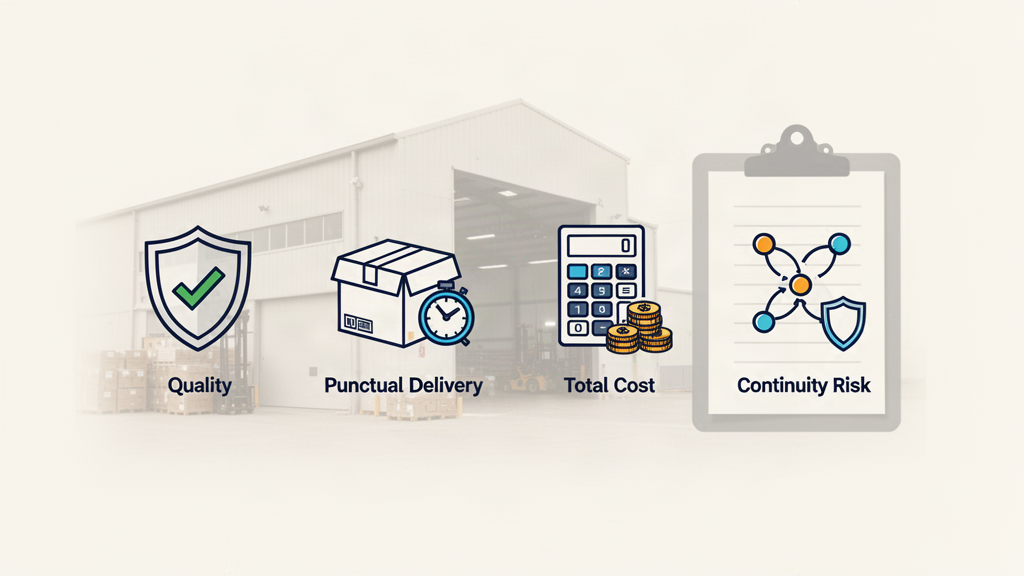
Keep the model small enough that the team can maintain it. A practical starting set might include quality and specification conformity, delivery reliability, total cost, responsiveness and problem resolution, documentation, and capacity or continuity. For a safety-critical product, quality and compliance may dominate. For a time-sensitive service, delivery and recovery capability may matter more. For a commodity purchase, total cost and consistency may carry more weight. Write down why each criterion matters before looking at the supplier results.
Illustrative starting weights for a routine repeat-order purchase could be quality 30%, delivery 25%, total cost 20%, responsiveness and corrective action 10%, documentation 10%, and continuity or capacity 5%. These numbers are not a benchmark or recommendation for every category. Adjust them to the business impact, mandatory requirements and available data, and make sure the weights total 100%. Do not change the weights after seeing which supplier wins; if the model needs to change, document the reason and apply the revised method consistently.
Scorecard fields
- Criterion and weight
- Definition of what a score of 1, 3 or 5 means
- Source data, period and denominator
- Actual result and evidence URL or document reference
- Score, weighted contribution and reviewer note
- Mandatory gate status, exception and corrective action
Rate evidence rather than memory or personal preference
Use a shared scale with definitions that can be applied consistently. For example, a score of 5 might mean the supplier consistently meets or exceeds the agreed requirement with strong supporting evidence; 3 might mean it meets the minimum requirement but has a documented gap or limited flexibility; 1 might mean repeated material failure against the defined requirement. Specify what 2 and 4 mean as well, and allow not assessed when evidence is missing. A blank or unknown should not quietly become an average score.
For delivery, calculate the on-time rate using a defined denominator and the delivery date that was contractually or operationally agreed, including rules for approved date changes. For quality, record defects, rejected lots or returns against the relevant quantity and period. For cost, compare invoice and quote on the same scope and currency, including agreed surcharges and change orders. For responsiveness, define the expected response or resolution time. Keep the raw data and source with the score so another reviewer can reproduce it.
Evidence to collect
- Quality: defects, nonconformances, inspection results and corrective-action closure
- Delivery: agreed date, actual date, complete quantity and approved changes
- Cost: quoted amount, invoice amount, approved changes and relevant fees
- Service: response time, escalation quality and issue resolution
- Documentation: accuracy, completeness and timeliness of required records
- Continuity: current capacity, lead-time changes and credible recovery plans
Calculate the weighted result and show what it hides
For each scored criterion, multiply the rating by its weight expressed as a decimal, then add the weighted contributions. If a criterion has a weight of 25% and a score of 4 out of 5, it contributes 1.00 point to a five-point total. The formula is easy; the important work is defining the scale, using comparable evidence and deciding how missing data is handled. If a criterion is not assessed, do not automatically treat it as zero or remove its weight without stating the method. Make the missing evidence visible and decide whether the result is still comparable.
Illustrative example only: Supplier A scores 4 for quality, 3 for delivery and 5 for cost; Supplier B scores 5 for quality, 4 for delivery and 3 for cost. If those three criteria have weights of 40%, 35% and 25%, A scores 3.90 and B scores 4.15 before any other criteria or mandatory gates. This example shows how the weighting changes the result; it does not establish that either supplier is suitable. A critical safety or specification failure should remain a separate gate, not be averaged away by a low price or strong delivery score.
Read the result carefully
- Show the overall score and every criterion contribution
- List gates, exceptions and missing evidence beside the score
- Use the same weights and scale for suppliers in the same comparison
- State the period, sample size and data limitations
- Keep a narrative reason for the recommendation and reviewer approval
Review trends and root causes, not just one period's total
A single average can hide a deteriorating trend. Review scores across consistent periods and look at the underlying events: repeated late deliveries, a spike in defects, unapproved substitutions, invoice mismatches or a change in capacity. Separate a supplier-controlled failure from an internal forecast change, late buyer approval or an agreed schedule revision. The point is to understand what happened and what evidence would demonstrate improvement, not to assign blame based on a number alone.
Use measures that fit the category and can be measured reliably. A small number of orders can make percentages unstable, so show the count as well as the rate and avoid overinterpreting one incident. For critical exceptions, report the actual event even if the overall score remains high. If the supplier relies on an upstream source, shared facility or single production line, record the dependency and the plan for handling a disruption. NIST's supply-chain guidance emphasizes mapping dependencies and assessing risk; apply the parts relevant to your product and operating context rather than copying a generic risk formula.
Questions for the review meeting
- Which result changed most from the previous period, and what evidence explains it?
- Was the target realistic and consistently applied to all suppliers?
- Is the root cause confirmed or still a hypothesis?
- What corrective action would reduce recurrence, and how will it be verified?
- Does the issue affect upcoming orders, customer commitments or continuity plans?
Turn a low score into an owned corrective action
A scorecard should lead to a decision, not merely a ranking. For each material gap, write the observed problem, evidence, expected standard, root cause if known, corrective action, owner, due date and proof of closure. Agree how progress will be checked and what happens if the action fails. A supplier may need a corrective-action plan, additional inspection, a limited pilot, a revised forecast, a commercial discussion, a restricted scope or a qualified alternative source. Choose the response proportionately to the risk and contract.
Do not renew, terminate or award solely because a numeric threshold was crossed unless that rule has been approved for the relevant contract and context. A high score does not prove every legal, technical or compliance requirement is met, and a low score does not explain why performance slipped. Keep the evidence, exception and decision trail so procurement, quality, operations and finance can review the same facts. Reassess whether the scorecard is still useful as the category, supplier, specification or risk changes.
Corrective-action record
- Observed gap and supporting evidence
- Required standard and agreed correction
- Action owner and target date
- Interim controls for open orders or customer risk
- Verification method and closure evidence
- Decision if the issue recurs or remains unresolved
Use Needo to tailor the scorecard to your actual category
Needo can help turn your procurement requirements and supplier records into a consistent evaluation template, calculate weighted scores from the figures you provide, compare quotes and identify missing evidence. Give it the category, mandatory requirements, evaluation period, supplier performance data and the decision you need to make. Ask it to keep proposed weights adjustable, preserve the source and date for each material claim, separate pass/fail gates from preferences and show the assumptions behind the recommendation.
The responsible procurement, technical, quality and compliance owners still need to approve the criteria and decision. Needo should not invent supplier performance, certify a company or automatically award business. The useful outcome is a repeatable scorecard that exposes the trade-offs, identifies the open risks and assigns the next action with a clear owner and verification method.
Sources and further reading
- NIST Manufacturing Extension Partnership — Supply Chain Management
Official manufacturing resource on supply-chain mapping, risk assessment and supplier scouting; use it to inform category-specific continuity questions rather than as a universal scoring formula.
- U.S. Department of Commerce — Perform Due Diligence
Official guidance on assessing potential international business partners and country risk. It supports the principle of checking evidence and context, not the numerical weights proposed in this article.
- NIST — Supply-chain risk strategies for small manufacturers
Explains supply-chain mapping and dependency analysis that can inform continuity and capacity criteria in a supplier review.
Sources support the specific points noted above. Confirm current requirements for your product, destination and contract before committing.
Need the actual problem solved?
This guide explains the method. Needo can work from your specific requirement, compare relevant options, verify important details and help move the next step forward.
Start with your exact problem →Selling or exporting? See live buyer requirements by product · see a sample verified shortlist