NEEDО · MANUFACTURING PROCUREMENT
Tooling Ownership Before a Supplier Deposit: What Buyers Should Agree
A buyer may pay for a mold, die or fixture that stays inside a supplier's factory and is used to make the buyer's product. That arrangement can work well, but a tooling invoice alone does not explain every right or responsibility. The physical asset, legal title, factory custody, permitted use, maintenance, technical files and retrieval process need to be addressed separately. Agree those points before the deposit, when the parties can still define the asset and the milestones. This guide is a commercial checklist, not a legal opinion; property, contract and intellectual-property rules vary by jurisdiction.
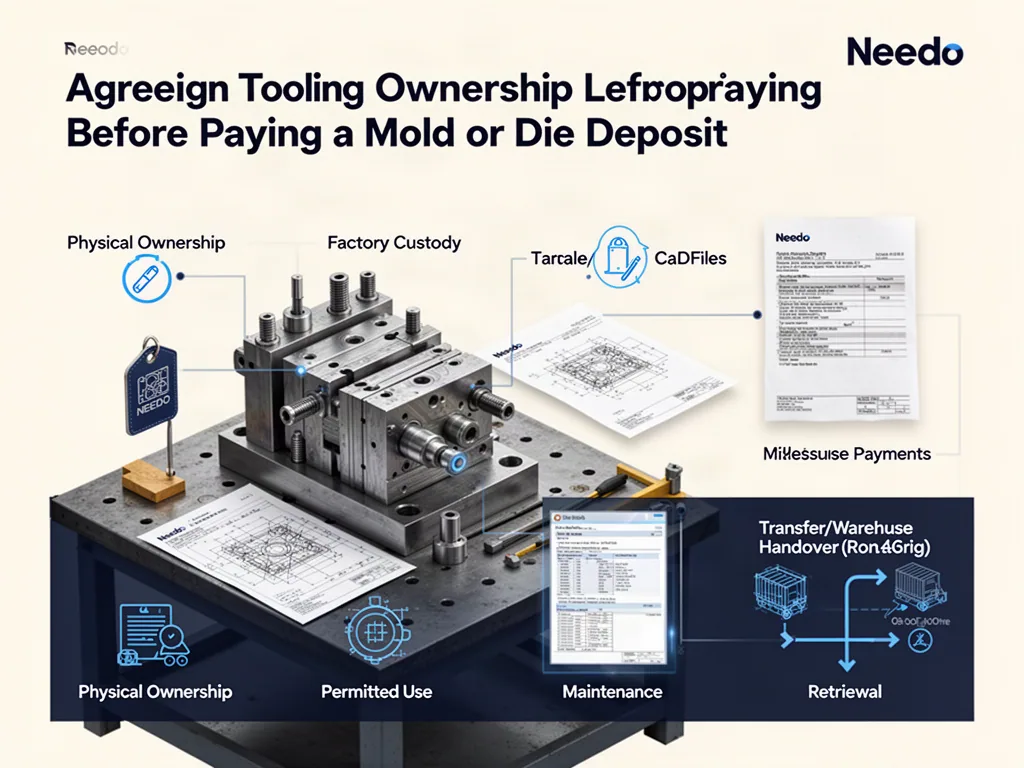
1. Separate ownership, custody, use and technical rights
The first question is not simply who paid. Ask four separate questions: who owns the physical tool, who has possession and control of it, who may use it and for which products, and who owns or may use the drawings, programs and process information needed to operate it. Those rights can sit with different parties. A buyer may own a mold while the supplier stores and operates it; a supplier may own a tool that is dedicated to the buyer's program; or the parties may agree an amortized or shared-cost model.
Put the intended arrangement in the quotation and agreement before the supplier orders steel or begins machining. Do not rely on a sales email that says the mold is yours if the purchase order or manufacturing agreement describes a different title-transfer event, volume condition or retrieval restriction. If the documents conflict, identify the conflict and obtain a written correction before funding the work.
Five questions to answer first
- Who owns the physical tool and when does title transfer?
- Which legal entity and factory site hold the tool?
- What products, customers and locations may the tool be used for?
- Who owns or may use drawings, CAD/CAM files and process know-how?
- How can the buyer inspect, move, replace or retrieve the asset?
2. Create an asset-level tooling description
A line item called tooling or mold may cover several different things. Identify each physical asset separately: mold base, cavities, cores, inserts, dies, jigs, fixtures, gauges, patterns, test equipment, spare components and any dedicated machine attachments. Add the product part number, drawing revision, process, material, cavity count, dimensions, tool material or steel specification, serial or tool number and the site where the asset will be made and stored.
Separate physical assets from digital and technical deliverables. A CAD model, mold-flow study, CAM program, CNC file, source code, process recipe, test method and engineering drawing are not the same thing as the steel tool. The buyer may need a licence, copy, assignment or handover right for some of those items to move production to another factory. State the required files and formats in the scope rather than assuming they are included because the tool was paid for.
Tooling register fields
- Unique asset number, buyer part number and drawing revision
- Tool type, material, cavity count, dimensions and included inserts
- Manufacturer, current location, physical custodian and intended production site
- Tooling cost, engineering cost, trial cost and payment status
- Associated drawings, CAD/CAM files, programs and documentation
- Photographs, identification plate, condition and acceptance record
3. Choose the commercial ownership model explicitly
There is no single correct ownership model for every project. Under a buyer-funded model, the buyer pays the tooling cost and may expect title to transfer at a defined event, while the supplier retains possession for production. Under a supplier-funded or amortized model, the supplier recovers its investment through unit prices or an agreed volume. A shared-investment model divides the cost and needs a clear allocation of title and exit rights. A supplier-owned dedicated tool may be reasonable where the supplier carries the investment and offers a commercial price in return, but the buyer should understand what happens if the relationship ends.
Compare the models using the expected program life, annual volume, design changes, tooling maintenance, second-source strategy, working-capital limits and cost of moving the tool. If a unit price includes tooling recovery, ask for the recovery basis and what happens if actual volume is below forecast. If the buyer pays only part of the tooling cost, define whether that payment buys title, a licence, dedicated capacity or a price concession. Do not assume the word dedicated means buyer-owned.
Models to compare
- Buyer-funded and buyer-owned, with supplier custody during production
- Supplier-funded and supplier-owned, with a defined dedicated-use commitment
- Amortized through unit prices, with a volume or buyout trigger
- Shared investment, with ownership and exit rights allocated in writing
- Leased or temporarily used tooling, with a return date and condition standard
4. Tie payment milestones to objective evidence
A deposit, progress payment and final payment should correspond to identifiable work and evidence. The parties might use design approval, material purchase evidence, machining completion, trial samples, dimensional reports, corrective work and final acceptance as milestones. The exact sequence depends on the tool and process. Define what the supplier must show at each stage, who reviews it, how long the buyer has to respond and what happens if a milestone fails.
Avoid an undefined final payment trigger such as tool complete if the buyer cannot tell whether that means the first trial, a conforming sample, production approval or delivery of the tool. If payment is linked to a sample, identify the sample version, inspection criteria, number of cavities or parts checked, required reports and treatment of rework. If title transfers only after full payment, make that condition consistent across the quotation, invoice, purchase order and agreement.
Milestone evidence examples
- Approved design and tool specification before fabrication
- Progress evidence tied to the identified tool and current revision
- Trial report and sample identification for each required stage
- Dimensional, material or process evidence against buyer-supplied criteria
- Written approval or documented open deviations before final acceptance
- Asset register, photographs and required technical files at handover
5. Define physical custody, marking and location
If the supplier will keep a buyer-owned tool, document the site, building or production area, custodian and conditions of storage. Require a durable asset identifier or plate where practical, and keep photographs and an inventory record that connect the tool to the buyer's part and drawing revision. Agree whether the supplier may move the tool to another building, factory, tool shop or subcontractor. If movement is permitted, require prior notice, approval where appropriate and an updated location record.
Access rights should be operational rather than vague. State how the buyer or its appointed inspector can confirm the tool's existence and condition, what notice is required, what safety or confidentiality rules apply and which records can be reviewed. If the supplier stores several customers' tools, the buyer should be able to identify its own asset without relying only on the supplier's internal label.
Custody controls
- Tool number and buyer ownership or dedicated-use marking where appropriate
- Named site and custodian with a process for location changes
- Inventory record and dated condition photographs
- Storage, corrosion prevention, security and access requirements
- Inspection or inventory-confirmation rights
- Disclosure and approval process for any subcontracted storage or movement
6. Restrict use to the agreed products and program
The agreement should state which products, revisions, purchase orders, customers and facilities the tool may serve. If the tool is buyer-owned or dedicated, specify whether the supplier may use it for another customer, a competing product, a sample run or an unapproved production site. Address copies, replacement inserts, modifications and any transfer to a subcontractor. A general promise to use the tool carefully does not explain the commercial permission the buyer is granting.
If the supplier is allowed to use the tool for related products or affiliates, describe that permission and how it can be withdrawn. If the buyer needs exclusivity, define its scope and duration rather than assuming that a dedicated tool creates a broad market or product exclusivity right. The agreement should also explain how unauthorized use is reported, investigated and remedied under the governing law.
Permitted-use questions
- May the tool be used only for the buyer's approved part numbers and orders?
- Can it be moved, copied, modified or used at another site?
- Are subcontractors allowed to possess or operate it?
- Who approves new cavities, inserts, programs or engineering changes?
- What records show production use and cycle counts?
- What happens if unauthorized use or a tool-location discrepancy is found?
7. Allocate maintenance, wear, repairs and insurance
A tool can be correctly identified and still become unusable if maintenance is neglected. Define routine cleaning, lubrication, corrosion prevention, storage, preventive maintenance, inspection intervals, cycle or shot-count records and responsibility for consumable inserts. Distinguish normal wear from damage caused by misuse, poor storage, unauthorized changes or a process outside the agreed conditions. The right allocation depends on the asset, production volume and contract.
Repairs and modifications should have a documented approval route. Ask the supplier to identify the fault, likely cause, proposed work, cost, expected downtime and whether a sample or process requalification is needed after the repair. Address insurance or other risk allocation for theft, fire, flood, transport damage and loss while the tool is in the supplier's or a subcontractor's custody. Do not assume that a supplier's general factory insurance covers a customer's tool at its full replacement value.
Maintenance and loss controls
- Preventive maintenance schedule and responsible technician
- Cycle count, repair history and condition reports
- Written approval for material modifications or replacement components
- Allocation of normal wear, misuse, repair and replacement costs
- Insurance or agreed risk-of-loss arrangement for the tool's location and value
- Requalification or sample approval after a material repair or change
8. Treat drawings, software and know-how as separate rights
A physical mold does not automatically give the buyer every right needed to reproduce the product elsewhere. Drawings, CAD/CAM files, programs, process parameters, prototypes, test data, designs and confidential manufacturing know-how may have separate ownership, licence or confidentiality terms. Identify which items the buyer supplies, which the supplier creates, which are pre-existing supplier materials and which are developed jointly. State whether the buyer needs an editable copy, a licence to use it at another factory or an assignment of specific project-created rights.
WIPO explains that trade-secret protection generally depends on information being commercially valuable because it is secret, known only to a limited group and subject to reasonable steps to keep it secret. Its guidance discusses confidentiality agreements and access controls as examples. Those are useful operational reminders, not a guarantee that an NDA alone protects every drawing or process in every country. The UK Trade Secrets Regulations contain a UK-specific definition that also refers to reasonable steps. Obtain local IP advice and use practical controls: mark confidential files, restrict access, record recipients and require approved suppliers to follow the agreed handling rules.
Technical-information schedule
- Buyer-supplied drawings, models, specifications and reference samples
- Supplier background IP and pre-existing tools or process know-how
- Project-created designs, modifications, programs and test data
- Ownership, licence, permitted use and transfer rights for each item
- Confidentiality, access, subcontractor disclosure and return or deletion duties
- Editable file formats and the records needed for a second source
9. Connect tooling acceptance to the product approval process
Tooling acceptance and product acceptance are related but not identical. A tool may be physically complete while the parts made from it still need dimensional, material, functional, cosmetic or process validation. Define the trial stages and sample quantities, identify the drawing revision, list the characteristics that matter and state who approves each result. If the first sample fails, the agreement should explain the correction cycle, cost, timing and effect on the payment milestone.
Keep engineering changes controlled. A change to material, geometry, cavity count, cooling, gate, surface finish, process parameter or supplier site may affect both the tool and the product. Require a written change request with technical impact, cost, timing and any new validation needed before work proceeds. This links the tooling asset to the approved product revision and reduces the risk of a tool being modified without a traceable decision.
Tool and sample approval record
- Tool identifier and approved drawing revision
- Trial date, machine or process conditions and sample identifiers
- Buyer-defined measurements and acceptance criteria
- Open deviations, corrective actions and re-trial evidence
- Final approval owner and payment milestone released
- Change history linking each tool modification to an approved request
10. Plan for retrieval, second sourcing and supplier exit
A retrieval clause should describe the steps, not merely say the supplier will return the tool on request. Identify who can issue the instruction, how much notice is required, which records accompany the tool, who arranges disassembly and packing, who pays freight and customs charges, what condition is acceptable and how the receiving factory confirms receipt. State how the parties will handle a genuine dispute over unpaid, undisputed charges without allowing a vague invoice disagreement to block all handover by default. The exact legal treatment needs jurisdiction-specific review.
If the supplier uses a third-party tool shop or holds the tool at an affiliate, the agreement should bind or otherwise address the party with actual custody. A buyer may need a direct acknowledgment from the custodian. Consider whether the tool can be moved safely and whether the receiving factory has compatible machines, utilities, process knowledge and qualification capability. A right to retrieve an asset is less useful if the buyer has no drawings, programs, maintenance history or receiving-site plan.
Exit and transfer checklist
- Who can request release and what notice is required?
- Which entity physically holds the tool and must cooperate?
- What condition, photographs, cycle records and maintenance files are handed over?
- Who disassembles, crates, insures and transports the tool?
- Which charges may be deducted or disputed and how are they resolved?
- What technical files, samples and process information does the receiving factory need?
- Who confirms receipt and any damage or missing components?
11. Worked example: a paid tool with an unclear volume condition
Illustrative example: a buyer receives a USD 12,000 quotation for a custom mold and pays a deposit. The quotation calls the mold dedicated to the buyer, but a separate manufacturing agreement says the supplier retains ownership until a cumulative volume of 100,000 units is reached. The buyer's forecast is 25,000 units and there is no buyout amount, transfer process or schedule for the CAD files. The problem is not solved by pointing to the deposit receipt; the commercial documents describe different expectations.
Before the next payment, the buyer should ask the supplier to reconcile the ownership model, volume trigger, shortfall treatment, buyout amount, permitted use, custody, maintenance and retrieval. It should also identify which drawings and programs are included and whether the buyer can use them at a second factory. Until the parties agree on the intended model and obtain appropriate legal review, the correct internal status is CLARIFY or HOLD, not an assumption that the tool is already transferable. This example is fictional and does not describe an actual supplier or contract.
What the buyer should resolve
- Does the buyer pay for title, dedicated use, amortized recovery or a combination?
- What event transfers title, and how is the volume shortfall handled?
- Can the supplier use the tool for other customers or sites?
- Which technical files are included and in what format?
- What is the agreed retrieval process if the program ends early?
12. Copy-ready questions before the tooling deposit
Send the same asset and contract questions to the supplier before authorizing fabrication. Keep the response with the quote, purchase order and final agreement. Ask a qualified lawyer to review the actual clauses for the governing jurisdictions; this checklist is designed to expose missing commercial decisions, not to supply legal wording.
Tooling due-diligence request
- Please identify each tool, insert, fixture and included technical file by asset number, drawing revision and specification.
- Who owns the physical tool, and what exact payment, approval or volume event transfers title?
- Who will hold the tool, at which site, and may it be moved or subcontracted?
- Which products, revisions, customers and production sites may use the tool?
- Who maintains, inspects, repairs, insures and records the tool's condition and cycle count?
- Which drawings, CAD/CAM files, programs, process parameters and test records will be delivered to us?
- What evidence is required for each tooling payment and first-article acceptance milestone?
- How will we retrieve the tool and technical files if the program ends or we change factories?
13. Use GO, CLARIFY or HOLD before releasing the deposit
GO means the asset is identified, the intended ownership and custody model is consistent across the documents, permitted use and maintenance are defined, technical rights are addressed, payment milestones are objective and the exit route is practical. CLARIFY means a missing detail can be resolved through a revised schedule, asset record or written confirmation. HOLD means the supplier will not identify the asset, the title or volume trigger is contradictory, the actual custodian is unknown, key technical files are excluded without an agreed alternative or retrieval is not addressed.
Needo can compare the documents you provide, map the missing terms and prepare questions for the supplier and your lawyer. It cannot determine title, guarantee enforceability, confirm that no lien exists, inspect the tool or make a supplier release it. The buyer's authorized commercial and legal owners must approve the final contract and payment.
Decision triggers
- GO: ownership, custody, use, maintenance, files, milestones and exit are documented consistently
- CLARIFY: asset identifiers, file formats, repair costs or transfer steps need detail
- CLARIFY: the supplier-funded or amortized model needs a clear buyout and shortfall calculation
- HOLD: the quote and agreement contradict each other on ownership or permitted use
- HOLD: the actual custodian or subcontracted tool shop is not identified
- HOLD: the buyer cannot obtain the technical records needed to continue production elsewhere
Sources and further reading
- WIPO — Frequently Asked Questions on Trade Secrets
Explains that trade secrets generally involve commercially valuable information kept within a limited group and protected by reasonable secrecy measures, including confidentiality agreements. The legal test and available remedies vary by jurisdiction.
- WIPO — Eight Steps to Secure Trade Secrets
Discusses identifying confidential information, controlling physical and electronic access, assessing risk and maintaining records. These are practical information-security steps, not a substitute for local legal advice.
- UK Legislation — Trade Secrets (Enforcement, etc.) Regulations 2018, regulation 2
Provides the UK-specific definition of a trade secret, including secrecy, commercial value because of secrecy and reasonable steps to keep the information secret. Do not apply this statutory definition as a universal rule in other jurisdictions.
- U.S. Patent and Trademark Office — Trade Secret Intellectual Property Toolkit
U.S. government resource describing practical reasonable efforts such as limiting access, using agreements, marking confidential material and controlling physical and digital access. U.S. law and the facts of the business determine the applicable legal protection.
Sources support the specific points noted above. Confirm current requirements for your product, destination and contract before committing.
Need the actual problem solved?
This guide explains the method. Needo can work from your specific requirement, compare relevant options, verify important details and help move the next step forward.
Start with your exact problem →Selling or exporting? See live buyer requirements by product · see a sample verified shortlist