NEEDО · EXPORT COMPLIANCE & TRANSACTION SCREENING
How to Screen an Overseas Buyer and End User Before Exporting
A real overseas buyer is not automatically an authorized end user, and a clean name search does not by itself establish that an export may proceed. Before you quote, accept an order, apply for a licence or release goods, connect the item, every transaction party, the intended end use and the ultimate destination. The exact rules depend on the exporter's jurisdiction, item origin and technical characteristics, destination, route, parties and any applicable re-export or sanctions regime. This guide provides an evidence workflow for exporters. It is not a legal opinion, sanctions clearance or licence determination.
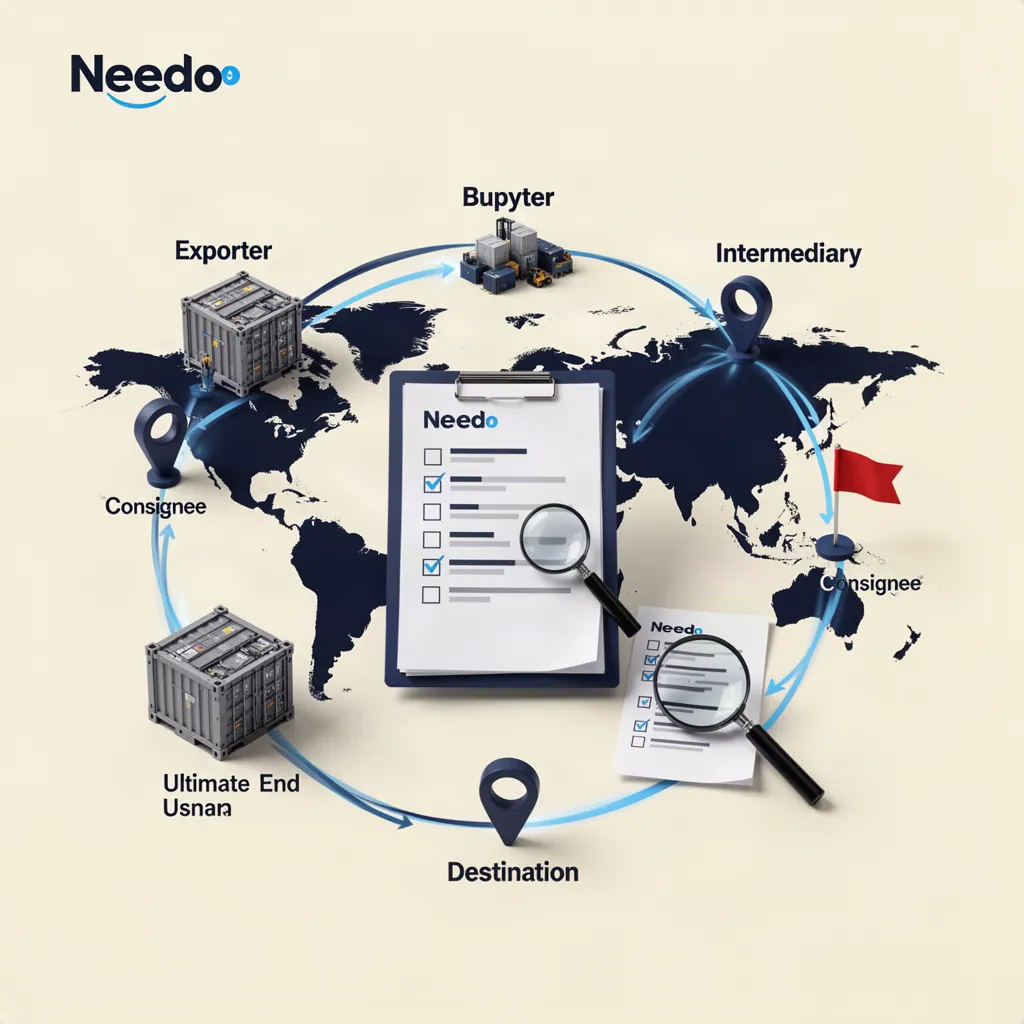
1. Separate item controls, party restrictions and end-use controls
Start by separating three questions that are often collapsed into one. First, is the product, software or technology controlled under a regime that applies to this transaction? Second, are any parties subject to restrictions, denial orders, asset freezes or other limits? Third, does the intended end use, destination, route or risk of diversion trigger an authorization requirement even if the item is not obviously listed? A positive answer to one question does not answer the others.
The jurisdictional analysis may depend on where the item was made, whether it contains controlled-origin content, which exporter's rules apply, whether a re-export or transfer is involved, and whether particular persons or activities are covered. Do not assume that the seller's country alone determines the rules. Identify the potentially applicable regimes before choosing a screening list or treating a result as a clearance.
Record the transaction perimeter
- Exporter legal entity, country of establishment and actual export location
- Item origin, manufacturer, model and any known controlled-origin content
- Destination, transit points, delivery location and any planned re-export
- Parties, intermediaries and ultimate end user
- Known US, UK, EU, Indian, Canadian or other jurisdictional connections
- The decision being considered: quote, contract, licence, payment or shipment
2. Map every party in the chain, not just the buyer
The company sending the purchase order may not be the consignee or the organization that will use the goods. Draw the chain from exporter to purchaser, buyer, distributor, broker, freight forwarder, consignee and ultimate end user. Add an intermediary or parent company when it has a meaningful role. Record the legal name, trading name, address, country, registration identifier where available, website, contact role and relationship between each entity.
Screening scope is jurisdiction-specific. Under a specific US EAR provision, §744.19, certain sanctions-based licensing policies can apply when a party to the transaction is the applicant, purchaser, intermediate consignee, ultimate consignee or end user. Other restrictions have their own scope, so check the exact provision rather than treating every list entry as having identical reach. Checking one buyer name and ignoring the rest of the transaction can miss a relevant party. Do not collect personal or ownership information beyond what is necessary and lawful.
Party-map questions
- Who issued the purchase order and who signed the contract?
- Who will pay, receive the invoice, take delivery and physically use the item?
- Is a distributor buying for stock or for a named downstream customer?
- Who arranged freight, insurance, customs entry and final delivery?
- Does any party act for another entity or use a different trading name?
- Are ownership, control or agency relationships relevant under the applicable regime?
3. Describe the intended end use and ultimate destination precisely
Ask what the product will do, where it will be installed, which facility will use it, who will operate it and whether it will be integrated into another system. For software or technology, identify functions, users, access location, technical assistance and any transfer of source code, design data or know-how. A broad statement such as industrial use may not explain a transaction involving a specialized component or technology.
Compare the stated use with the product's capability, the buyer's business, the end user's industry, the destination and the quantity. Ask whether the item will be resold, incorporated into another product, transferred to another country, used by a government or military organization, or sent to a different site. A change in end user, destination, consignee or route after the original review should reopen the assessment.
End-use questions to document
- What exact function will the item perform and in which process or system?
- What facility and country will receive and use it?
- Who is the named ultimate end user and who controls the facility?
- Will the item be resold, re-exported, transferred, modified or integrated?
- What installation, training, maintenance or technical support is requested?
- Which statements are supported by documents and which remain customer representations?
4. Screen the official lists that actually apply
There is no single public list that clears every international transaction. The US Consolidated Screening List brings together specified lists maintained by Commerce, State and Treasury; OFAC also provides its own sanctions-list search. Relevant UK, EU, Indian, Canadian or other national lists and controls must be considered separately when those regimes apply. Use the official authority for the jurisdiction and transaction rather than relying on an unofficial copied list.
Search legal names and known aliases, but also compare addresses, registration numbers, country, parent relationships and other identifiers. Transliteration, abbreviations and common names can produce false positives or misspellings can hide a relevant result. A potential name match is a lead to resolve, not proof that the party is the listed person. No result from one tool is not a global clearance and does not resolve end-use or licensing questions.
Record the list or data source, search terms, date and time, identifiers compared, result and resolution. OFAC's public search tool is designed for individual users; its FAQ says it should not be used as a continuously running automated screening system. Businesses with recurring screening needs should use official list data or a properly governed screening process suited to their legal obligations.
Minimum screening record
- Applicable jurisdiction and reason the list is relevant
- Official list or authority used and the version or retrieval date
- Exact and alternate names searched, including relevant identifiers
- Potential matches and the facts used to resolve or escalate them
- Reviewer, review date and any approval or legal advice reference
- A note that list screening is only one part of transaction due diligence
5. Treat red flags as questions to resolve, not a score to average away
Possible warning signs include an end user that will not be identified, a buyer whose business has no plausible connection to the product, a request to ship through an unexplained third country, a destination or consignee change without a credible reason, unusual secrecy, an implausible quantity, inconsistent technical configuration, or refusal to provide ordinary installation or end-use information. A third-party payer or intermediary is not automatically improper, but the relationship and commercial reason should be understood.
BIS's Know Your Customer and Red Flags guidance under the US Export Administration Regulations explains that exporters should examine abnormal circumstances. Under that US-specific guidance, red flags call for inquiry into end use, end user or ultimate destination; do not treat the guidance as a universal statement of every country's law. The BIS EAR 732 page currently carries an effective-date note, updated November 9, 2026, stating that paragraph (b)29 of Supplement No. 3 was further stayed until January 10, 2027. Check the current regulation and notices before applying that paragraph.
The UK published Sanctions End-Use Controls guidance on April 22, 2026. It describes targeted controls for cases where the government informs an exporter of a specified diversion risk and explains the resulting licensing process. The guidance does not create a blanket licensing requirement for every ordinary export to a third country. If an official notice applies, follow it and obtain the required authorization before proceeding.
Examples that warrant a pause and inquiry
- The customer refuses to identify the ultimate end user or installation site
- The requested item or performance level does not fit the stated application
- The consignee, route or destination changes after screening
- A distributor cannot explain why it needs the product or where it will go
- Documents conflict on product model, quantity, end user or destination
- A government authority has issued a notice, hold or licence-related instruction
6. Assemble a consistent end-user and transaction evidence pack
Where the applicable regime or risk assessment calls for an end-user statement, use the correct authority or licence-application format. A useful statement may identify the end user, consignee, item, quantity, purchase order or contract, specific use, installation location and any restrictions on resale or re-transfer. Some regimes or applications require information from multiple entities when the foreign buyer, consignee and ultimate end user differ. Do not copy one country's form and assume it satisfies another country's requirements.
Reconcile the statement against the purchase order, contract, invoice, packing information, technical description and shipping instructions. Check that legal names, product model, quantities, destination and intended use are consistent. If a distributor is involved, ask for the downstream customer and explain whether the goods are for stock or a named end user. Keep the signed version and supporting evidence with the transaction record.
Evidence-pack checklist
- Purchase order, contract and commercial description of the item
- End-user statement in the applicable official format, if required
- Buyer, consignee, intermediary and ultimate end-user identities
- Specific end use, facility address, country and onward-transfer plan
- Product classification references and manufacturer technical information
- Screening results, red-flag questions, responses and approvals
- Licence, authorization, government notice or legal review where applicable
7. Decide when to hold, escalate or seek an official determination
Do not let a high commercial score offset a material unresolved compliance issue. Hold the transaction if a potential restricted-party match remains unresolved, the ultimate end user is unknown where it matters, a red flag has not been investigated, the item may require authorization, a government notice applies, or the documents conflict in a way that changes the transaction. A hold is a process control, not an accusation against the buyer.
Escalate to the exporter's compliance lead, qualified export-control counsel, the relevant licensing authority or another competent professional. Ask a precise question and provide the product technical file, parties, route, end use, classification rationale and supporting documents. Needo can organize that evidence and prepare questions, but it cannot issue a licence, give a binding sanctions determination or replace the authority responsible for the export.
Escalation triggers
- Possible match on a relevant official restricted-party or sanctions list
- Unclear end user, ownership, consignee or destination
- Unexplained route, product, quantity or payment inconsistency
- Item classification or licence requirement is unresolved
- A new intermediary, end user or destination appears after approval
- Any government notice or instruction requires action before export
8. Keep the review auditable and repeat it when facts change
Keep a dated record of what was checked, by whom, against which source, using which identifiers and with what result. Store the item classification rationale, end-user statement, purchase order, route, screening evidence, questions, answers and internal approval. Retain only information the business is entitled or required to keep, and apply its data-protection and retention policy.
Repeat the relevant checks at the stages required by the applicable regime and your compliance programme. A review performed when an enquiry arrives may no longer reflect the parties or route at shipment. Re-screen when a buyer changes legal entity, a new consignee or intermediary is introduced, the destination changes, ownership information changes, the item is modified, or list status needs to be refreshed.
Review milestones
- Initial enquiry and product/market qualification
- Before contract acceptance or a binding quotation where appropriate
- Before submitting a licence or authorization application
- Before shipment, release or transfer
- After any material change in party, route, item, destination or end use
9. Worked example: a distributor will not name the final end user
Illustrative example only: an Indian engineering exporter receives an order from a trading company in a third country for a specialized measurement unit. The distributor says the equipment will be resold to an industrial customer but does not identify the customer or installation site. The exporter should not assume that the distributor's registration or a clean name search answers the end-use question. It records the exact product model and technical parameters, identifies the relevant Indian and other potentially applicable regimes, and asks for the ultimate end user, application and destination.
The exporter maps the purchaser, consignee, forwarder and end user; checks the official lists relevant to the transaction; compares the proposed use with the product's capability; and obtains the end-user evidence required by the applicable process. If the distributor still refuses or a material inconsistency remains, the transaction stays on hold while the compliance lead or competent authority is consulted. No conclusion about a restricted party or licence requirement can be drawn from this illustrative scenario alone.
Decision record
- Known: legal buyer and product model stated in the purchase order
- Unknown: ultimate end user, installation site and final application
- Action: request end-user and route evidence in the applicable format
- Action: resolve item classification and relevant party screening
- Decision: HOLD until material gaps are resolved by the responsible reviewer
10. Use Needo to organize a preliminary export-screening review
Needo can turn the transaction details and documents you provide into a structured party map, source register, end-use question list, red-flag review and evidence-gap checklist. It can help compare names and transaction details against relevant public information and prepare the next questions for your compliance team. The result should distinguish public facts, customer representations, assumptions, possible matches and unresolved issues.
Needo does not certify a buyer or end user, guarantee that every restricted-party list has been checked, determine a binding licence requirement, issue an export authorization or clear goods for shipment. Do not upload classified, controlled, confidential or personal information unless your organization is authorized to share it with the service. Redact sensitive technical details where possible and use qualified compliance professionals for the final decision.
Sources and further reading
- U.S. Bureau of Industry and Security — EAR 732: Steps for Using the EAR
Official US EAR steps for assessing item, destination, recipient and end-use obligations. The live page includes a November 9, 2026 effective-date note stating paragraph (b)29 of Supplement No. 3 was further stayed until January 10, 2027.
- U.S. Bureau of Industry and Security — EAR Part 744: End-User and End-Use Controls
Current US EAR provisions for end-user, end-use, Entity List and transaction-party restrictions. Check the current regulation and its effective-date notes.
- U.S. Bureau of Industry and Security — Consolidated Screening List
Official BIS page describing the searchable and downloadable Consolidated Screening List, which combines specified Commerce, State and Treasury export-screening lists.
- U.S. Office of Foreign Assets Control — Sanctions List Search Tool
Official US sanctions-list search tool. A potential name result requires identity resolution and does not replace other jurisdictional or end-use checks.
- OFAC FAQ 287 — Use of Sanctions List Search
Explains that the public search tool is intended for individual users and should not be used by automated systems configured to run continual searches.
- UK Government — Sanctions End-Use Controls: Guidance for Businesses
Published April 22, 2026. Explains targeted UK diversion controls, written informing notices, licensing and record-keeping expectations; the control is not a blanket licence requirement for all third-country exports.
- India Department of Atomic Energy — Export Control FAQs
Official explanation of India's SCOMET list and authorization framework for specified controlled goods and technologies.
- European Union — Regulation (EU) 2021/821 on Dual-Use Items
Current consolidated EU dual-use export, brokering, technical-assistance, transit and transfer framework, with the version dated September 21, 2026.
Sources support the specific points noted above. Confirm current requirements for your product, destination and contract before committing.
Need the actual problem solved?
This guide explains the method. Needo can work from your specific requirement, compare relevant options, verify important details and help move the next step forward.
Start with your exact problem →Selling or exporting? See live buyer requirements by product · see a sample verified shortlist