NEEDО · PROCUREMENT & COST ANALYSIS
Total Cost of Ownership for Supplier Quotes: Formula and Worked Example
A supplier quote with the lowest purchase price may not be the lowest-cost choice over the period you will use the product. Equipment, components and service contracts can carry different delivery, installation, energy, consumable, maintenance, downtime and disposal costs. Total cost of ownership (TCO) makes those costs visible on a common basis. It goes beyond import landed cost, which focuses on getting goods to a defined destination. The model below is a decision aid: use the same functional requirement, time horizon and evidence standard for each option, and label uncertain inputs instead of hiding them in a precise-looking total.
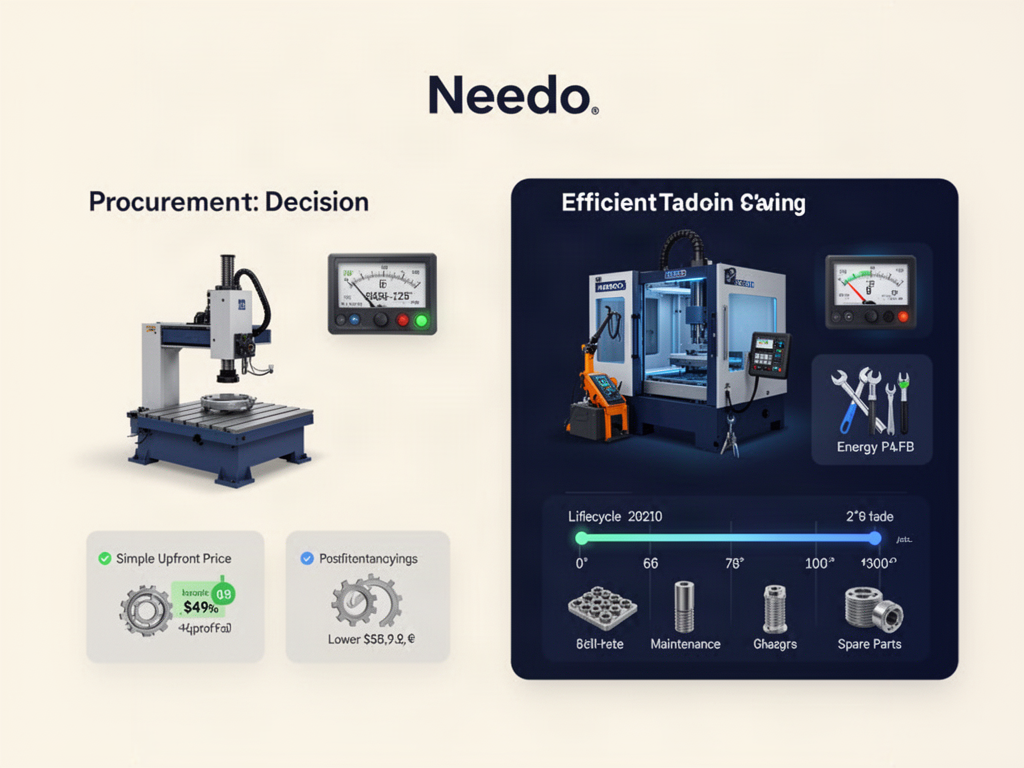
Define the comparison before collecting prices
First state what the purchase must do: capacity, output, duty cycle, quality, compatibility, safety or regulatory requirements, service level and expected life. A cheaper option that cannot meet a mandatory requirement is not a valid low-cost alternative. Decide the comparison period and workload—such as five years at a stated number of operating hours—before calculating totals. Use the same period and service assumptions for each supplier.
Keep TCO distinct from landed cost. Landed cost typically helps establish the cost of acquiring and importing a unit; TCO can include costs after delivery, such as installation, use, maintenance, consumables, training and end-of-life handling. If your existing landed-cost worksheet already includes freight, duty or insurance, carry those values into TCO once rather than adding them again.
Record the common basis
- Same required function, output, specification and quality threshold
- Same quantity, operating hours or usage volume
- Same evaluation period and currency
- Same delivery destination and cost basis
- Same assumptions about service, warranty and expected life
- Mandatory pass/fail requirements kept separate from cost ranking
Use a transparent TCO formula
A practical starting formula is: TCO over the chosen period = purchase price + delivery and handling + installation or commissioning + operating energy or fuel + consumables + scheduled maintenance and spare parts + training or implementation + other evidenced ownership costs + credible expected downtime or quality costs + end-of-life cost − residual value. Not every category applies to every purchase. Include only costs relevant to the product and decision, and document the source and calculation for each line.
For a multi-year comparison, keep the units and time basis consistent. If costs occur at materially different times, the purchase is long-lived or finance policy requires it, a discounted life-cycle model may be more appropriate. Use an approved discount rate and stated method rather than mixing present values with undiscounted future costs. Do not invent a cost for downtime, defects or emissions just to complete the table; leave it unknown or show a scenario if there is a defensible basis.
Cost categories to consider
- Acquisition: unit price, tooling, delivery, duties and required installation
- Operation: electricity, fuel, water, software or other recurring inputs
- Support: consumables, service contracts, spare parts and planned maintenance
- Execution risk: training, changeover, credible downtime or rework costs
- End of life: removal, disposal, recycling cost or a supported residual value
- Evidence: quote line, supplier confirmation, historical record or clearly labeled estimate
Ask every supplier for the same missing details
A quote often omits costs because they sit outside the supplier's unit price. Send the same data request to each candidate and record what is included, excluded or unknown. Ask for the basis of any claimed operating life, energy use, service interval, spare-parts price or warranty coverage. If a supplier gives a rated figure, check whether it matches your actual workload and operating conditions.
For equipment, the useful questions may include rated power or fuel use, output per hour, consumable yield, planned maintenance intervals, service response, spare-part availability, training, installation, software or licensing, warranty exclusions and disposal requirements. For services or components, adapt the categories to the actual use case; do not force an equipment template onto a purchase where those costs do not apply.
Supplier data request
- What exactly is included in the quoted price and delivery scope?
- What installation, commissioning, training or setup costs apply?
- What operating input is expected at the workload we specified?
- Which consumables and spare parts are required, and at what quoted price?
- What maintenance, service response and post-warranty costs apply?
- What expected life, disposal cost or residual value is supported by evidence?
Worked example: compare two equipment offers over five years
Illustrative example only, using currency units and assumed figures—not market prices or a prediction. Both options meet the same required output over five years. Option A has purchase price 8,000, delivery and installation 1,000, annual energy cost 2,400, annual maintenance and spares 1,800, annual consumables 600, and end-of-life cost 500. Its five-year TCO is 8,000 + 1,000 + (2,400 × 5) + (1,800 × 5) + (600 × 5) + 500 = 33,500 units.
Option B has purchase price 11,000, delivery and installation 1,000, annual energy cost 1,600, annual maintenance and spares 1,000, annual consumables 500, and end-of-life cost 300. Its five-year TCO is 11,000 + 1,000 + (1,600 × 5) + (1,000 × 5) + (500 × 5) + 300 = 27,800 units. On these assumptions, B is 5,700 units lower over five years despite the higher initial price. Before relying on that result, verify that the options have comparable output, reliability, service availability and warranty, and test what happens if the energy or maintenance estimates are wrong.
Check the arithmetic
- Option A: 8,000 + 1,000 + 12,000 + 9,000 + 3,000 + 500 = 33,500
- Option B: 11,000 + 1,000 + 8,000 + 5,000 + 2,500 + 300 = 27,800
- Difference under these assumptions: 33,500 − 27,800 = 5,700
- All figures are illustrative and should be replaced with comparable supplier data
- Do not rank the offers until mandatory fit and service gates are checked
Show uncertainty and avoid double-counting
TCO is only as reliable as its assumptions. For every important number, record whether it is quoted, measured from your own history, calculated from a stated rate or estimated. If a supplier has not confirmed energy use, service costs or useful life, create low/base/high scenarios or leave the field open for clarification. Sensitivity testing is especially useful when one uncertain cost could change the ranking.
Check for double counting. If the supplier's annual service package includes replacement parts, do not add the same parts again. If a delivered quote already includes freight or duties, do not add them twice. If a residual value is subtracted at the end, state how it was estimated. Where downtime or scrap costs are included, show the operational assumption and evidence rather than treating a speculative loss as a fact. Keep the original quote and the calculation sheet together so another reviewer can reproduce the result.
Model quality checks
- Every cost line has a source, unit, time period and owner
- Included services and exclusions are explicit for each quote
- Shared or bundled costs are not counted twice
- Estimates and scenario ranges are visibly labeled
- Useful life and workload assumptions are the same across options
- The ranking is tested against the largest uncertain cost drivers
Make the decision on fit first, then whole-life value
After the mandatory requirements pass, compare TCO alongside the operational evidence that matters: delivery readiness, support coverage, spare-part lead times, warranty terms, maintainability, supplier capacity and quality history. A low calculated total does not erase a critical technical failure or a service gap that could stop production. Keep the scorecard and TCO model separate enough that decision-makers can see both the numeric result and the risks behind it.
For public-sector procurement, use the life-cycle cost method and supplier data requirements specified by the applicable rules and procurement documents; jurisdiction-specific guidance is not a universal rule for private purchases. For a major capital decision, ask finance, engineering, operations and procurement to agree the assumptions and approve the model before award. Record why the selected option meets the need and which uncertainties will be monitored after purchase.
Decision checklist
- All mandatory technical, safety and compliance gates pass
- Supplier prices and cost scopes are normalized
- TCO uses the same time horizon and workload for each option
- Largest estimates have a source or an explicit uncertainty range
- Service, warranty, spare parts and downtime risks are visible
- Decision owner, approval and post-purchase review are recorded
Use Needo to compare the actual quotes
Needo can structure supplier quotes and supporting documents into a like-for-like TCO worksheet, identify missing operating-cost inputs, calculate totals from your figures and test scenarios without inventing supplier data. Provide the same expected workload, evaluation period, delivery scope and mandatory requirements for each option. Ask it to show the formula, sources, assumptions, exclusions and sensitivity of the result so the comparison can be reviewed by procurement, finance and technical owners.
Needo does not certify a supplier, predict equipment life or approve a purchase automatically. The useful output is a transparent comparison that shows which offer meets the requirement, what the ownership cost could be under stated assumptions, which evidence is missing and what to ask before making the commitment.
Sources and further reading
- U.S. Department of Energy — Life-Cycle Costs for Acquisition
Official guidance for federal buyers on considering the total cost of owning products, especially energy-using equipment. Its federal context should not be mistaken for a universal private-sector rule.
- UK Government — Value-Based Procurement: Whole Life Cost
A public-sector medical-technology example of whole-life cost categories including purchase, implementation, operation, maintenance, post-warranty service and disposal. Apply only the categories relevant to your own purchase.
- Acquisition.gov — Federal Acquisition Regulation, Part 7
Defines life-cycle cost in U.S. federal acquisition as the total cost of acquiring, operating, supporting and, where applicable, disposing of an item. The definition is specific to that procurement framework.
Sources support the specific points noted above. Confirm current requirements for your product, destination and contract before committing.
Need the actual problem solved?
This guide explains the method. Needo can work from your specific requirement, compare relevant options, verify important details and help move the next step forward.
Start with your exact problem →Selling or exporting? See live buyer requirements by product · see a sample verified shortlist