NEEDО · EXPORT SALES & ORDER VERIFICATION
How to Verify an Overseas Purchase Order Is Genuine Before Production
An overseas purchase order can look complete and still be unsafe to act on. The document may use a real company's name but come from an impersonator, an unauthorized employee, a compromised mailbox or an intermediary whose role is unclear. A genuine buyer can also send a PO that conflicts with the quotation, contract, delivery plan or approved credit limit. Before you reserve materials, pay a subcontractor, start production or dispatch goods, verify both the transaction and the authority behind it. This guide is a practical exporter-side review process. It is not a fraud determination, a credit decision or a guarantee that the buyer will pay.
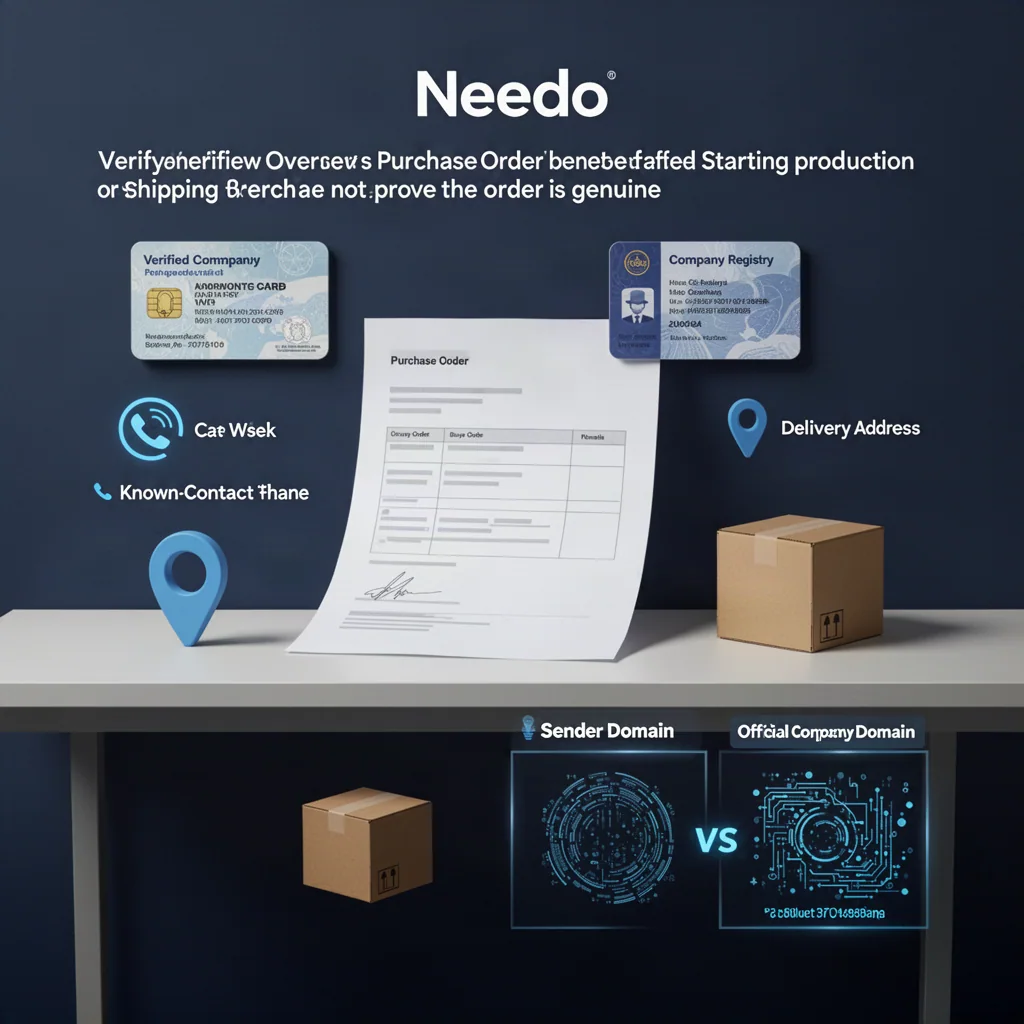
1. Treat the purchase order as a request to verify, not proof by itself
A purchase order records a buyer's stated intent and commercial instructions. Its legal effect depends on the parties' contract, governing law, prior offer and acceptance, authority, terms and the surrounding facts. A PDF with a company logo, PO number and signature does not by itself prove that the company issued it, that the sender can commit the company, that the buyer has budget or that payment will arrive. Equally, a legitimate buyer may use a portal, blanket order, call-off or electronic procurement system rather than a conventional signed PDF. Verify the method the real buyer normally uses.
Keep three questions separate: is the buyer organization real; did an authorized person or system issue this specific order; and can your business safely perform it on the stated commercial and payment terms? A company-registration check answers only part of the first question. A familiar email thread does not resolve the second if the mailbox could be compromised. A valid PO does not automatically answer the third.
Set the review boundary
- Record whether you are deciding to quote, accept, buy materials, begin production, ship or extend credit.
- Identify the legal entity that would owe the money, not only the brand or group name.
- Preserve the original email, full headers where available, attachment and any portal reference.
- Do not treat a screenshot of a PO or remittance advice as independent payment evidence.
- Assign the review to sales or procurement, with finance and operations involved where their approvals are required.
2. Verify the sender through a contact route you already trust
Inspect the complete sender address and reply-to address, not just the display name. Compare the domain character by character with the buyer's established domain and previous genuine correspondence. Lookalike domains can add a hyphen, change one letter, append a country or business suffix, or use a different top-level domain. Check links and attachments cautiously; do not use a telephone number, email address or portal link supplied only in the suspicious message as the independent verification route.
Use a contact already stored in your approved customer record or obtain the main switchboard from the buyer's independently located official website or relevant company registry. Ask the known procurement contact to confirm the PO number, issue date, total, delivery location and the person or portal that authorized it. Record who confirmed the details, how you reached them and when. A callback is a control to establish that the request is genuine; it does not replace the contract or credit approval.
Independent confirmation checklist
- Compare sender, reply-to and link domains with the buyer's established domain.
- Use a known contact or independently sourced switchboard, not contact details in the new request.
- Confirm the exact PO number, value, product, quantity, ship-to and requested date.
- Ask whether the named buyer contact has authority under the buyer's procurement process.
- If the buyer uses a portal, navigate to the portal independently and confirm the order there.
3. Confirm the contracting entity and purchasing authority
Match the PO's buyer name, registered entity, bill-to address and tax or registration identifiers with the quotation, contract, customer master and prior invoices. A trading name, subsidiary, group purchasing company or local buying office may legitimately differ from the brand on the website, but the relationship must be documented. If the PO is issued by one entity while another promises to pay, identify the contractual basis and who is liable for the invoice before accepting the order.
Ask which procurement system or approval reference governs the order and whether the named buyer contact can issue it. For large or unusual orders, confirm that the purchasing department recognizes the product category, quantity and delivery schedule. A real employee may still lack authority to place a commitment of that size. Do not infer authorization from a job title, LinkedIn profile or email signature.
Entity and authority checks
- Contracting entity and legal name match the approved customer record or are reconciled in writing.
- Registered and operating addresses are plausible for the stated business.
- The PO number and approval route can be confirmed independently.
- The named buyer and signatory have the authority required by the buyer's process.
- Any group company, purchasing agent, distributor or third-party payer relationship is explained and documented.
4. Reconcile the PO against the quotation, contract and product specification
Compare every commercial and technical field with the last approved quotation and contract version. Check the exact product, part number, SKU, model, drawing or specification revision, material or grade, customization, packaging, labels, accessories and any inspection or test requirement. A PO that says the right product family but omits a critical revision or substitutes an unapproved material can create a real production dispute even when the buyer is genuine.
Recalculate quantities, units, unit prices, line extensions, discounts, taxes and order totals. Check currency, quote validity, minimum order, price breaks, tooling or setup charges, sample credits, freight, insurance, delivery term and named place. Compare requested delivery dates with confirmed capacity and material availability. If the PO adds a penalty, warranty, acceptance, cancellation or payment condition that was not in the approved offer, do not silently accept it by starting work.
Line-by-line comparison
- PO number, issue date, buyer entity and supplier entity.
- Product identifier, description, model, revision and approved specification.
- Quantity, unit of measure, unit price, currency, discounts, tax and total arithmetic.
- Delivery term, named place, ship-to, consignee, delivery window and freight responsibility.
- Packaging, labelling, inspection, certificate, sample and acceptance requirements.
- Payment milestones, due date, bank charges, cancellation rights and any new clauses.
5. Investigate the ship-to address, consignee and logistics instructions
The delivery address may differ from the buyer's registered office for entirely legitimate reasons: a distribution centre, third-party warehouse, construction site, port, customer facility or nominated freight consolidator. The difference is a question to resolve, not automatic proof of fraud. Ask who controls the destination, why the goods are being sent there, who will receive them and whether the buyer's authorized procurement contact confirms the arrangement.
Be more cautious when a first-time buyer requests an unusually large order for delivery to a residence, self-storage unit, unrelated business, freight forwarder or address in another country without a coherent commercial explanation. Check whether the consignee, route, freight account and customs responsibilities match the contract. If the destination changes after the order is verified, reopen the review instead of treating the amendment as routine.
Destination questions
- Is the ship-to address consistent with the buyer's stated business and delivery plan?
- Who owns or operates the warehouse, site or nominated receiving location?
- Does the buyer independently confirm the consignee and any third-party logistics provider?
- Are the export destination, transit route, importer and customs responsibilities clear?
- Does a new address or route create sanctions, export-control, tax or insurance questions that need separate review?
6. Check payment terms and credit exposure separately
Compare the payment terms with the approved quote, contract, customer credit limit and your internal release policy. A request for open-account terms, a larger credit limit, a different currency or an advance purchase of materials can materially change the risk even when the PO is authentic. Calculate the expected peak unpaid exposure using current receivables plus the proposed order and other shipments likely to be outstanding before collection. If the proposed order exceeds the approved limit, refer it to the authorized finance owner rather than allowing sales urgency to override the control.
Treat any new or changed bank instructions as a separate payment-control event. Confirm them through the independent procedure already held in your supplier or customer records; do not rely on the same email thread. A remittance screenshot, bank transfer advice or payment confirmation image is not proof that funds have cleared into your account. Check the actual credit with your bank or payment provider before releasing goods when cleared funds are a contractual condition. Do not refund an alleged overpayment or redirect funds based only on an email.
Finance release checks
- Payment method, currency, due date and milestone match the approved commercial terms.
- The buyer's current and projected exposure stays within the authorized limit.
- Any deposit or advance is confirmed in the agreed way before work begins.
- Changed beneficiary or remittance instructions are verified independently.
- Cleared funds are confirmed with the bank or provider when required by the contract.
- Any insurance, letter of credit or bank instrument is checked against its actual issued terms, not its label.
7. Recognize purchase-order fraud patterns without overreacting to one signal
Official fraud advisories describe patterns that can appear in fake bulk orders: lookalike domains, contact details that do not belong to the named organization, implausibly large quantities, urgent or overnight shipping, unusual delivery addresses, poor or inconsistent correspondence, false payment evidence, third-party supplier instructions and requests to move money or change established payment details. No single item proves fraud. The purpose of a red flag is to trigger independent questions and evidence, not to accuse a customer or average away a serious inconsistency.
The FBI's purchase-order fraud case guidance highlights mismatched domains, unusual shipping addresses, unconnected telephone numbers and unusually large or urgent orders. The FBI's later commodity-acquisition advisory describes impersonation and fake purchase orders used to obtain goods on credit. Singapore Police also advises businesses to independently verify bulk-order customers and payment claims. Apply the warning signs to the facts of the transaction and the laws of the relevant countries; do not treat an old advisory as a current prevalence statistic.
Pause and investigate when
- The sender uses a lookalike domain or refuses a confirmation through a known contact.
- The buyer cannot confirm the PO through its normal procurement system.
- The order is far outside the buyer's normal product, quantity or purchasing pattern.
- The ship-to address, consignee or freight arrangement changes without a credible explanation.
- The buyer sends only screenshots of payment or asks you to refund an overpayment.
- A new intermediary, nominated supplier or bank account is introduced at the last minute.
8. Worked example: a large first order from a familiar brand
Illustrative scenario: an exporter receives a PO for 18,000 units from a retailer whose brand is well known. The email arrives from a domain that differs from the retailer's established domain by one extra character. The PO requests overnight delivery to a third-party storage address and includes a remittance screenshot for a deposit. The unit price and product description match a recent quotation, which initially makes the order look credible.
The correct response is not to accept or reject the order from those facts alone. The exporter pauses production, calls the buyer's procurement switchboard using a number already on file, and asks the known contact to confirm the PO number, quantity, ship-to and sender. The buyer says the order is not in its procurement portal and the contact is not an employee. The exporter preserves the email and attachment, does not ship or refund anything, and follows its incident and reporting procedure. This example shows why matching price and logo is not enough; it is not a claim about a real Needo customer.
Decision record
- Verified: product and unit price match the prior quotation.
- Unverified: sender identity, purchasing authority, ship-to and payment.
- Contradicted: buyer's known procurement contact cannot find the PO.
- Decision: HOLD; no production, supplier deposit, refund or dispatch.
- Owner: export sales and finance, with security or legal escalation if required.
9. Use Needo to prepare a reviewable PO evidence pack
Needo can compare the PO with the quote, contract, product specification, buyer record and prior amendments you provide. It can extract key fields, calculate line totals, flag mismatches, organize the sender and destination checks, and prepare the independent questions for your authorized contact. Ask it to distinguish document facts from claims, label what it could not verify and preserve the exact source and date for each public-company or registry check.
Needo does not authenticate an email sender, call the buyer, confirm a bank transfer, approve customer credit, accept contractual terms, start production or release shipment. The authorized exporter must complete the independent contact verification, finance approval, export-control review and contract decision. If a fraud attempt is suspected, preserve evidence and contact your bank, security team and relevant authorities promptly under your incident process.
What to provide
- The PO and original email or procurement-portal reference, with sensitive personal data redacted.
- The buyer legal entity, official website and a known contact route already in your records.
- The accepted quote, contract, product specification and approved amendments.
- The customer credit limit, payment terms and current outstanding exposure.
- The proposed ship-to, consignee, freight instructions and delivery term.
- Your internal approval rules and the date by which the order decision is needed.
10. Copy-ready GO / CLARIFY / HOLD checklist
Record the evidence and owner for each check. A blank field is not a pass. If the order is genuine but the terms differ, return it for a corrected PO or signed amendment. If the buyer or sender cannot be independently confirmed, hold the transaction until the discrepancy is resolved. If the order is confirmed as impersonation, preserve the evidence and follow the reporting process rather than continuing the commercial conversation.
Before production or shipment
- Buyer legal entity and purchasing authority independently confirmed.
- Sender domain and PO issue route verified through a trusted channel.
- PO, quotation, contract, specification and revisions reconciled.
- Quantity, price, currency, arithmetic, delivery and acceptance terms approved.
- Ship-to, consignee, freight route and importer responsibilities explained.
- Payment terms, credit exposure and beneficiary instructions approved by finance.
- Export-control, sanctions, product and destination questions resolved where applicable.
- Decision, evidence, reviewer, approver and date recorded.
Sources and further reading
- FBI — Purchase Order Scam Leaves a Trail of Victims
FBI case guidance describing purchase-order fraud indicators such as lookalike domains, unusual delivery addresses, unconnected phone numbers and unusually large or urgent orders. The case report is older and is used for the warning patterns, not current prevalence.
- FBI Internet Crime Complaint Center — BEC Tactics Used to Acquire Commodities and Defraud Vendors
Official advisory describing impersonation and fraudulent purchase orders used to obtain commercial goods on credit, with independent contact and domain-verification recommendations.
- Singapore Police Force — Fake Bulk Order Scam Advisory (July 28, 2025)
Official July 28, 2025 business advisory describing impersonated bulk orders, fake payment screenshots and the need to independently verify counterparties before committing funds or goods.
- UK Government — Crime and Fraud Prevention for Businesses in International Trade
Official guidance on vetting international business partners, protecting business identity and taking action when trade fraud is suspected.
Sources support the specific points noted above. Confirm current requirements for your product, destination and contract before committing.
Need the actual problem solved?
This guide explains the method. Needo can work from your specific requirement, compare relevant options, verify important details and help move the next step forward.
Start with your exact problem →Selling or exporting? See live buyer requirements by product · see a sample verified shortlist