NEEDО · U.S. IMPORT COMPLIANCE
How to Verify a U.S. Customs Broker Before Signing a Power of Attorney
A broker's sales presentation is not proof that the correct legal entity is licensed, that the proposed office is permitted, or that the power of attorney matches the service you are buying. Before authorizing U.S. customs work, verify the broker through U.S. Customs and Border Protection (CBP), reconcile the legal identity across the proposal and authorization, and define who will prepare, file, check and correct each entry. This guide is a practical due-diligence workflow, not legal advice. Import rules and contract terms can change, so confirm the current requirements for your shipment and ask a qualified customs professional or lawyer about material uncertainties.
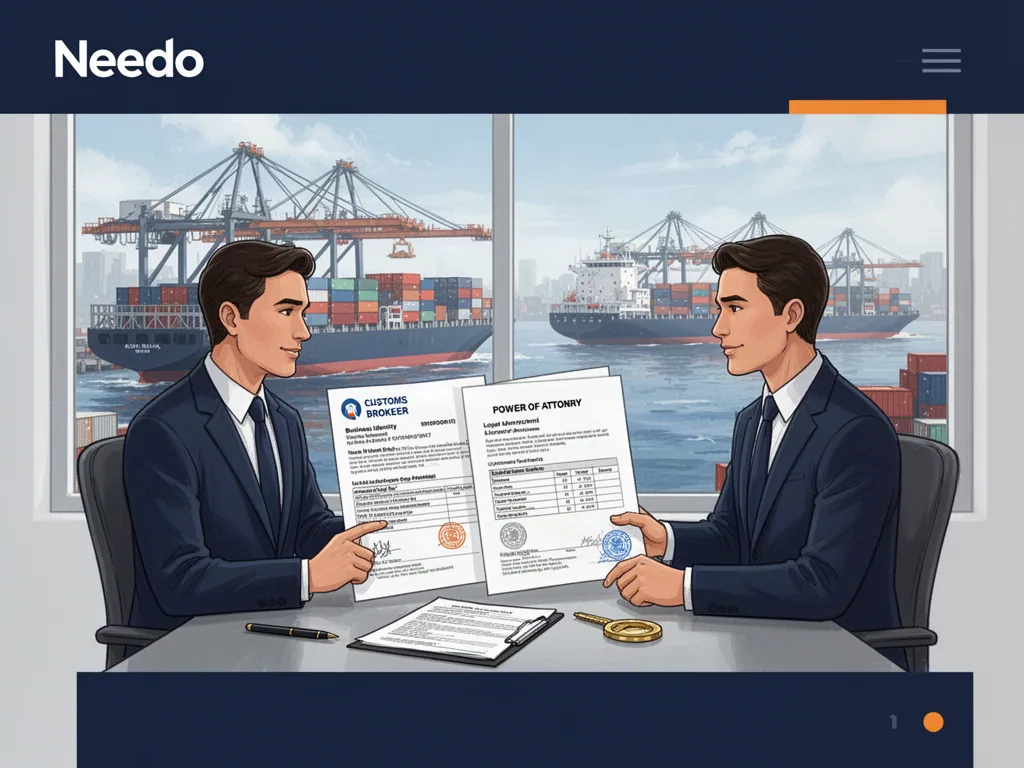
1. Verify the exact legal entity, not just the sales contact
Start with the entity that will actually transact customs business. A brand name, website, salesperson, freight forwarder and licensed customs broker may be different legal persons. Ask for the full legal name, any trading name, business address, broker license or permit details, the office handling your entry and the name of the responsible broker. Put those details beside the entity named in the quote, service agreement, invoice instructions and draft power of attorney.
Do not assume that a person who answers your enquiry is personally licensed, or that every company in a logistics group performs customs brokerage. A carrier or freight forwarder may coordinate the shipment while a separate broker files the entry. Your due-diligence record should show which organization performs each regulated or contractual task and which party is responsible when a declaration is questioned.
Identity fields to reconcile
- Full legal name and any registered trading name
- Business address and the office that will handle the work
- Broker license holder and permit information supplied by the provider
- Public phone, email, website and named operational contact
- Entity named in the quote, contract, invoice and power of attorney
2. Use CBP’s Permitted Customs Brokers Listing as a starting check
CBP directs people who want to check whether a customs broker is still licensed to its public Permitted Customs Brokers Listing. Search the broker's name and, where relevant, the port or location associated with the shipment. The public listing can expose useful identity details such as the permitted broker name, filer code, city, state, phone number and email address. Compare those fields with the proposal and the contact details you received rather than treating a matching logo as sufficient evidence.
CBP's February 13, 2026 help article points users to this listing for a current license check. A March 20, 2025 CBP notice described quarterly updates to the listing from National Permit records. Because a directory can lag a recent change or omit context, record the date checked and follow up with CBP Broker Management if the legal name, status or contact details conflict. A search result is evidence to investigate, not a complete due-diligence certificate.
How to record the public-listing check
- Save the official listing URL and date checked
- Record the exact permitted broker name and filer code shown
- Compare city, state, phone and email with the proposal
- Note any name, address, office or contact mismatch
- Ask CBP Broker Management how to resolve a material discrepancy
3. Understand the U.S. license and national-permit rules
Under 19 CFR 111.2, a person generally must obtain the license provided for in Part 111 to transact customs business as a broker, subject to the regulation's stated exceptions. The same section says a national permit issued under section 111.19 is sufficient permit authority for the broker to conduct customs business within the U.S. customs territory. This is why you should ask for the exact broker entity and its permit evidence rather than relying on a generic claim that a company has a local office near your port.
The rule also distinguishes an importer or exporter acting solely on its own account from a person acting as a broker for another party. An importer may make its own entry, subject to applicable requirements; hiring a broker is not a universal legal requirement. If the provider's proposed role is unclear, ask it to explain whether it is acting as the broker, arranging a separate broker, or supplying transport and documentation services only.
CBP published an interim final rule on 6 November 2026 that takes effect on 5 January 2027; brokers are expected to be in full compliance no later than 6 May 2027. Its entry restrictions apply to merchandise entered for consumption where a formal entry is required, and to specified informal entries for which CBP Form 3461 or 7501 (or an electronic equivalent) must be filed. A CTPAT-validated foreign IOR may make entry itself or hire a licensed broker. A foreign IOR that is not CTPAT-validated must designate a licensed CTPAT-validated broker to make entry or act as IOR. If the principal on the power of attorney is not the owner or purchaser, the designated broker must act as IOR. This is not automatically a rule for every overseas seller: first identify the actual IOR and whether the goods and entry type fall within the rule's scope. The rule also adds §111.29: before filing a declaration for a client under §141.22 as a U.S. IOR, a broker must verify the client's U.S.-IOR qualification and request and review supporting records. CBP lists examples such as corporate charters, financial statements, purchase receipts and documents of title. This broker-side check is separate from the foreign-IOR CTPAT requirement. CBP may approve a broker request for delayed compliance with the §111.29 verification changes; requests are due by 5 January 2027, and all brokers are expected to be fully compliant by 6 May 2027. Ask whether an approved delay applies rather than assuming one. Confirm the transaction-specific position with CBP or qualified customs counsel before appointing a provider.
Authorization and importer-of-record checks
- Which legal person holds the broker license?
- What permit or national-permit record applies to that entity?
- Who will perform the actual customs filing?
- Is any part of the work subcontracted to another broker?
- Who will be the importer of record for this entry, and is it a U.S. or foreign IOR?
- Is the merchandise entered for consumption through a formal entry or a specified informal entry requiring CBP Form 3461 or 7501 (or an electronic equivalent)?
- For an entry within the rule's scope from 5 January 2027, is the foreign IOR CTPAT-validated?
- If not, is the proposed filing broker both licensed and CTPAT-validated?
- If the broker may act as IOR for a principal who is not the owner or purchaser, who is the principal and how is the POA structured?
- If the client will declare as a U.S. IOR, how will the broker verify and record the §111.29 check before filing?
- Has the broker requested or received an approved delayed-compliance decision for §111.29, if applicable?
- What official source or CBP contact can confirm a disputed record?
4. Match the broker’s experience to your goods and entry profile
A valid license does not prove that a broker is the best operational fit for every commodity. Ask about experience with your product category, transport mode, entry volume, ports, tariff-line complexity, country of origin, valuation questions and any Partner Government Agency requirements that may apply. A broker familiar with ordinary consumer goods may still need specialist support for food, chemicals, medical devices, children's products, controlled goods or temperature-sensitive cargo.
Give every candidate the same short shipment brief: product description, intended use, materials or ingredients where relevant, origin, value basis, quantity, mode, destination port, expected frequency and the documents already available. Ask which facts the broker will verify, which facts it expects you to provide and which matters must be referred to a regulator, laboratory, attorney or other qualified adviser. A confident sales answer is not a substitute for a defined process.
Product and route fit checklist
- Commodity and product category experience
- Port, mode and expected entry volume
- Classification, origin and valuation support boundaries
- Relevant FDA, USDA, CPSC, EPA or other agency coordination where applicable
- Inspection, permit, certificate and document handoffs
- Named operational and escalation contacts
5. Review the power of attorney before authorizing work
19 CFR 141.46 requires a customhouse broker to obtain a valid power of attorney before transacting customs business on behalf of a principal. The 2026 interim final rule expressly clarifies that this also applies when the broker acts as importer of record on the principal's behalf. The broker retains the power of attorney with its books and papers; the regulation does not require the broker to file it with CBP. Ask the provider to explain the document it wants you to sign, why that form is needed and which customs activities it covers. Match the principal's legal name to the importer or exporter that is actually authorizing the work.
Read the scope, effective date, duration, termination language, named broker entity, authorized signatories and any provisions about sub-agents or other representatives. Do not sign a blank form, leave the principal identity incomplete or assume that a power of attorney is merely an administrative contact form. Broad or continuing authority can have legal consequences. Have your authorized legal or customs owner review the actual wording; this article does not interpret or approve a particular instrument.
POA review questions
- Is the principal the correct importing or exporting legal entity?
- Does the broker entity match the one independently checked?
- What customs business and procedures are covered?
- When does the authority begin and how can it be terminated?
- Are sub-agents, affiliates or other representatives addressed?
- Who in your organization is authorized to sign?
6. Define who prepares, files, checks and corrects each entry
Ask the broker to map the work from document intake to release and post-entry follow-up. Identify who supplies the commercial invoice, packing list, product description, tariff classification, country-of-origin evidence, customs value and any permits or certificates. Then identify who checks those facts, who submits the entry, who receives customs messages, who responds to a query and who approves a correction. If more than one company is involved, record the handoff between them.
The service agreement should distinguish routine entry work from additional services such as Importer Security Filing for applicable ocean shipments, partner-agency data, inspection attendance, amendments, post-entry corrections, protests or special procedures. Do not assume that the words full clearance include every task. Ask the provider to list exclusions and the event that triggers an extra charge before the first shipment is booked.
Responsibility matrix fields
- Task and responsible legal entity
- Information or document supplied by the importer
- Broker review or validation performed
- Approval owner and submission deadline
- Exception route, correction process and additional fee trigger
7. Protect importer data and customs-account access
A broker may need sensitive business and shipment information, but that does not mean you should share a personal password or give broad access without an agreed control. Ask which secure channel is used for documents, who can see the information, how access is removed when the engagement ends and how the broker handles corrections to contact, importer or shipment records. Use named user access and the access controls supported by the relevant system; do not send credentials in ordinary email.
Agree how instructions are authenticated when a bank detail, delivery address, importer identity or shipment value changes at short notice. Use an independently sourced callback or another approved control for high-risk changes. Keep the original instruction, confirmation and final record together so that a later reviewer can see what changed, who authorized it and why.
Data and access controls
- Named contacts and a secure document-transfer method
- No shared passwords or unapproved credential forwarding
- Least-privilege access and a clear revocation process
- Independent confirmation for material instruction changes
- A record of document versions, approvals and corrections
8. Remember that hiring a broker does not remove importer responsibility
CBP's guidance for new importers and the U.S. International Trade Commission both explain that an importer remains responsible for complying with applicable requirements and for the correctness of information presented to CBP, even when a broker is used. The broker is not a CBP employee. A service contract can allocate tasks between the parties, but it does not make it safe for the importer to ignore product identity, valuation, origin, permits, duties or the documents supporting an entry.
Create an internal owner for the commercial and technical facts the broker uses. Keep the final entry summary, supporting records, broker instructions, duty and tax calculations, corrections and release evidence in the shipment file. If the broker flags an unknown classification or regulatory issue, do not turn that uncertainty into a confirmed answer merely because a deadline is approaching. Resolve material gaps with the responsible authority or qualified adviser.
Importer-side records to retain
- Approved product description, classification basis and origin evidence
- Commercial invoice, packing list, purchase order and valuation support
- Permits, certificates and partner-agency documents where required
- Broker instructions, entry records, duty and tax calculations
- Customs queries, corrections, approvals and release records
9. Compare the complete service and fee schedule
A low base entry fee may exclude additional tariff lines, document handling, agency filings, inspection attendance, amendments, urgent work, disbursement or post-entry support. Ask for the billing unit and the event that triggers every extra charge. Separate broker service fees from government duties and taxes, carrier charges, terminal handling, storage, demurrage, detention and inland delivery. If a provider bundles costs, request the components so that the alternatives can still be compared on the same shipment.
Needo already has a separate practical guide to comparing customs broker quotes. Use that guide for the fee-normalization exercise, then return here for the license, legal-entity and POA checks. Keeping those intents separate prevents a low price from being mistaken for proof of authority or a valid appointment.
Commercial terms to compare
- Base entry fee and included number of tariff lines
- ISF, partner-agency, permit and document fees where relevant
- Inspection, amendment, query and urgent-service charges
- Disbursement, account, currency and payment terms
- Excluded carrier, port, storage and government charges
- Quote validity, cancellation, liability and escalation terms
10. Use GO, CLARIFY or HOLD instead of a vague pass
GO means the legal entity and public listing have been reconciled, the provider has explained the license and permit evidence, the proposed POA has been reviewed by the right owner, the service scope fits the shipment and the importer understands the information and approvals it still owns. GO is an internal appointment decision, not a CBP endorsement or a guarantee that a shipment will clear without examination.
CLARIFY means a material detail is missing but can reasonably be resolved: a trading name differs, the filing office is unclear, a subcontractor is involved, or the POA scope needs explanation. HOLD means a material identity or authorization conflict remains, the provider refuses to explain who files, the POA names the wrong entity, or the requested access is inappropriate. Do not let a low quote or urgent cut-off turn a HOLD into an informal approval.
Examples of decision triggers
- GO: public listing and legal entity match; scope and authority are reviewed
- CLARIFY: contact details or office differ and CBP confirmation is pending
- CLARIFY: the broker's subcontractor or filing role is not yet documented
- HOLD: the named entity cannot be reconciled to official evidence
- HOLD: the provider asks for passwords or a blank, unexplained POA
- HOLD: no one will identify who submits and corrects the entry
11. Copy-ready request for broker verification
Send the same request to each candidate and keep the answers with the quote. Do not attach confidential importer credentials or sensitive account information until the provider and document channel have been checked. Replace the placeholders with the actual shipment facts and ask the provider to identify any answer that depends on a separate broker, attorney or regulator.
Broker due-diligence request
- Please provide the exact legal entity, trading name, responsible broker and license/permit details.
- Please identify the CBP Permitted Customs Brokers Listing entry and the date you last checked it.
- Which entity and office will file this entry, and is any customs work subcontracted?
- Which goods, ports, modes and partner-agency procedures do you regularly handle?
- Please explain the scope, duration and termination process of the proposed POA.
- Who prepares, checks, submits and corrects the entry, and who receives customs queries?
- Which documents and facts must we supply and which checks do you perform?
- Please itemize included services, extra fees, excluded charges and escalation coverage.
- What entry records and status updates will we receive after filing and release?
12. Use Needo to organize the evidence before appointment
Needo can compare the broker's public listing, company details, proposal, service scope and draft POA; build a source-linked discrepancy matrix; and prepare questions for CBP Broker Management, the provider or your legal adviser. Give it the importing entity, product, origin, destination port, transport mode, broker candidates and the documents you are comfortable sharing. Ask it to separate official public records from provider statements and facts that still need direct confirmation.
Needo does not issue a customs-broker license, endorse a provider, provide a legal opinion, sign a power of attorney, access your ACE account or file a customs entry. Use the output as a structured review aid. The appointment, authorization and final customs decisions remain with the importer and the appropriately qualified people responsible for the transaction.
Sources and further reading
- U.S. Customs and Border Protection — How to Check if a Customs Broker Is Still Licensed
CBP help article published 13 February 2026; directs users to the Permitted Customs Brokers Listing and Broker Management for license-status questions.
- U.S. Customs and Border Protection — Permitted Customs Brokers Listing
Official public listing referenced by CBP for permitted customs brokers; compare the exact legal name and contact details and record the date checked.
- Electronic Code of Federal Regulations — 19 CFR 111.2, Licence and Permit Required
Current U.S. regulation covering the customs-broker license requirement, exceptions and national-permit authority.
- Electronic Code of Federal Regulations — 19 CFR 141.46, Power of Attorney Retained by Customhouse Broker
Requires a customs broker to obtain a valid power of attorney before transacting customs business in the principal's name and to retain it with its records.
- U.S. Customs and Border Protection — Tips for New Importers and Exporters
CBP guidance explains that brokers are not CBP employees, broker lists are not endorsements, and importers remain responsible for the correctness of entry information and applicable duties, taxes and fees.
- U.S. International Trade Commission — Should I Hire a Broker to File My Documents with Customs?
Explains that there is no general legal requirement to hire a customs broker and that importers remain responsible for compliance with applicable U.S. requirements.
- U.S. Customs and Border Protection — CSMS #64484038, Updating the Permitted Customs Broker Listing
CBP notice dated 20 March 2025 describing the public listing fields and the update process for National Permit contact details.
- U.S. Government Publishing Office — Federal Register 91 FR 69977, Heightened Requirements for Foreign Importers of Record
Official Federal Register PDF for the CBP interim final rule published 6 November 2026. Effective 5 January 2027, it covers specified formal and informal entries for consumption, sets CTPAT conditions for foreign IORs, adds broker verification duties for U.S.-IOR clients under §111.29, and allows requests for delayed compliance before 5 January 2027; full broker compliance is expected by 6 May 2027.
Sources support the specific points noted above. Confirm current requirements for your product, destination and contract before committing.
Need the actual problem solved?
This guide explains the method. Needo can work from your specific requirement, compare relevant options, verify important details and help move the next step forward.
Start with your exact problem →Selling or exporting? See live buyer requirements by product · see a sample verified shortlist