NEEDО · IMPORT & EXPORT OPERATIONS
How to Compare Customs Broker Quotes: Scope, Fees and Responsibility
A customs broker quote is not comparable just because both providers use the words customs clearance. One may cover a single import declaration; another may include tariff-line handling, document checks, customs queries, inspection attendance or post-clearance corrections. A low headline fee can exclude the work your shipment actually needs. This guide helps importers and exporters compare the service, authority, fee schedule and responsibilities on the same shipment facts. Customs representation and licensing rules differ by country, so use the local authority's current requirements before appointing anyone.
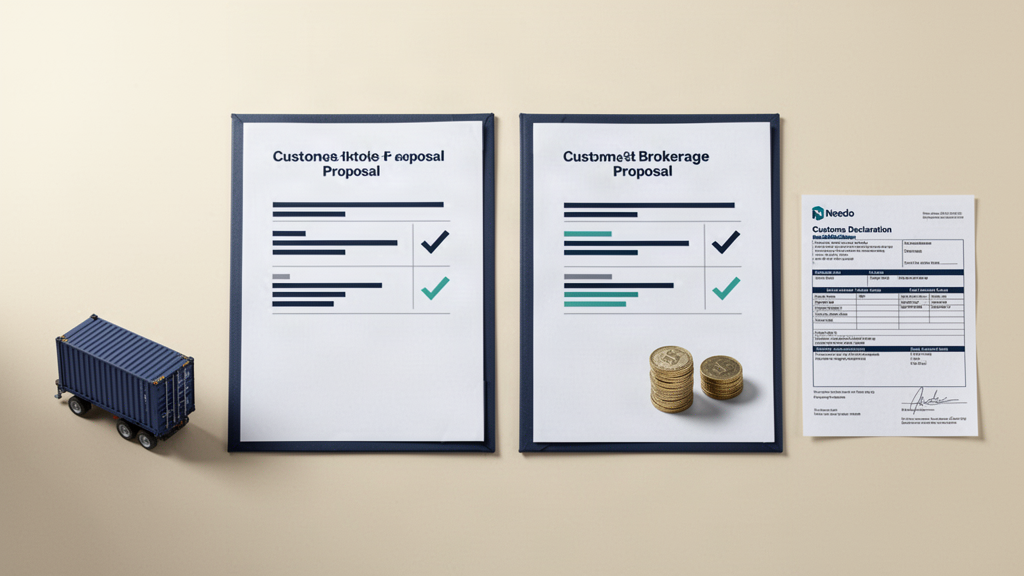
Define the customs service you actually need
First separate customs brokerage from the wider movement of freight. A freight forwarder arranges transport and may also provide customs clearance directly or through a specialist broker. A customs agent or broker focuses on customs procedures and declarations within the scope allowed by the relevant jurisdiction. An express operator may combine parcel transport and customs services. Ask each provider to state which legal entity will perform each task and whether any work is subcontracted.
Write the required outcome before requesting prices: import declaration, export declaration, transit, special procedure, safety and security filing, tariff classification support, permit coordination, customs query handling or inspection attendance. Do not assume a provider's broad phrase full service includes every document, authority, route or post-clearance task. The written scope and commercial agreement should say what is included, what is excluded and who is responsible for each handoff.
Define the service boundary
- Import, export, transit, re-export or special customs procedure
- Who prepares and submits each declaration
- Who checks product description, classification, origin and customs value
- Who obtains or checks permits and controlled-goods documents
- Who responds to customs queries and attends inspections
- Whether freight, insurance, port handling and final delivery are separate services
Give every broker the same shipment brief
A fair comparison starts with the same facts. Provide the importing and exporting countries, ports or border locations, route, commodity description, product condition, origin, value, currency, quantity, package count, transport mode and expected shipment frequency. Include the tariff code and its source if known, but label it tentative if it has not been confirmed. State whether the goods are controlled, hazardous, temperature-sensitive, subject to special procedures or likely to require permits.
Also estimate the number of declarations, tariff lines, invoices, certificates and shipments per week or month. A provider pricing one occasional entry may structure its fee differently from a provider supporting regular multi-line shipments. Give the same data and the same requested service level to every candidate; otherwise the price comparison will reflect different assumptions rather than different value.
Shipment brief fields
- Origin, destination, ports and border locations
- Goods description, quantity, value, currency and country of origin
- Tariff code and classification status: confirmed, provisional or unknown
- Shipment type, mode, frequency and expected declaration volume
- Required customs procedure, permits, certificates and inspections
- Cut-off times, operating hours and expected response window
Check authorization and route coverage independently
Ask for the provider's exact legal name, registration details, licence or authorization number where the jurisdiction requires one, the office that will handle the entry, and any subcontractor involved. Then check the applicable official register or regulator rather than relying only on a logo, certificate image or statement in the proposal. Confirm that the authorization is current and covers the activity, location and type of goods involved. The rules differ: Japan Customs, for example, explains that customs brokers must be approved by the Minister of Finance and publishes a broker list.
For a UK movement, HMRC directs traders to consider whether the provider can handle the relevant goods, routes, customs procedures, declaration volume and operating hours. It also provides a register of customs agents and express operators. These are UK-specific examples, not a universal global licensing scheme. If a country has no public register or the record is difficult to interpret, mark authorization as unverified and ask the relevant customs authority or qualified local adviser how to confirm it.
Independent provider checks
- Legal entity and trading name match the quote and contract
- Current licence or authorization checked in the relevant official source
- Authorization covers the customs activity and route required
- Actual filing office, branch and any subcontractor are identified
- Goods category and special procedures are within the provider's capability
- References or relevant experience can be checked without treating testimonials as proof
Understand representation and who carries responsibility
Ask whether the broker proposes direct or indirect representation, who will be named as declarant, whose account or deferment facility will be used, and what written authority or power of attorney is required. These terms can have legal consequences. Do not sign a broad authorization without understanding the activities, countries, procedures and liability it covers. Ask the broker to explain the arrangement in writing and have your responsible customs or legal owner review it.
The UK guidance is explicit that the trader remains responsible for due diligence on customs declarations even when another person is appointed. It also explains that the consequences of direct and indirect representation differ, including potential joint liability in specified circumstances. That is a UK legal example; liability in another jurisdiction must be checked against its own customs law and the actual representation agreement.
Questions to resolve in writing
- Who is the declarant and who submits the information?
- Is representation direct or indirect under the applicable law?
- Who verifies classification, origin, valuation and supporting documents?
- Who pays duties, taxes and other amounts, and from which account?
- What authority is granted, for which countries and procedures, and for how long?
- How are errors, amendments, penalties, claims and customs queries handled?
Normalize every fee line before ranking the quotes
Request an itemized schedule and a clear billing basis. Depending on the service, the broker may charge a fixed account fee, a fee per declaration, an additional fee per tariff line or item, document-processing charges, transit or safety filing fees, amendment fees, inspection attendance, special-procedure work, out-of-hours support or a monthly minimum. Ask whether each charge is per shipment, declaration, entry, invoice, line, hour, port or other unit. Do not assume similarly named fees cover the same work.
Keep the broker's service fee separate from government customs duty, import VAT or other taxes, carrier charges, terminal handling, port fees, storage, demurrage, detention and inland delivery. Ask whether the broker advances funds, uses a deferment account, adds a disbursement or financing fee, and how currency conversion is handled. A quote that bundles several costs may still be valid, but you need to see the components before comparing it with an itemized proposal.
Quote comparison columns
- Base fee and included declaration type
- Additional tariff lines, invoices, items or documents
- Amendments, customs queries, inspections and special procedures
- Out-of-hours, urgent or weekend handling
- Disbursement, account, financing and currency-conversion charges
- Government duties and taxes shown separately from broker fees
- Excluded carrier, terminal, storage, delivery and other third-party charges
- Quote currency, validity date, minimum volume and payment terms
Test operational fit and exception handling
A customs broker is part of the shipment's control chain. Check who will answer when a declaration is rejected, a customs officer requests more evidence, a shipment is selected for examination or a document arrives after the cut-off. Ask for the escalation route, normal operating hours, emergency coverage, expected acknowledgement time and how the provider reports status. Confirm that the team can handle your commodity, route, language, data format and expected declaration volume.
Ask how documents and instructions are exchanged, how revisions are approved, how records are retained and how the broker prevents an outdated product description or tariff assumption from being reused. If the provider relies on your team for classification, valuation or origin data, agree who checks the source and who signs off. A responsive sales contact is not proof that the operational filing team has the necessary authorization or capacity.
Operational questions
- Who is the named day-to-day contact and escalation owner?
- What happens if customs queries a classification, value, origin or permit?
- Who attends an inspection and what extra charges apply?
- How are corrections approved and documented?
- What system or secure channel is used for instructions and records?
- Can the provider handle the required route, volume and cut-off times?
Worked example: compare scope before comparing price
Illustrative example only: Broker A quotes a lower base declaration fee but lists extra charges for additional tariff lines, amendments, inspection attendance and out-of-hours work. Broker B quotes a higher fixed fee that includes a defined number of lines and one standard document correction, but excludes inspection attendance and duty disbursement. Neither quote is automatically cheaper. The buyer must apply both schedules to the same shipment brief and confirm whether the excluded work is likely to be needed.
Build the comparison as: expected broker service cost = base fee + applicable line or document charges + expected amendment or inspection services + any agreed disbursement or urgent-service fees. Keep duties, taxes and third-party transport charges outside that subtotal. If the likelihood or scope of an exception is unknown, show a low and high scenario rather than inventing a probability. The example uses no market prices and does not predict the cost of a real shipment.
Decision record
- Same shipment facts and same requested service scope
- Every fee mapped to a common category and billing unit
- Mandatory authorization and route requirements passed
- Representation and responsibility accepted by the correct owner
- Exclusions and exception scenarios priced or clearly marked unknown
- Selected provider, reason, approval and unresolved conditions recorded
Copy-ready questions to send with a customs brokerage RFQ
Use the same questions for each candidate. Ask for the answer in writing and attach the shipment brief so the provider can identify assumptions. Do not send identity documents, banking credentials or confidential product data until the provider and secure submission channel have been checked.
Broker appointment questions
- Which legal entity will perform the customs work, and under what authorization?
- Which routes, ports, goods and procedures are within your current scope?
- Will you act directly or indirectly, and what written authority do you require?
- Which declaration, tariff-line, document and amendment services are included?
- What fees are triggered by inspections, queries, corrections or urgent work?
- Which government, carrier, port and storage charges are excluded?
- Who checks classification, origin, value, permits and supporting documents?
- Who is liable for which errors under the proposed contract and local law?
- What records, status updates and escalation coverage will we receive?
Use Needo to compare actual customs broker proposals
Needo can turn the same shipment brief and broker proposals into a like-for-like comparison. It can normalize fee units, separate broker fees from duties and third-party charges, identify missing scope, compare route and goods coverage, and prepare questions about authorization, representation, liability and exception handling. Provide the actual quote documents and the jurisdiction so the comparison can use the correct official registers and rules.
Needo does not appoint a customs broker, sign a power of attorney, verify a licence where the official record is inaccessible, submit a customs declaration or guarantee clearance. Keep unverified details visible and have the authorized importer or exporter review the appointment and representation agreement before giving instructions.
Sources and further reading
- UK Government — Check What to Consider Before Getting Someone to Deal with Customs for You
HMRC guidance updated 21 August 2024 covering service scope, routes, declaration volumes, fee models, direct and indirect representation, and the trader's continuing due-diligence responsibilities.
- UK Government — Get Someone to Deal with Customs for You
HMRC guidance updated 6 February 2025 on appointing customs agents, written instructions, registers and agreed terms.
- HM Revenue & Customs — Due Diligence When Making Customs Declarations
Updated 28 January 2025; explains customs-trader and representative responsibilities, written authority, records and due diligence in the UK context.
- Japan Customs — Outline of Customs Brokers and Customs Brokers List
Explains Japan's approval requirement for customs brokers and points to the official broker list; this is a Japan-specific authorization example.
Sources support the specific points noted above. Confirm current requirements for your product, destination and contract before committing.
Need the actual problem solved?
This guide explains the method. Needo can work from your specific requirement, compare relevant options, verify important details and help move the next step forward.
Start with your exact problem →Selling or exporting? See live buyer requirements by product · see a sample verified shortlist