NEEDО · US EXPORT CONTROLS & DATA-CENTRE DUE DILIGENCE
BIS Remote-Access Rule 2026: Data-Centre Due Diligence Checklist
On 15 November 2026, the U.S. Bureau of Industry and Security (BIS) released an interim final rule addressing remote access to advanced semiconductors through overseas data centres. The prepublication Federal Register document is scheduled for publication on 19 November 2026. As of 17 November, its effective-date field still contains a publication-date placeholder; this guide therefore describes a released but not-yet-effective prepublication rule, not a rule already in force. The proposed new 15 CFR §744.24 focuses on advanced Super Intelligence (SI) items used in data centres that provide more than 12,000,000 aggregate total processing performance (TPP) to or for certain Macau- or Country Group D:5-headquartered entities. The operational issue is customer and ultimate-parent diligence across linked facilities, not simply the physical location of the server. This guide organizes the evidence operators and chip exporters should prepare while the official publication and effective date are confirmed.
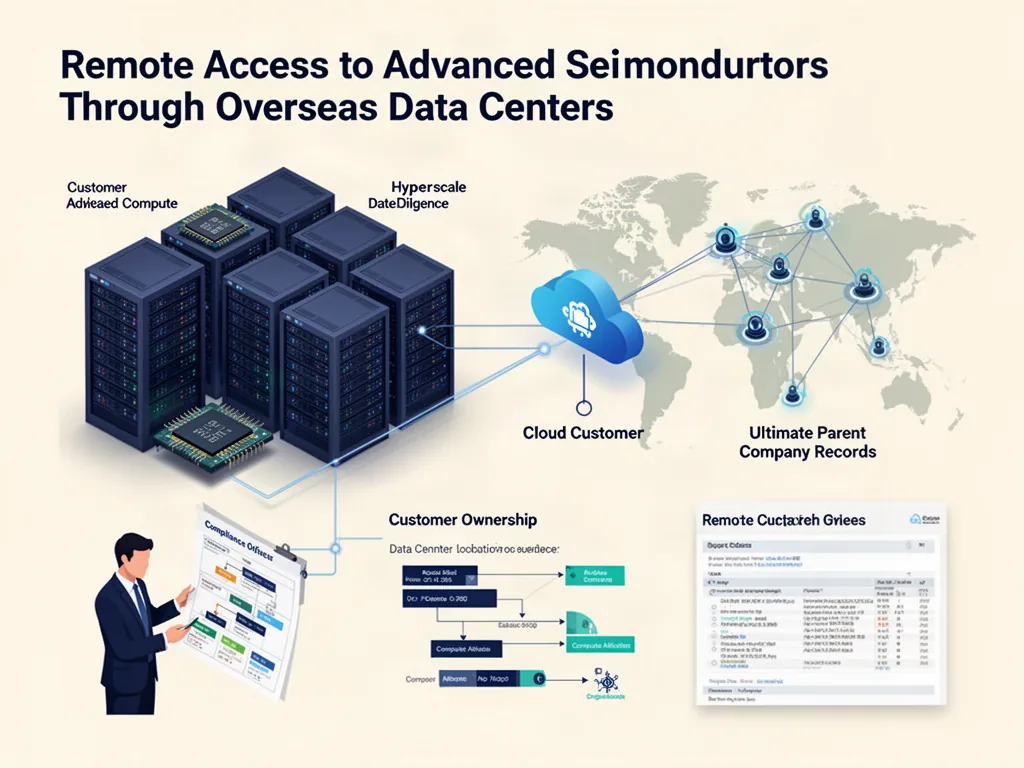
1. Confirm the rule's publication and effective status first
BIS announced the interim final rule on 15 November 2026. The official prepublication document is titled Addressing Remote Access to Advanced Semiconductors, docket 261116-0005, RIN 0694-AK50, document 2026-23529. Its notice says it is scheduled to be published in the Federal Register on 19 November 2026. The DATES section still states that the rule is effective on the date of Federal Register publication and leaves that date as a placeholder in the prepublication copy.
That distinction matters. As of 17 November 2026, an operator should not state that the new §744.24 is already effective or calculate the 90-day transition deadline from 15 November. The final publication date and any final text must be checked in the Federal Register. The interim final rule also invites public comments, so a later amendment or clarification is possible. Keep a dated copy of the version used for each internal decision.
The prepublication text is still useful for preparation because it identifies the proposed controls, due-diligence expectations, threshold and transition mechanism. Use it to inventory customers, ownership, linked data centres and hardware evidence, while marking legal conclusions and effective dates as pending until the official publication is confirmed.
Status record as of 17 November 2026
- BIS release: 15 November 2026.
- Federal Register document: 2026-23529, docket 261116-0005, RIN 0694-AK50.
- Scheduled Federal Register publication: 19 November 2026.
- Prepublication effective-date field: date of publication, not yet populated.
- Operational control: verify the published document before treating the new provision as effective.
2. What the proposed new §744.24 is designed to control
The rule adds an end-use control for certain advanced SI items when a person has knowledge that the items are destined for use in a data centre that will provide direct or indirect access to significant computing power to or for an entity headquartered in Macau or a destination listed in Country Group D:5, or whose ultimate parent company is headquartered there. The data centre can be located anywhere in the world. A server outside a restricted destination is not automatically outside the analysis.
The prepublication text specifies a threshold of more than 12,000,000 aggregate TPP, either at one data centre or across linked data centres. The rule covers access provided to or for the relevant companies. It is not a simple test of where the customer logs in, where the invoice is paid or where the physical server rack is installed. The ownership, ultimate parent, indirect customer relationship and actual compute allocation all matter.
The provision is an additional end-use control on top of other applicable Export Administration Regulations requirements. A licence requirement may arise from item classification, destination, another end-use rule or end-user restriction even if the new data-centre threshold is not met. Conversely, the threshold should not be used as a general safe harbour for every chip or server transaction.
Keep the scope test together
- Is the item subject to the EAR and within the covered advanced SI item descriptions?
- Will it be used in a data-centre end use?
- Will one or more facilities provide more than 12,000,000 aggregate TPP?
- Are the facilities linked through physical or digital networking infrastructure?
- Is the compute provided directly or indirectly to or for a Macau- or D:5-headquartered entity or its relevant ultimate parent?
- What knowledge, customer information and red flags exist at the time of export, reexport or transfer?
3. Map the parties and their corporate relationships
A data-centre customer may be a cloud reseller, managed-service provider, AI laboratory, systems integrator, model developer or procurement intermediary. The customer signing the service agreement may not be the organisation that ultimately receives the compute. Record the legal entity that contracts for the service, the entity that pays, the entity that controls the account, the end user of the workload and any parent or affiliate with ownership or control.
The prepublication text expects due diligence on whether data-centre customers are subject to direct or indirect ownership or control by persons located in, headquartered in, or whose ultimate parent is headquartered in Macau or a Country Group D:5 destination. This is a corporate-relationship review, not merely a name-screening exercise. A company registered in a different country can still have a relevant parent, owner, controller or downstream user.
Use the legal names and registration identifiers for each entity. Record the country of incorporation, principal place of business, registered address, parent chain, disclosed beneficial owners, voting or control rights, directors where relevant, account administrator, contracting party and the source and date of each record. If a customer uses a nominee, reseller or complex group structure, describe the unresolved link rather than guessing at the ultimate parent.
Entity and ownership evidence
- Customer legal name, registration number, jurisdiction and address.
- Contracting entity, purchaser, payer, account holder and actual workload user.
- Direct parent, ultimate parent and relevant subsidiaries or affiliates.
- Ownership, voting, board, contractual or other control evidence.
- Public registry extracts, customer declarations and independent source records.
- Source date, reviewer, unresolved ownership gaps and escalation owner.
4. Treat indirect access and intermediaries as part of the review
The rule is not limited to a direct service agreement between the data-centre operator and the restricted-headquartered company. The preamble explains that compute may be provided through a non-D:5 customer that is itself training SI models for, participating in training for, or providing SI models to a D:5 company. A reseller, hosted platform, managed service or model provider can therefore be a relevant part of the access chain.
Map who can allocate the compute, who can create or administer workloads, who receives the output, who can transfer access and who can instruct the service provider. Record whether a customer can sublicense, resell, pool or reassign capacity. A contract that prohibits onward transfer is useful evidence, but it does not replace the actual access model and information available to the operator.
Where an intermediary says it does not know the ultimate customer, ask what information it collects, how it validates customer identity and ownership, whether it monitors changes and whether it can provide the information required by the data-centre operator or exporter. A chain with no meaningful visibility should be escalated rather than treated as low risk because the immediate customer is outside the listed destinations.
Indirect-use questions
- Can the customer resell, sublicense, broker or reassign compute capacity?
- Can another entity control the workload or model-training process?
- Does a downstream party receive model access, model outputs or hosted inference?
- Who can create, administer and terminate accounts or workloads?
- What contractual and technical controls prevent unapproved onward access?
- What information is available when the operator or exporter must reassess the transaction?
5. Inventory linked data centres, not just individual buildings
The proposed definition of a linked data centre includes two or more separate data centres connected by networking infrastructure that lets physical and virtual facilities share resources, balance workloads and replicate data as a unified whole. The definition expressly includes digitally linked infrastructure, not only facilities joined by a physical connection.
A group may operate multiple regions, availability zones, colocation sites or cloud facilities. Do not assume that each building is a separate threshold calculation if the network lets facilities operate as a linked whole. Record the network relationship, resource-pooling capability, workload movement, orchestration layer, data replication and the entity that controls the shared capacity.
Build a facility register with legal owner, operator, physical location, network relationship, covered hardware, compute capacity, customer allocation and service dates. Where capacity is shared among customers, describe the allocation method and whether it is measured by reserved capacity, provisioned instances, actual use or another operational metric. The regulatory calculation must follow the rule's technical definition and qualified export-control advice, not an internal sales dashboard alone.
Facility register fields
- Data-centre legal entity, owner, operator and physical address.
- Country, region, site identifier and date the facility entered service.
- Physical and digital links to other facilities.
- Resource sharing, workload balancing and data-replication capability.
- Covered chips, servers and relevant item identifiers at each site.
- Customer-level capacity allocation and the source of the measurement.
6. Build a defensible aggregate-TPP evidence file
The rule uses aggregate total processing performance, not a simple count of servers, GPUs, racks or compute hours. The prepublication document refers to the technical notes for ECCN 3A090. Those notes define TPP using the maximum claimed MacTOPS and the bit length of the operation, aggregated across processing units on the integrated circuit. The relevant item descriptions and technical notes must be checked for the exact hardware and configuration.
A vendor datasheet may state TOPS, FLOPS, memory bandwidth or a model-specific benchmark. Those numbers are not automatically interchangeable with the rule's TPP measure. Preserve the manufacturer, exact chip model, board or module, server configuration, datasheet revision, technical note, maximum claimed performance, precision or bit length, number of processing units and any relevant package or die details. If the item classification or TPP cannot be reconciled, mark it as an unresolved technical input.
For the threshold review, record the aggregate TPP at each individual facility and across the linked network, and identify the customer or group receiving the capacity. Keep the calculation reproducible: source document, formula, assumptions, unit conversions, aggregation logic and reviewer. Do not present an estimate from a marketing slide as an authoritative ECCN or TPP determination.
Hardware evidence to collect
- Manufacturer, exact integrated-circuit model and part number.
- Applicable ECCN or classification evidence supplied by the manufacturer or exporter.
- Technical datasheet and the revision used for the calculation.
- MacTOPS, bit length and processing-unit information required by the relevant TPP note.
- Number of covered items and the facility or linked-network allocation.
- Formula, assumptions, calculation owner and unresolved technical questions.
7. Check customer ownership and control before accepting missing information
The proposed §744.24 note describes the information expected to support the absence of knowledge. It calls for sufficient information from the foreign data centre about its know-your-customer checks, including whether customers are subject to direct or indirect ownership or control by persons located in, headquartered in, or whose ultimate parent is headquartered in Macau or a Country Group D:5 destination.
The text is explicit about a difficult case: a foreign data centre that declines or is unable to provide enough information to verify compliance is a red flag that presumptively provides knowledge unless the red flag is resolved before proceeding. A blank ownership form, an unsigned self-certification or a statement that the customer is confidential should not be recorded as a completed check without further analysis.
Use a risk-based evidence process. Request the missing information, compare it with independent company records where available, document any mismatch, restrict the transaction from proceeding while a material red flag remains unresolved, and escalate to the export-control owner or counsel. The precise legal standard and any required action must be determined under the published EAR text and the facts; Needo can organize the evidence but cannot decide the legal result.
Red flags to resolve
- Customer will not identify its ultimate parent or beneficial ownership.
- The customer uses an intermediary but refuses to identify downstream users.
- The legal entity, payer, account administrator and end user do not reconcile.
- Ownership or control information conflicts with public registry records.
- The customer cannot explain workload purpose or compute allocation.
- A data-centre operator cannot provide sufficient KYC evidence to the exporter or transferor.
8. The commercial-recommender exception is narrow
The prepublication rule describes a commercial recommender system as an SI tool exclusively designed and exclusively used to rank, filter or suggest commercial products, services or content to users based on user behaviour, transaction history or item attributes. The word exclusively matters. A system that has a recommender feature is not automatically within the exception.
The definition expressly excludes an SI system designed or used to generate novel text, images, audio, video, software or other content in response to user inputs, and excludes a system that incorporates such a model even if it also performs recommendation functions. A generative model used for product suggestions, customer support, summarisation or content creation should not be treated as an exempt commercial recommender solely because it ranks products as one of its functions.
The exception also has reporting conditions. The prepublication text identifies information including the name of the company receiving the compute, the sum of the TPP of the relevant integrated circuits or commodities provided to or for it, and the due diligence performed to ensure that the compute is exclusively used for the qualifying recommender system. Have counsel review the exact published paragraph and reporting route before relying on it.
Exception review questions
- Is the system exclusively designed for ranking, filtering or suggesting commercial products, services or content?
- Is it exclusively used for that function in the relevant compute environment?
- Does it generate novel content or incorporate a generative model?
- Can the operator segregate and evidence the workloads covered by the claimed exception?
- Can the operator identify the recipient company and aggregate the relevant TPP?
- Can the required due-diligence and reporting evidence be produced?
9. Existing data-centre services have a 90-day transition provision
The prepublication text says that a data centre providing significant compute power to companies headquartered in Macau or Country Group D:5, or whose ultimate parent is headquartered there, before the rule's publication date must obtain a licence within 90 days of the effective date if it wishes to continue providing those services. The document's effective date is the Federal Register publication date, which remains unfilled in the 17 November prepublication copy.
Do not calculate the deadline from the BIS press release date or from the scheduled publication date until the official publication confirms the effective date. Once the final date is known, identify every existing customer and linked facility that may be in scope, calculate the 90-day period from the correct date, assign a licence and compliance owner, and preserve the evidence showing the service and customer status before publication.
The rule also contains a separate narrow commercial-recommender exception and a discussion of existing services. Because the preamble and operative provisions must be read together, do not assume every recommender workload receives the same transition treatment or that a 90-day period is an automatic licence exemption. Obtain a transaction-specific interpretation from export-control counsel or BIS where the facts are material.
Transition calendar
- Save the final Federal Register publication date and effective-date text.
- Snapshot customer, ownership, workload and linked-facility data as of the publication date.
- Identify existing services to D:5- or Macau-headquartered entities and their ultimate parents.
- Calculate the 90-day date from the actual effective date once confirmed.
- Assign licensing, customer communication, technical and legal owners.
- Record any licence application, approval, denial or service restriction decision.
10. Monitor subsequent changes in end use
The proposed rule adds a notification and authorization requirement for subsequent changes in end use. If an item was originally exported, reexported or transferred without authorization because the exporter, reexporter or transferor did not have knowledge of a prohibited data-centre end use, a later change can create a new issue. The text requires the original transferor to inform the recipient when the relevant change in use means BIS authorization is required and to identify the data-centre operator's authorization and KYC responsibilities.
This makes onboarding only the beginning of the control. A customer can change its parent, be acquired, add a reseller, move workloads, connect another data centre or start providing compute to a new downstream model developer. Record which changes require notice, who receives the notice, when the operator must reassess the customer and who can stop or restrict the affected service.
Use contract clauses, periodic certifications, account monitoring, workload telemetry and escalation procedures appropriate to the service. Do not rely on a once-only form if the customer or network can change materially after the original chip shipment.
Change events to monitor
- Change in customer ownership, ultimate parent or control.
- New reseller, intermediary, downstream model provider or end user.
- New data-centre location or digitally linked facility.
- Material increase in aggregate TPP or customer allocation.
- Change from a non-prohibited workload to a potentially prohibited use.
- New information, notice or red flag that changes the knowledge analysis.
11. Do not confuse the data-centre rule with the separate five-country chip rule
The same interim final rule also adds a separate destination-based licence requirement for specified advanced semiconductors exported, reexported or transferred to or within Indonesia, Malaysia, Singapore, Thailand and Brazil. That provision is distinct from the new remote-access end-use control in §744.24. A transaction may need to be assessed under both, but the five-country destination list is not the same test as the more-than-12-million-TPP data-centre rule.
The prepublication document describes a separate exclusion from that destination-based requirement for semiconductors destined to an ultimate consignee or end user headquartered in the United States, or whose ultimate parent is headquartered in the United States, provided the specified reporting requirements are met. This is not a general exemption for all cloud customers or every data-centre service. Review the exact item scope, destination, ultimate consignee, end user and reporting provisions in the published rule.
For an operator in one of the five countries, a server or chip transaction can therefore raise a destination-based issue even when the data-centre customer is not headquartered in Macau or D:5. Conversely, a data centre in another country can still fall within the remote-access analysis if it provides the relevant compute to or for a Macau- or D:5-headquartered entity. Keep the two decision paths separate in the transaction file.
Two distinct control questions
- Destination-based rule: is the advanced semiconductor export, reexport or transfer to or within one of the five named destinations and within the specified item scope?
- Remote-access rule: will covered items be used in a data centre providing more than 12,000,000 aggregate TPP to or for a Macau- or D:5-headquartered entity?
- For either path, check any U.S.-headquartered ultimate-parent exclusion and its reporting conditions only where the exact provision permits it.
- Do not treat a customer's country of incorporation as the only relevant ownership or end-use fact.
12. Worked example: a cloud customer using two linked sites
Illustrative example: a cloud operator in Singapore runs two data-centre sites that share networking infrastructure, balance workloads and replicate data. A customer incorporated in a third country purchases capacity through a managed-service provider. The customer's ultimate parent is headquartered in a Country Group D:5 destination. The operator's technical team estimates that the two linked sites together provide more than 12,000,000 aggregate TPP to or for the customer group.
The operator should not assess each building in isolation if the sites meet the linked-data-centre definition. It should map the customer, managed-service provider, ultimate parent, account administrator, workload user and any downstream model provider; identify the covered chips and their TPP evidence; document the customer allocation; and obtain the ownership and control information needed for the KYC review. If the intermediary or data-centre customer cannot provide sufficient information, the rule describes that as a red flag that is presumptively knowledge unless resolved.
The example does not determine that a licence is required in a real case. The exact item, EAR jurisdiction, technical calculation, customer relationship, date, rule publication and any applicable exception must be assessed under the final text and the transaction evidence. The practical result is a documented escalation pack rather than an automatic approval or rejection.
13. A customer questionnaire that produces usable evidence
A questionnaire should ask for facts that can be checked. Ask the customer to identify its contracting legal entity, registration number, principal address, direct parent, ultimate parent, ownership and control structure, and any relevant affiliate that will receive compute. Ask who pays, who administers the account, who creates workloads, who can assign capacity and whether any other party can resell or sublicense access.
Ask the customer to describe the workload, whether it trains or provides SI models, the intended users, the locations from which the service is accessed, the data-centre sites involved and any linked infrastructure. Request the compute allocation or reserved-capacity evidence needed for the operator's TPP analysis. If the customer claims the commercial-recommender exception, require a detailed explanation of the system's exclusive design and use, confirmation that it does not generate or incorporate novel content models, and the evidence needed for the specified reporting.
Make the questionnaire versioned and dated. Ask the customer to notify the operator of changes in ownership, control, ultimate parent, workload, downstream users, linked facilities or compute allocation. A customer certification is an input to due diligence, not a substitute for reviewing contradictory information or resolving a red flag.
Copy-ready questionnaire fields
- Legal entity, registration number, jurisdiction, address and website.
- Direct parent, ultimate parent, ownership and control information.
- Purchaser, payer, account administrator, workload user and downstream recipient.
- Purpose of compute, model training or inference activity and intended users.
- Data-centre locations, linked sites, resource sharing and workload movement.
- Reserved and actual compute allocation, hardware identifiers and supporting technical data.
- Resale, sublicensing, third-party access and change-notification commitments.
14. Use Needo to assemble the remote-compute diligence pack
Needo can organize customer onboarding records, ownership charts, company registry evidence, contracts, data-centre inventories, network diagrams, chip lists and technical datasheets into a single review. It can separate the contracting customer from the payer, account administrator, ultimate parent and downstream user; identify missing ownership links; and map each facility to the customers and workloads that use its capacity.
It can also build a preliminary TPP evidence worksheet from supplied manufacturer data, show which technical inputs are missing, map linked facilities and customer allocations, prepare the 12-million threshold questions, and create a dated transition calendar once the Federal Register effective date is confirmed. It can distinguish a claimed commercial-recommender workload from one that generates or incorporates novel content, and list the evidence needed for counsel to review the exception.
The deliverable is an evidence pack: entity graph, ownership and control register, linked-data-centre map, item and TPP matrix, customer questionnaire, red-flag log, change-monitoring plan and GO / CLARIFY / HOLD handoff. Needo does not determine EAR jurisdiction, assign a binding ECCN, make an authoritative TPP calculation without technical evidence, grant a licence or certify compliance.
Expected review outputs
- Customer, parent and ownership evidence register.
- Data-centre and linked-network inventory.
- Covered-item and TPP evidence matrix with assumptions visible.
- Direct and indirect access map for customers and downstream users.
- Red-flag, exception and reporting checklist.
- Publication-date-based transition calendar and counsel handoff.
15. Final operator checklist before relying on the rule
Before a chip shipment, reexport or in-country transfer, confirm the item's jurisdiction, ECCN and technical description using authoritative evidence. Before providing remote compute, map the customer and ultimate parent, ownership and control, downstream users, linked facilities and customer-level allocation. Confirm whether the relevant threshold and end-use conditions are met, and whether sufficient KYC information is available to resolve red flags.
Then check the final Federal Register publication, effective date, operative text, comment or amendment history and any separate destination-based licence requirement. For an existing service, calculate the 90-day transition period from the actual effective date rather than the press-release or scheduled-publication date. Record the owner of each open question and the date by which it must be resolved.
The strongest control is one that remains accurate after the customer, network or workload changes. Keep a current ownership and access record, preserve the technical basis for TPP, monitor downstream changes, and make the legal review specific to the item, destination, end user, end use and date. A checklist helps organize evidence; it does not replace the published EAR or a licence decision.
Release gate
- Final Federal Register text and effective date checked.
- Item jurisdiction, ECCN and technical data reviewed by the responsible export-control owner.
- Customer, ultimate parent and direct or indirect ownership/control evidence recorded.
- Linked data centres and aggregate TPP evidence reconciled.
- Downstream use and any commercial-recommender claim reviewed.
- Red flags resolved or transaction held for qualified review.
- 90-day transition and subsequent-change owners assigned where applicable.
Sources and further reading
- Federal Register — Addressing Remote Access to Advanced Semiconductors, document 2026-23529 (prepublication copy)
Primary prepublication text for proposed new 15 CFR §744.24, the 12,000,000 aggregate TPP threshold, linked data-centre definition, KYC expectations, recommender exception and 90-day transition. Scheduled for Federal Register publication on 19 November 2026; verify the final published text and effective date.
- U.S. Bureau of Industry and Security — BIS Issues Rule Addressing Remote Access to American Super Intelligence Technology
BIS announcement dated 15 November 2026 confirming release of the interim final rule and its focus on remote access through overseas data centres.
- BIS — Supplement No. 3 to Part 732: Know Your Customer Guidance and Red Flags
Official EAR guidance on knowledge, customer diligence, investigating red flags and avoiding self-blinding.
- BIS — Export Administration Regulations, Part 740 and Country Groups
Official current Part 740 source for country groups and related EAR provisions. Confirm the current Supplement No. 1 listing when evaluating a specific destination.
- BIS — Export Compliance Toolkit
BIS guidance for building an export compliance programme, including KYC, red-flag review and screening controls.
Sources support the specific points noted above. Confirm current requirements for your product, destination and contract before committing.
Need the actual problem solved?
This guide explains the method. Needo can work from your specific requirement, compare relevant options, verify important details and help move the next step forward.
Start with your exact problem →Selling or exporting? See live buyer requirements by product · see a sample verified shortlist