NEEDО · INVENTORY PLANNING
How to Calculate a Reorder Point for Imported Inventory
A reorder point is the stock position at which you should trigger replenishment so expected demand can be covered while new stock becomes usable. For imported goods, that waiting period can include supplier production, inspection, export handling, international transit, customs, inland delivery and receiving. A useful calculation therefore needs more than the average number of units sold. It needs a realistic replenishment lead time, a stated safety-stock method and a clear view of stock already committed or on the way. The worked example below is illustrative; use your own SKU history and constraints before changing purchasing policy.
Start with the basic reorder point formula
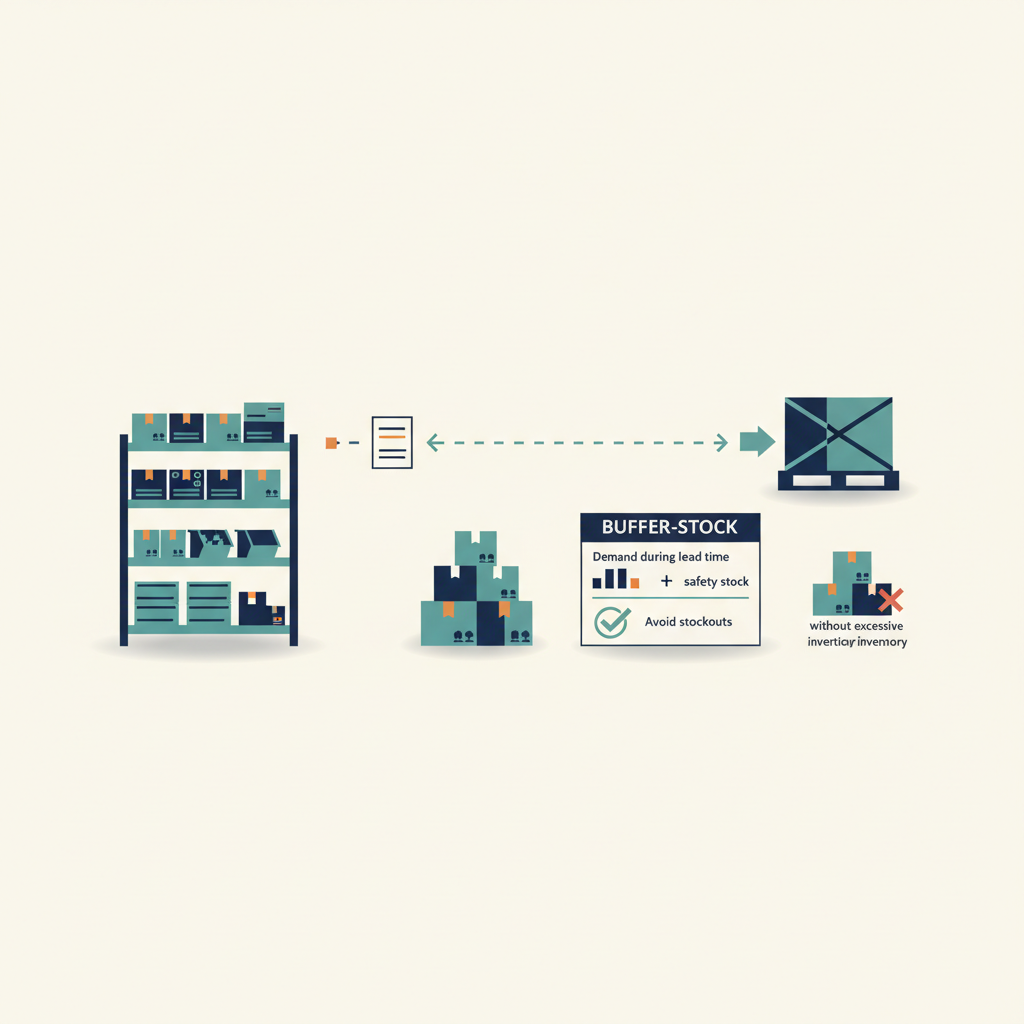
A simple starting formula is: reorder point = demand during replenishment lead time + safety stock. If demand is reasonably stable, demand during lead time can be estimated as average daily usage multiplied by lead time in days. Safety stock is a separate buffer intended to absorb the variation or uncertainty you have chosen to protect against.
The formula is a trigger, not a guarantee that stock will never run out. It works only as well as its inputs, the lead-time definition, the stock records and the replenishment process. Keep units consistent: daily demand must be multiplied by lead time in days, not weeks or calendar periods that mean something different.
Write the calculation with units
- Average usage: units per day
- Replenishment lead time: days from order release until stock is usable
- Lead-time demand: units per day multiplied by days
- Safety stock: units, with the method and assumptions recorded
- Reorder point: lead-time demand plus safety stock
Collect the data before choosing a buffer
Use recent demand or component-usage history for the SKU, but inspect the period before averaging it. Promotions, shutdowns, seasonality, lost sales during stockouts and one-off projects can distort the result. If demand is intermittent or highly seasonal, a single daily average may conceal the periods that matter most.
Use actual supplier order-to-usable-stock history where possible. A supplier's quoted production time may exclude inspection, consolidation, port handling, customs clearance, inland delivery or your own receiving delay. Record the date range and whether lead time is measured in calendar days or working days; use the same basis for demand and replenishment.
Inputs to gather
- Daily or weekly demand/usage for the SKU and the dates covered
- Actual order, dispatch, arrival and usable-stock dates from prior replenishments
- Known seasonal or project demand changes
- Current usable stock, quarantined stock and allocated quantities
- Confirmed inbound orders and their expected usable dates
- MOQ, pack-size, shelf-life, storage and cash constraints
Worked example: calculate a simple reorder point
Illustrative example: a component is used at an average of 20 units per day. The replenishment lead time from order release to usable stock is 18 days. The business chooses a safety-stock buffer of 120 units based on its own risk tolerance. Lead-time demand is 20 × 18 = 360 units. The reorder point is 360 + 120 = 480 units.
Under these assumptions, place the replenishment order when inventory position reaches 480 units or less, subject to the purchasing policy and any required approvals. The 120-unit buffer is an example, not a recommendation for every business. A different SKU, service target, demand pattern or lead-time risk could justify a different method and result.
Keep the calculation auditable
- Demand assumption: 20 units per day
- Lead-time assumption: 18 days
- Lead-time demand: 360 units
- Illustrative safety stock: 120 units
- Illustrative reorder point: 480 units
Use inventory position, not only the physical shelf count
A warehouse may show 400 usable units while 100 more are confirmed inbound and 20 units are already allocated or backordered. A simple inventory-position calculation is usable on-hand + confirmed inbound − committed demand, giving 400 + 100 − 20 = 480 units. In the example above, that is exactly the reorder threshold, so the buyer should review whether replenishment must be released now.
Do not count unconfirmed supplier promises as certain inbound stock. Keep quarantined, damaged, expired or otherwise unusable stock out of the usable balance. If an inbound order is late, cancelled or no longer matches the SKU, update the inventory position and lead-time assumptions instead of letting an old expected date suppress a necessary reorder.
Reconcile before triggering
- Usable stock only, not every unit physically present
- Confirmed inbound quantity and realistic arrival date
- Allocated, reserved or backordered demand
- Cancelled, delayed or disputed purchase orders
- Lot, expiry or quality restrictions that make some units unavailable
Choose a safety-stock method you can explain
A simple fixed buffer is easy to understand but can be too high for stable items or too low for volatile ones. A max-versus-average approach can be used as a rough planning estimate when the history is limited, but it is sensitive to outliers and does not provide a universal service guarantee. If demand and lead-time history is adequate, a statistical method can model variability and a chosen service target; the method should match the demand pattern and replenishment policy.
Enterprise planning references commonly define reorder level as safety stock plus forecast demand during replenishment lead time. More advanced methods use forecast error or demand and lead-time variability. Do not copy a service-level factor or statistical formula without checking its assumptions. If data is thin, state that limitation and use a transparent provisional estimate that will be reviewed when better history is available.
Record the safety-stock decision
- Chosen method and why it fits the data available
- Demand and lead-time history used, including exclusions
- Service or stockout-risk objective if one was selected
- Costs of excess stock, obsolescence and expiry
- Date and trigger for recalculating the buffer
Imported inventory needs a realistic lead-time definition
For imports, distinguish the supplier's production lead time from the full time until goods are received, cleared, checked and available for use. Depending on the shipment, the timeline may include raw-material availability, production scheduling, pre-shipment inspection, export documentation, consolidation, port cut-offs, ocean or air transit, customs, duties or holds, inland transport and receiving inspection. Not every shipment has every step; use the actual route and contract.
If lead time varies, retain the history instead of relying only on the supplier's best-case promise. Track promised versus actual dates and note the cause of material delays. A supplier scorecard or backup-supplier plan may be useful when repeated delays make the buffer expensive or unreliable. Raising safety stock is not always the best fix if the underlying issue is unstable supply or an incorrect forecast.
Import-specific checks
- Which events start and end the lead-time clock?
- Does the estimate include inspection, clearance and receiving?
- Are quoted lead times consistent with actual delivery history?
- Are port closures, seasonal peaks or product-specific checks relevant?
- Does a late shipment require a separate exception or recovery plan?
Separate the reorder point from the order quantity
The reorder point answers when to act. It does not decide how much to buy. Order quantity may depend on supplier MOQ, carton or pallet multiples, price breaks, freight economics, storage capacity, expiry, cash availability and the next expected replenishment. A large MOQ can make a sensible reorder trigger result in too much stock, while an order that is too small may create repeated freight or handling costs.
Evaluate the trigger and the order quantity separately, then test whether the combined policy creates a plausible stock path. If the minimum order exceeds the amount you can safely consume before expiry or obsolescence, consider negotiating a lower MOQ, staged deliveries, another supplier or a different sourcing arrangement rather than simply increasing the order.
Before releasing a purchase order
- Is the MOQ compatible with demand and shelf life?
- Are case packs or pallet multiples included in the quantity?
- Can the budget cover the order without harming other commitments?
- Would staged delivery or a blanket order reduce exposure?
- Does the quote use the same currency, delivery basis and landed-cost assumptions?
Know when the simple formula is not enough
Recalculate or change the method when demand changes materially, a product is seasonal, lead times become unreliable, stockouts suppress recorded sales, a supplier changes production location, a product has a short shelf life, or multiple SKUs share constrained components. Intermittent-demand items may need a different forecast approach. New products with little history should carry an explicit uncertainty note rather than a false-precision number.
Treat the result as a decision aid, not an automatic order authorization. Confirm the latest supplier status, available cash, open orders and any commercial or compliance blockers. Record what would make you override the trigger, who can approve that exception, and how the actual result will be reviewed after the next replenishment.
Review triggers
- Demand shifts beyond the agreed tolerance
- Actual lead time repeatedly exceeds the planning assumption
- A shipment is delayed, short, damaged or held
- Supplier MOQ, price, route or production site changes
- A product becomes seasonal, regulated, obsolete or near expiry
Use Needo to build a transparent replenishment plan
Needo can organize SKU history, supplier lead times, inventory records, MOQ and stockout constraints into a reviewable reorder calculation. Ask it to show the formula, units, source period, inventory-position reconciliation, safety-stock method, uncertainty and sensitivity to a late shipment or demand increase. Provide the actual records and keep estimates distinct from verified data.
Needo should not invent demand or lead times, promise zero stockouts, or release a purchase order without the required authorization. Use the result to improve the planning decision, then compare the next actual replenishment against the assumptions so the policy gets better with evidence.
Sources and further reading
- SAP Help Portal — Reorder Level Calculation
Official SAP documentation describes the reorder level as safety stock plus the requirement forecast during replenishment lead time.
- Oracle Inventory Help — Reorder Point Planning
Oracle documentation explains safety-stock planning approaches and the role of forecast error and service-level assumptions.
- QuickBooks — What Is the Reorder Point?
A worked explanation of lead-time demand, safety stock and reorder-point calculation; verify the method against your own demand and replenishment data.
Sources support the specific points noted above. Confirm current requirements for your product, destination and contract before committing.
Need the actual problem solved?
This guide explains the method. Needo can work from your specific requirement, compare relevant options, verify important details and help move the next step forward.
Start with your exact problem →Selling or exporting? See live buyer requirements by product · see a sample verified shortlist