NEEDО · INDUSTRIAL PARTS & SOURCING
How to Find a Replacement for a Discontinued Industrial Part
When an industrial component is discontinued, the urgent task is not simply to find a seller with something that looks similar. You need to identify the exact item already installed, understand what the original manufacturer says about its lifecycle, and determine whether a proposed replacement is a direct substitute, a functional alternative or an engineering migration. Those are different decisions. A matching product name or connector is not proof of compatibility, and a marketplace listing is not proof of genuine stock. The workflow below turns an obsolete-part search into an evidence-backed sourcing and review brief while leaving technical approval with the responsible engineer or asset owner.
Confirm exactly which part is unavailable
Start by separating the failed component from the larger machine or assembly. A machine model may contain several motor, drive, sensor, controller or gearbox variants. The part that needs replacing may also differ by production revision, voltage, firmware, connector, mounting option or serial-number range. Record whether the original part is formally discontinued, temporarily unavailable, regionally out of stock, under allocation or simply difficult to source. Those conditions call for different next steps.
Ask what must be restored: the exact component, the original function, the machine's approved configuration or a supported migration path. If the machine is still operating, identify whether the component is a planned spare, a failed item or a critical single point of failure. Do not assume that a machine being old means every part in it is obsolete.
Capture the complete identity before searching
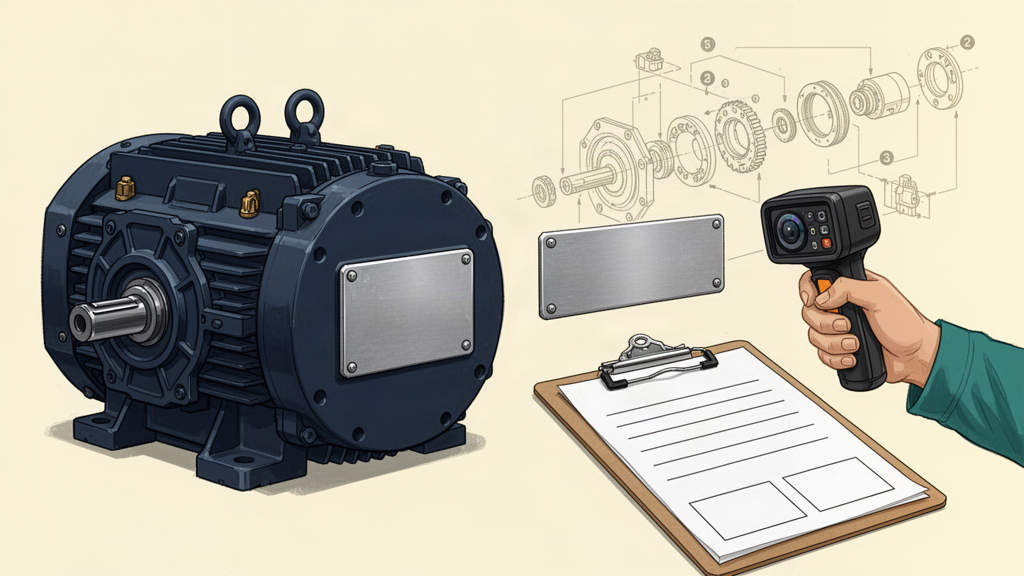
Photograph the component and its labels before removing or cleaning anything. Capture the full nameplate, all readable part and order numbers, manufacturer, model/type, serial number, revision, electrical ratings and any option codes. Take wider photographs showing connectors, mounting points, adjacent components and the installed orientation. If the label is damaged, preserve the original image and mark uncertain characters instead of silently guessing them.
Record the host machine or assembly model and serial number as well. Manufacturer workflows illustrate why both levels can matter: NORD provides product identification using equipment, order, serial and QR-code numbers. A Siemens CALOMAT 62 manual says its rating plate includes the device article number, product version and serial number; its spare-parts order example also records the device name, order number, serial number and spare-part designation/article number. These are manufacturer-specific examples, not a universal field list.
Identification pack
- Original manufacturer and complete part number, including suffixes
- Component model/type, revision, serial or order number and option codes
- Host machine model, serial number and production year if known
- Nameplate photographs, installation photographs and any QR/Data Matrix code
- Existing BOM, spare-parts list, wiring diagram, manual or previous purchase order
- Application details: what the part connects to and what it must do
Check the original manufacturer's documentation and lifecycle status
Search the manufacturer's own product page, parts catalogue, service portal, manual, product-change notice and lifecycle-status tool before relying on reseller descriptions. Look for an explicit status, effective date, replacement category, successor part number, technical bulletin, repair option or migration notice. Save the URL, document revision and date checked. A lifecycle status can change, and a search result or cached catalogue may be out of date.
If the OEM publishes a recommended replacement, read the complete notice and supporting technical documentation. Confirm the region, product revision and exact catalog number. Some manufacturers distinguish direct replacement, engineering replacement, functional replacement and no planned replacement. Do not translate one manufacturer's labels into another manufacturer's policy. If the official record is unclear, ask the OEM or authorized technical support route to confirm the exact item and application.
Classify each candidate instead of calling everything equivalent
Use a clear candidate label. An exact same-part replacement has the same manufacturer identity and complete part number. A manufacturer-designated direct replacement is a successor the OEM explicitly identifies for the original item, subject to its stated conditions. A functional replacement may perform a similar role but can require wiring, programming, mounting or control changes. An engineering replacement or migration may affect the wider system and require a design review, retrofit plan, validation and documentation update. Repair, exchange, refurbished and used options are separate supply/condition choices, not automatic technical equivalents.
Keep the candidate's evidence beside its label. A cross-reference database can help discover possible alternatives, but its own disclaimer may say the suggested part is only a candidate and that application suitability must be checked. Never convert a parametric match or distributor cross-reference into an approved substitution without the required review.
Compare the parameters that matter in the actual application
Build a side-by-side comparison against the original specification, not just the short product description. For an electrical or automation component, relevant checks may include supply voltage, current, power, signal type, input/output count, communication protocol, firmware, safety rating, environmental limits, connector pinout and mounting. For a mechanical component, compare dimensions, shaft or bore, load, speed, torque, material, pressure, temperature, lubrication and interface geometry. The applicable parameters depend on the equipment and its duty.
Separate hard requirements from acceptable changes. Mark every field as exact match, documented difference, not applicable or unknown. Record the source document and revision for each important value. A candidate with one unresolved safety, control or interface parameter should not receive an overall green score merely because many other fields match.
Check the seller, condition and traceability
Ask whether the offered unit is new OEM, authorized-channel stock, surplus, used, refurbished, repaired or remanufactured. Request the exact part number and suffix, photographs of the offered item, serial or date code where relevant, quantity actually available, storage history if material, warranty, return conditions and dispatch location. Ask for traceability documents appropriate to the component and transaction, and independently confirm the seller's relationship to the manufacturer when authorization matters.
For obsolete electronic or industrial parts, authenticity and condition deserve their own review. NASA's GIDEP 'Know Your Part' article describes information-sharing about counterfeit, substandard and discontinued parts. Where you have access to applicable alerts or exchange programmes, check them; otherwise request traceability and inspection evidence from the supplier. A low price or an old product photograph is not evidence that the offered unit is genuine or usable.
Define the validation gate before placing the order
Write down who is authorized to approve the replacement and what evidence that person needs. Depending on the application, validation may involve a datasheet review, drawing comparison, sample inspection, bench test, configuration check, controlled trial, commissioning test or formal change-control approval. Define the acceptance criteria, test owner, affected machine/serial range, rollback plan and records that must be updated.
If the part affects safety, regulatory compliance, a protected control function or a critical process, route the decision to the qualified engineering and compliance owners. Needo can organize the evidence and prepare questions; it cannot certify that a component is safe or authorize a machine modification.
Send suppliers a quote-ready replacement brief
A useful enquiry makes it hard for a supplier to quote the wrong variant. Include the original part identity, machine context, quantity, required condition, delivery location, deadline, technical documents and the exact questions you need answered. Ask the supplier to state whether the proposed item is exact, OEM-designated, functional or engineering replacement, and to attach the source for that claim. Request separate pricing for new, repaired, refurbished or surplus condition rather than mixing them in one line.
Copy-ready brief: 'We need [quantity] of [manufacturer + complete part number] for [machine model/serial range]. Please confirm exact identity, current condition, traceability, warranty, stock location, lead time and whether this is the original part or a proposed successor. Attach the OEM document or datasheet supporting any replacement claim, list every known difference and do not substitute another item without written approval.'
Worked example: a discontinued drive module
Illustrative example: a maintenance team needs a drive module for an older production line. A reseller offers a newer model with a similar rating and connector. The team first records the old module's complete catalog number, revision, machine serial range, motor data, control interface and firmware context. It then checks the OEM lifecycle page and finds that the original is discontinued, but the published replacement category is an engineering migration rather than a direct drop-in.
The team compares the candidate's ratings, control signals, communication, dimensions, configuration requirements and installation documentation. The reseller's stock claim is checked separately from the technical match. Engineering defines a controlled test and approval gate before procurement releases the order. If the evidence does not support the proposed migration, the team keeps searching for an exact part, repair route or another candidate. The example is fictional and does not approve any specific drive or replacement.
Use Needo to move from the part number to a reviewed shortlist
Needo can start with a nameplate photo, part number, manual, BOM or supplier offer; organize the identity and application details; research OEM lifecycle information and candidate sources; compare documented specifications; and prepare a supplier enquiry and validation checklist. Ask it to label direct replacements, functional alternatives, engineering migrations and unknowns separately, and to show the source behind each important claim.
The useful outcome is not a confident-sounding substitute. It is a shortlist that shows what is known, what differs, which supplier claims need confirmation and what the authorized technical owner must approve before the part is ordered or installed.
Sources and further reading
- NORD — Spare Part Identification
Manufacturer example of identifying spare parts using order, serial, equipment and part numbers, with separate nameplate locations for gearbox, motor and inverter.
- NORD — Digital Services and Self Services
Manufacturer example of product identification using equipment number, gear-motor or inverter serial number, order number and QR-code number.
- Siemens — CALOMAT 62 Operating Instructions, Spare Parts
Manufacturer manual identifies the article number, product version and serial number on the rating plate and shows a spare-parts order using device name, order number, serial number and spare-part designation/article number.
- Rockwell Automation — Product Lifecycle Status
Manufacturer lifecycle definitions and product-status lookup; use the exact catalog number and current OEM record rather than assuming every discontinued item has a direct replacement.
- Schneider Electric — Cross Reference Tool
A manufacturer cross-reference tool that explicitly warns a replacement may not be one-for-one and must be reviewed against the product literature and application.
- NASA — GIDEP Helps You to 'Know Your Part'
NASA describes GIDEP information-sharing about counterfeit, substandard and discontinued parts; access and applicability depend on the relevant programme and organization.
Sources support the specific points noted above. Confirm current requirements for your product, destination and contract before committing.
Need the actual problem solved?
This guide explains the method. Needo can work from your specific requirement, compare relevant options, verify important details and help move the next step forward.
Start with your exact problem →Selling or exporting? See live buyer requirements by product · see a sample verified shortlist