NEEDО · INDIA EXPORT POLICY & BATTERY RECYCLING
India Black Mass Export Ban: What Exporters Must Check Under DGFT Notification 49/2026-27
India changed the export policy for lithium-ion battery black mass on 10 November 2026. The Directorate General of Foreign Trade (DGFT), through Notification No. 49/2026-27, moved the specified item under ITC(HS) 85491400 from Free to Prohibited with immediate effect and until further orders. The Government of India announced the change on 11 November. For a recycler, trader or exporter with stock, a signed purchase order or a shipment being prepared, the urgent question is not simply whether the material has value. It is whether the exact material and transaction fall within the notified item and whether the transitional provisions in paragraph 1.05 of the Foreign Trade Policy 2023 can apply to the particular export. This guide organizes the official rule, the records to assemble and the questions to put to DGFT, customs and environmental advisers. It is a document-preparation guide, not permission to export.
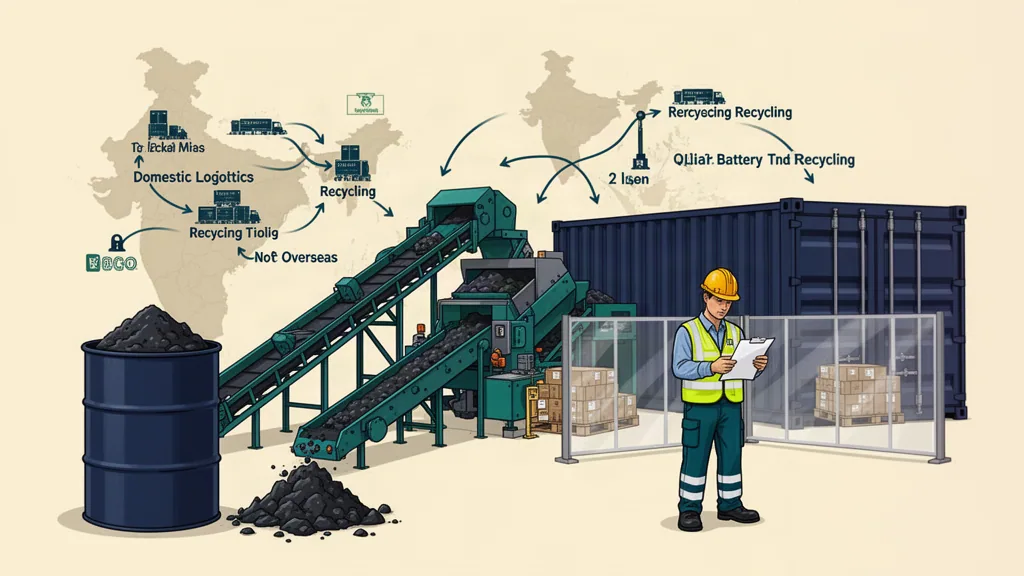
1. What changed on 10 November 2026?
The Government's 11 November 2026 announcement says DGFT Notification No. 49/2026-27, dated 10 November 2026, prohibits export of lithium-ion battery black mass falling under ITC(HS) Code 85491400. The policy changed from Free to Prohibited with immediate effect and remains so until further orders. The notification also states that the transitional arrangements under paragraph 1.05 of FTP 2023 apply. Do not treat a press report, a buyer's email or an older export-policy screenshot as a substitute for the notification and the current ITC(HS) Schedule II entry.
The stated policy purpose is to retain black mass generated in India for domestic recycling and refining, supporting recovery of lithium, cobalt, nickel and manganese. That policy explanation is useful context, but the exporter’s operational decision must be based on the operative notification, the exact goods description, the applicable transition rule and the facts of the proposed export. The policy change is not a general ban on every lithium-ion battery, every battery component or every metal-bearing powder. The official announcement identifies lithium-ion battery black mass under the stated tariff item.
Record the policy facts
- Notification number: 49/2026-27.
- Notification date: 10 November 2026.
- Announced by the Government of India on 11 November 2026.
- Identified item: lithium-ion battery black mass under ITC(HS) 85491400.
- Policy status: Prohibited with immediate effect until further orders, subject to the stated transitional arrangements.
2. Confirm the material and tariff-item scope before applying the change
Start with the physical material, not only the commercial invoice description. The PIB announcement explains that ITC(HS) 85491400 covers specified waste and scrap of primary cells, primary batteries and electric accumulators, including spent cells, batteries and accumulators that are unsorted and do not contain lead, cadmium or mercury. It specifically describes lithium-ion battery black mass as the powdery material obtained by shredding end-of-life lithium-ion batteries and battery-manufacturing waste. The tariff item description and the notification must be read together.
Ask the technical and customs teams to document how the material was generated, whether it has been sorted or processed, its composition, the source batteries, the process used, the physical form and the intended next use. A marketing name such as metal concentrate, black powder, recycled feedstock or intermediate does not by itself settle tariff classification or waste status. Conversely, do not assume that every material recovered from a battery is automatically the notified black mass. Where the product description, composition or tariff classification is uncertain, obtain a reasoned classification review from the customs professional and the relevant authority before shipment.
Material identity file
- Process flow from spent batteries or manufacturing waste to the material offered for export.
- Representative composition, assay and sampling records, with laboratory and batch details.
- Physical form, sorting or separation status, contaminants and packaging.
- Commercial description, technical specification, invoice description and proposed ITC(HS) code.
- Written explanation of any difference between the supplier's product name and the tariff-item wording.
3. Read paragraph 1.05(b) as a specific transition test
The official FTP 2023 Chapter 1 explains that item-wise export policy is governed by the policy on the date of export. It identifies the shipping bill as a key document for deciding the date of export, with the date further defined in paragraph 2.17 of the Handbook of Procedures 2023. Paragraph 1.05(b) says exports already made before the date of a change from Free to Restricted or Prohibited are not affected. For an export on or after the change, the paragraph provides a limited route where the exporter had a commitment through an Irrevocable Commercial Letter of Credit before the restriction or regulation was imposed.
That route is not a general grandfathering clause for every commercial commitment. The paragraph limits the permitted export to the balance quantity, value and period available in the pre-existing ICLC and requires the applicant to register the ICLC with the jurisdictional DGFT Regional Authority against a computerised receipt within 15 days of the restriction or regulation. The precise facts and documents matter. The PIB announcement confirms that paragraph 1.05 applies to this notification, but the exporter should still have the current notification and the current FTP/HBP text reviewed for the specific shipment.
Do not substitute a different milestone
- A signed purchase order is not the same document as an irrevocable commercial letter of credit.
- An advance payment receipt is not, by itself, proof of the ICLC condition.
- A draft LC, ordinary payment promise or post-notification instrument should not be assumed to qualify.
- The balance quantity, value and validity period must be reconciled to the ICLC.
- Registration with the jurisdictional Regional Authority and the computerised receipt must be evidenced.
4. Build the ICLC and 15-day registration evidence pack
For an exporter relying on paragraph 1.05(b), assemble the complete ICLC rather than a bank email that merely says an LC was discussed. Record the issuing bank, applicant, beneficiary, issue date and time, amount, currency, goods description, quantity, expiry, shipment period, partial-shipment terms and amendments. Reconcile those details to the export contract and the exact black-mass lot. If the instrument covers several products or shipments, show how much value and quantity remain available for this item after earlier drawings or shipments.
The FTP text requires registration with the jurisdictional Regional Authority within 15 days of the imposition of the restriction or regulation. Treat that as a time-sensitive control, not a box to complete later. Preserve the submitted document set, the online acknowledgement, computerised receipt number, submission date and time, any clarification request and the authority's response. If the exporter cannot prove the required registration or if the ICLC does not clearly cover the proposed quantity and period, mark the transition question unresolved and obtain written advice. Needo can organize the chronology; it cannot decide that an authority must accept the claim.
ICLC reconciliation fields
- Original ICLC and all amendments, with issue date before 10 November 2026.
- Applicant, beneficiary, issuing bank and transaction currency.
- Goods description and quantity that can be reconciled to the notified material.
- Unutilised balance value, quantity and remaining validity or shipment period.
- Regional Authority registration proof and computerised receipt within the applicable 15-day window.
- Written authority, customs or professional clarification for any mismatch.
5. Check the actual export date and shipment status carefully
A container booking, truck gate pass, warehouse dispatch note, port arrival, vessel nomination or buyer's requested ship date does not automatically establish the date of export for paragraph 1.05(b). The FTP points to the shipping bill as a key document, and the Handbook of Procedures provides the relevant date definition. Build a timeline using the shipping bill, customs system status, examination or let-export evidence, port records and transport documents. Ask the customs broker to explain which event legally determines the export date for the particular transaction.
For a shipment that was already exported before the policy change, preserve evidence showing that the export was made before 10 November. For goods that were only in transit to the port, at a container yard, loaded after the change or awaiting a shipping bill, do not assume that physical movement or a prior contract settles the transition question. Where the ICLC route is relied on, assess it separately against the exact terms of paragraph 1.05(b). A shipment's commercial urgency does not override a prohibition or replace a required authority determination.
Timeline evidence to reconcile
- Factory release, transporter receipt and arrival at the customs station.
- Shipping bill number, filing date and system acknowledgement.
- Customs examination, let-export order or other relevant customs event.
- Container, port, vessel and bill-of-lading records.
- Any hold, amendment, cancellation or change in goods description after 10 November.
6. Keep export policy separate from hazardous-waste and environmental controls
The DGFT export-policy change is one legal layer. It does not replace the Hazardous and Other Wastes (Management and Transboundary Movement) Rules, environmental consents, authorisations, battery-waste requirements, safe storage, transport or facility-specific conditions. The material's status can depend on how it is generated, handled, transferred and used. A commercial invoice calling the material a product or intermediate does not settle its status under environmental law. The exporter and recycler should have the relevant State Pollution Control Board or Pollution Control Committee consent and authorisation reviewed for the actual process and premises.
The Ministry of Environment, Forest and Climate Change's January 2025 technical-review record discusses CPCB input that black mass self-processed within the same premises may be treated differently from black mass transported or sold to another processing unit. That record is a reason to check the current rules and facility facts; it should not be turned into a universal conclusion for every recycler. Confirm the current hazardous-waste classification, movement documentation, consent conditions and any required central or state permission with the competent authority and qualified environmental counsel.
Environmental questions to resolve
- Which entity generated the black mass and at which authorised site?
- Is the next step captive utilisation at the same premises or transfer to another unit?
- What current SPCB/PCC consent and hazardous-waste authorisation cover the process?
- Do the transport, storage, packaging and movement records satisfy the applicable conditions?
- Does any separate permission or reporting requirement apply to the proposed movement or treatment?
7. Understand the domestic recycling evidence without treating it as an export permission
CPCB's published standard operating procedure for utilisation of black mass addresses recovery of carbon or graphite and metal compounds through hydrometallurgy. It describes requirements for eligible black mass generated by battery or e-waste dismantlers and recyclers, including authorised sources, leakproof packaging, controlled storage, fire precautions, process segregation and other facility safeguards. This is useful when evaluating a domestic recycling route or a prospective domestic buyer, but it is not a licence to export the material.
If the export route is no longer available, the commercial team may need to evaluate domestic offtake, captive processing or a revised downstream arrangement. Do not assume that a domestic buyer is authorised simply because it has a website or claims to recover lithium and cobalt. Check the buyer's legal entity, site, process, consent and authorisation scope, permitted capacity, input specification, acceptance criteria, payment terms and evidence of lawful handling. Any proposed transfer should be assessed under the current waste rules and the actual permits held by both parties.
Domestic offtake diligence
- Buyer legal entity, facility address and authorised operating site.
- Current consent to operate and hazardous-waste authorisation, including scope and validity.
- CPCB SOP applicability to the proposed utilisation process and material source.
- Permitted input capacity, acceptance specification, sampling and rejection procedure.
- Transport, storage, weighment, receipt and downstream recovery records.
- Contract terms for title, rejected loads, environmental responsibility and payment.
8. Review the export contract, inventory and buyer communication
A change from Free to Prohibited can affect supply contracts, purchase orders, advance payments, storage costs, insurance, demurrage and buyer commitments. Review the exact contract clauses on change in law, export restrictions, force majeure, regulatory approvals, delivery obligations, title transfer, cancellation, refunds, storage and dispute resolution. Do not promise a shipment date or ask a logistics provider to move goods toward export while the legal route is unresolved. If the buyer has paid an advance, reconcile the amount to the contract and ask counsel to assess the contractual consequences rather than treating payment as an export authorisation.
If the original export cannot proceed, a lawful domestic sale or alternative product route may be commercially possible, but it must be a genuine transaction that complies with the applicable policy and environmental rules. Do not relabel the material, split a shipment, change an invoice description or route the goods through another party to evade a prohibition. Keep the buyer informed with a factual status note: what changed, which authority documents are being checked, what evidence is missing and when the next update will be provided.
Commercial review checklist
- Contract, purchase order, invoice and payment evidence reconciled.
- Change-in-law, cancellation, refund and force-majeure clauses reviewed.
- Inventory location, storage conditions, insurance and demurrage exposure recorded.
- Buyer, consignee, destination and end-use details retained.
- Any alternative domestic transaction checked against environmental permissions and buyer capability.
9. Assemble one review pack before approaching the authority
The most useful submission is a chronological, internally consistent file. Put the notification and relevant FTP provision first, then the material identity and tariff evidence, the contract and ICLC, the Regional Authority registration receipt, the shipping bill and port records, and the environmental permissions. Use a document index with a unique file name, date, issuer, version, related shipment or lot and the question the document answers. If a record is missing, label it missing; do not replace it with an assumption or an unsigned summary.
Prepare a short issue sheet that states the exact decision required. For example: does the identified lot fall within the notified description; what is the legally relevant export date; does the pre-notification ICLC satisfy paragraph 1.05(b); was it registered with the jurisdictional Regional Authority within the required period; what quantity and value remain; and what environmental permissions apply to the proposed handling or domestic route? Ask the DGFT Regional Authority, customs broker and environmental adviser to answer the part within their competence.
Minimum review-pack index
- DGFT Notification 49/2026-27 and the current ITC(HS) export-policy entry.
- FTP 2023 paragraph 1.05(b) and relevant HBP export-date provision.
- Material description, process flow, assay and tariff-classification rationale.
- Contract, PO, ICLC, bank records and Regional Authority registration receipt.
- Shipping bill, customs status, port and transport records.
- SPCB/PCC consent, hazardous-waste authorisation, CPCB or MoEFCC documents and proposed buyer details.
10. Worked example: a purchase order and advance do not answer the ICLC question
Illustrative example: an Indian recycler signs a purchase order on 3 November 2026 to sell a lot of black mass to an overseas buyer. The buyer sends a 20 percent advance on 7 November. The material is packed and a container is booked, but no shipping bill has been filed before the policy change. On 10 November, Notification 49/2026-27 changes the identified export policy to Prohibited. The exporter has a PO and payment evidence, but no pre-notification irrevocable commercial letter of credit. Those records do not, by themselves, establish the ICLC condition in paragraph 1.05(b). The shipment should be held for a transaction-specific written determination rather than treated as automatically grandfathered.
A different example might involve an ICLC issued before the policy change, with a balance quantity and validity that appear to cover the proposed shipment and a registration receipt from the jurisdictional Regional Authority within the required 15-day period. That is evidence relevant to the transition test, not an automatic guarantee. The exporter still needs to reconcile the precise material, beneficiary, value, quantity, period, registration, export date and all other applicable requirements. Both examples are illustrative and are not legal determinations for a real shipment.
The decision should state
- What facts are confirmed by original documents.
- Which transition conditions are satisfied, not satisfied or unresolved.
- Which authority or professional must confirm the open legal issue.
- Whether the current decision is HOLD, CLARIFY or ready for a competent authority's review.
11. Use Needo to organize the black-mass export review
Give Needo the material specification, process flow, ITC(HS) code, contract, purchase order, ICLC, registration receipt, shipping bill, customs status and environmental permissions. Ask it to create a dated chronology, match each record to the lot and transaction, compare the evidence with the official notification and FTP paragraph, and identify the facts that still need a DGFT, customs or environmental decision. It can also prepare a domestic-offtake diligence checklist if the export route is unavailable.
The useful result is not a green badge or a promise that the cargo can leave India. It is a reviewable evidence pack that makes the material scope, transition facts, shipment timeline, environmental responsibilities and unresolved questions visible to the people authorised to decide. Keep the outcome open until the relevant authority or qualified adviser has addressed the legal issue and the shipment evidence supports the next step.
Sources and further reading
- Press Information Bureau — DGFT prohibits export of Lithium-Ion Battery Black Mass, 11 November 2026
Government announcement identifying Notification 49/2026-27, the 10 November date, ITC(HS) 85491400 and the immediate Prohibited policy change.
- DGFT — Foreign Trade Policy 2023, Chapter 1: Legal Framework and Trade Facilitation
Official paragraph 1.05(b) on the export-policy date, shipping bill, prior export, pre-existing ICLC, balance quantity/value/period and Regional Authority registration.
- Central Pollution Control Board — Standard Operating Procedure for Utilization of Black Mass
Official process and facility safeguards for the specified domestic hydrometallurgical utilization of black mass; not an export authorisation.
- Ministry of Environment, Forest and Climate Change — Decision based on the 91st Technical Review Committee meeting, 28 January 2025
Official record discussing black-mass handling, captive utilisation and transfer to another processing unit; apply the current rules to the actual facility and transaction.
Sources support the specific points noted above. Confirm current requirements for your product, destination and contract before committing.
Need the actual problem solved?
This guide explains the method. Needo can work from your specific requirement, compare relevant options, verify important details and help move the next step forward.
Start with your exact problem →Selling or exporting? See live buyer requirements by product · see a sample verified shortlist