NEEDО · INTERNATIONAL LOGISTICS
How to Verify a Freight Forwarder Before Entrusting an International Shipment
A freight forwarder may arrange several parts of an international shipment: booking transport, coordinating inland movement, preparing documents, arranging storage and connecting local agents. The risk is not simply choosing a high quote or a low quote. It is knowing which legal entity you are appointing, what role it is taking, which parties will handle the cargo and what happens if the shipment is delayed, damaged or misrouted. This guide is a practical pre-appointment review for exporters and importers. It is separate from comparing freight rates: the focus here is identity, regulatory status where applicable, operating capability, subcontracting, contractual liability and insurance. Licensing rules vary by country and mode, so use the relevant regulator for the actual trade rather than applying one country's rules globally.
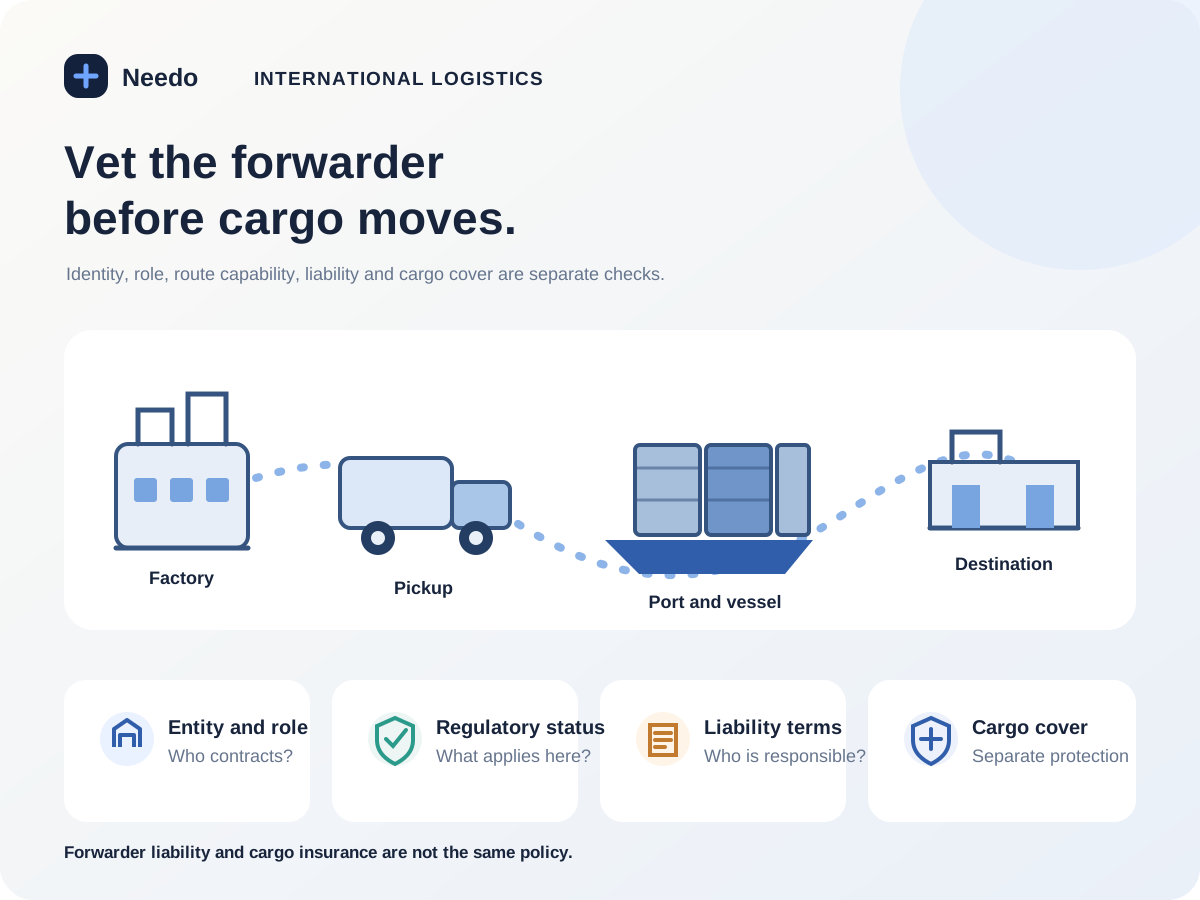
Start by identifying the role you are actually appointing
The words freight forwarder, carrier, NVOCC, customs broker and shipping agent are not interchangeable. A forwarder may arrange carriage on your behalf; a carrier undertakes the transport; an NVOCC may act as a carrier to the shipper while buying vessel space from an operating carrier; and a customs broker handles customs-entry work under the rules of the relevant jurisdiction. One company can perform more than one role, but the contract and transport documents should make the capacity clear.
The U.S. Department of Commerce describes freight forwarders as agents for exporters and separately explains the regulated role of U.S. customs brokers. The Federal Maritime Commission defines ocean freight forwarders and NVOCCs for U.S. ocean trades. These distinctions matter because the party that issues a house bill of lading, accepts cargo as contractual carrier or files customs entries may carry different responsibilities from the party that simply arranges a booking.
Ask these role questions first
- Which legal entity signs the service agreement and invoices you?
- Is the provider acting as agent, contractual carrier, NVOCC, customs broker or a combination?
- Who books the vessel, airline, rail or road carrier?
- Who issues the house transport document and who issues the master document?
- Who files customs declarations and under whose authority?
- Who is responsible for each leg and for communicating exceptions?
Verify the legal entity and contact route independently
Collect the full legal name, registration number where applicable, registered address, operating address, website domain, main telephone number and named commercial contact. Compare these details across the quote, service agreement, invoice, transport documents, insurance certificate and payment instructions. A trading name or local agent may be legitimate, but the relationship should be documented rather than assumed.
Use an independent company registry or regulator where one exists. Do not rely only on a certificate, logo or phone number supplied in the same email thread as the quote. Call a number obtained independently, confirm the person is authorized to represent the contracting entity and ask the provider to explain any difference between the legal entity, branch, agent and payee. A real company record establishes identity more readily than operational competence, so it is only one part of the review.
Identity checks
- Legal entity and trading name reconciled.
- Registered and operating addresses explained.
- Website domain and contact details match independently sourced records.
- Contracting entity, invoicing entity and bank beneficiary are consistent or the difference is documented.
- Named contact and authority to bind the provider are confirmed.
- Any agent, branch or group-company relationship is identified in writing.
Check regulatory status for the actual country, mode and trade
Do not assume that every freight forwarder worldwide needs the same license. For U.S. ocean transportation intermediary activity, the FMC states that U.S.-based ocean freight forwarders and U.S.-based NVOCCs must obtain an FMC license and provide financial responsibility. Non-U.S.-based NVOCCs serving the U.S. trades have a foreign-registration option or may obtain a license if they establish the required U.S. presence. The FMC's active OTI list includes licensed freight forwarders and NVOCCs as well as registered foreign-based NVOCCs.
For a U.S. ocean shipment, search the OTI list by the correct legal name and check the relevant status-change notices as well as the list itself. A registered foreign-based NVOCC may not have a conventional license number. Check the associated tariff and financial-responsibility status where the rules require them. The FMC posted 2026 status notices in October, so a historic screenshot or old PDF is not a substitute for a current check on the appointment date.
For other countries, modes or services, identify the competent transport, customs or maritime regulator and verify only the permissions that apply to the provider's actual role. An FMC entry does not establish authorization in another country, competence on a particular route, cargo insurance or a good service record.
Regulatory verification record
- Country, mode and legal role that trigger the check are stated.
- The regulator's current register or status page was searched using the legal entity.
- License, registration, bond, tariff or other evidence was checked where applicable.
- Any limitation, suspension, expiry or name/address mismatch is recorded.
- The check date and source URL are saved so the status can be refreshed before booking.
Test route and commodity capability, not just a sales claim
Ask for evidence of experience with the actual origin-destination pair, mode, ports or airports, cargo type and service level. A provider that handles general dry containers may not be suitable for temperature-controlled food, dangerous goods, oversized equipment, high-value electronics or time-critical air freight. Capability should be specific to the shipment, not inferred from a broad list of services on a website.
Confirm cut-off times, booking lead time, transit assumptions, consolidation or transshipment points, warehouse arrangements, tracking visibility, customs coordination, document review, exception notifications and escalation contacts. If the shipment has a special handling or regulatory requirement, ask who is qualified to perform that work and what records will be supplied. Check a small number of comparable references or shipment examples where the exposure justifies it, while respecting customer confidentiality.
Route and service questions
- Has the provider handled this mode and route recently?
- Which carriers, ports, airports, warehouses and destination agents are involved?
- Can the provider handle the commodity's temperature, security, dangerous-goods or handling requirements?
- What tracking events and exception alerts will be available?
- Who owns customs questions, document corrections and delivery appointments?
- What is the escalation path outside normal working hours?
Map subcontractors and every handoff
International shipments often pass through carriers, local agents, warehouses, terminal operators and customs specialists. Ask the forwarder to identify the material parties and explain which ones are directly contracted, which are subcontracted and who remains responsible to you. A long network is not automatically a problem; an undisclosed or unaccountable handoff is.
The contract should explain whether the forwarder acts as agent or principal for the relevant service, how subcontractors may be used, what transport documents will be issued and how claims or service failures are handled. FIATA's Model Rules discuss rights, obligations and liability where a forwarder acts as the shipper's agent or as contractual carrier. They are a reference, not automatically the contract for your shipment: check whether any model rules or standard trading conditions are incorporated and whether they are valid under the governing law.
Handoff map
- Origin pickup and warehouse operator.
- Main carrier and any transshipment or interline party.
- Destination agent and final-mile provider.
- Customs broker or declarant, where separate.
- Party issuing each transport document.
- Party responsible for delay, damage, loss, document error and claims at each stage.
Read the trading conditions and separate liability from cargo insurance
Read the forwarder's trading conditions before you accept the booking. Check the capacity in which it acts, liability limits, exclusions, claims-notice deadlines, time bars, jurisdiction, lien rights, subcontracting terms and the procedure for reporting loss or damage. A low freight rate can be a poor trade if the contract leaves a material gap that your business has not accepted.
Forwarder liability insurance and cargo insurance are not the same thing. Liability cover protects the forwarder against specified claims for which it may be legally responsible; it does not automatically insure the full value of your goods. Cargo or marine insurance is a separate cover for the goods in transit and must be checked against the shipment, route, commodity, value, packing, exclusions and insured party. The UK Government's freight-risk guide explains this distinction, but that guidance was last updated on 13 June 2013; use it as a general explanation and confirm current policy wording and applicable law with your insurer or broker.
Insurance and contract evidence
- Current forwarder liability certificate, insurer, policy period and relevant limits.
- Separate cargo policy or written confirmation of who arranges it.
- Named insured, beneficiary, shipment value, route and commodity fit the proposed cover.
- Exclusions, deductibles, warranties and claims-notice requirements are understood.
- Trading conditions were supplied before contract acceptance.
- Liability limits and any required higher cover have been reviewed by the appropriate owner.
Check payment controls and protect against changed instructions
Confirm the beneficiary name and bank country through your approved finance process. The payee should match the contracting entity or have a documented explanation, such as a disclosed group treasury or authorized local agent arrangement. Verify any new or changed bank instruction through an independently sourced contact route, not by replying to the email that delivered the change.
Agree the payment milestone, currency, bank charges, deposit, balance trigger, refund or cancellation treatment and the documents that must be supplied before payment. Avoid paying an unrelated third party simply because the forwarder says it is faster. If the commercial arrangement is unusual, pause for finance or legal review rather than letting a shipment deadline force an unverified transfer.
A practical appointment decision: proceed, clarify or hold
Illustrative example: an exporter is booking an ocean shipment from India to the United States. The provider's quote uses one trading name, its service agreement uses a different legal entity and the house bill will be issued by an NVOCC. The review therefore checks the contracting entity, the actual NVOCC, the FMC OTI list and relevant registration or licensing path, tariff and financial-responsibility records, the destination agent, trading conditions and the separate cargo-insurance arrangement. The exporter does not assume that the quote sender and contractual carrier are the same company.
The outcome is proceed only when the roles, required regulatory status, service scope, contract and insurance responsibilities are sufficiently evidenced for the shipment. Clarify if an address, agent or policy detail is missing but can be resolved before booking. Hold if the provider will not identify the contracting entity, cannot explain its regulatory role, changes bank details without independent confirmation or refuses to provide its terms. These are decision controls, not a guarantee that a shipment will be problem-free.
Appointment checklist
- Entity, role and payee are reconciled.
- Applicable regulator checks are current and recorded.
- Route, commodity and special handling capability are evidenced.
- Material subcontractors and handoffs are identified.
- Trading conditions and liability limits are reviewed.
- Cargo cover is separate, suitable and confirmed by the insurer or broker.
- Claims, escalation, payment and document responsibilities are clear.
Use Needo to build an evidence-led forwarder review
Needo can compare the provider's identity, proposal, contract, regulatory records, subcontractor details and insurance evidence against the shipment you actually need to move. It can organize checks by jurisdiction and mode, identify missing records, distinguish a public-register match from proof of operational capability and draft the clarification questions that should be resolved before booking.
Provide the route, mode, commodity, legal entity and documents rather than asking for a generic list of the best forwarders. Have your logistics, finance, legal or insurance owner review the result. Needo does not issue licenses, bind insurers, certify a forwarder or guarantee cargo delivery.
Sources and further reading
- Federal Maritime Commission — Ocean Transportation Intermediaries
Official definitions of ocean freight forwarders and NVOCCs and the FMC requirements applicable to U.S.-based providers in U.S. trades.
- Federal Maritime Commission — Apply for a License or Request a Foreign Registration
Current instructions for U.S.-based OTI licensing and the foreign-based NVOCC registration or license options.
- Federal Maritime Commission — Active OTI List
The Commission's active list includes licensed ocean freight forwarders, licensed NVOCCs and registered foreign-based NVOCCs that meet the listed requirements.
- Federal Maritime Commission — OTI License Status Changes
The Commission publishes applications, revocations, suspensions and surrenders; the page showed October 2026 notices when checked on 8 November 2026.
- U.S. Department of Commerce — Customs Brokers and Freight Forwarders
Explains the separate roles of U.S. customs brokers and international freight forwarders and common forwarding services.
- UK Government — Freight Forwarding: Managing Risk
General explanation of trading conditions, liability limits and the distinction between forwarder liability insurance and cargo insurance. The page was last updated 13 June 2013, so current policy wording and law must be checked.
- FIATA — Model Rules on Freight Forwarding Services Update
Explains how the FIATA Model Rules address forwarder rights, obligations and liability depending on whether the forwarder acts as agent or contractual carrier. The rules apply only when appropriately incorporated and subject to applicable law.
Sources support the specific points noted above. Confirm current requirements for your product, destination and contract before committing.
Need the actual problem solved?
This guide explains the method. Needo can work from your specific requirement, compare relevant options, verify important details and help move the next step forward.
Start with your exact problem →Selling or exporting? See live buyer requirements by product · see a sample verified shortlist